· Venture Capital · 9 sources · Verified
Xona Raises $250M at $2.45B to Expand Its GPS Alternative
Future Ventures led Xona's $250M Series D. Its Pulsar network is moving toward customer service, with farm-robot tests showing both the opportunity and the work ahead.

By Venture Capital Tracker
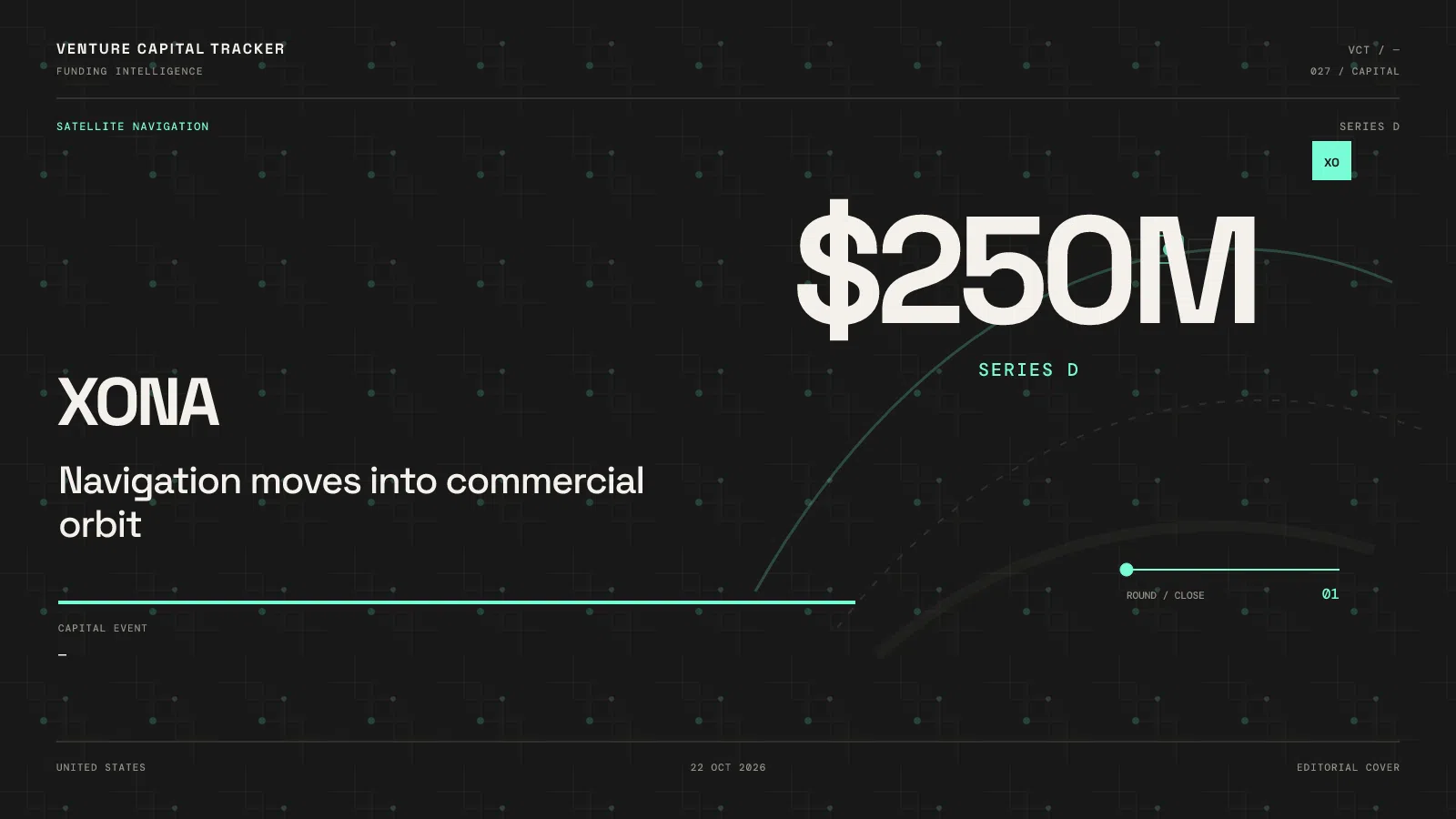
Xona has announced $250 million in Series D equity funding at a $2.45 billion valuation, led by Future Ventures, to expand Pulsar, its commercial satellite-navigation network.
The October 22 financing follows the launch of six additional satellites. Four are intended to support initial customer beta service in 2027. That makes this a transition from technology demonstrations toward an operating network, with substantial deployment work still ahead.
Xona's company-issued release identifies additional new and existing investors without naming them. It does not specify whether the valuation is before or after the new money.
Why a company would pay for better navigation
GPS supplies a common location and time reference. Businesses needing greater precision or resilience may also use correction services, local equipment or backup systems.
Pulsar's proposition is to make more of that capability available directly from satellites closer to Earth. Xona says compatible receivers can adopt its signals through software updates, reducing the need to replace equipment. Compatibility still depends on the device and integration.
The buyers are equipment makers, robotics developers and operators of systems that need reliable positioning or timing. The business opportunity is selling a useful commercial service around those needs. Xona has not disclosed public service pricing, current revenue or the contract economics in the reviewed financing material.
Its August 2025 announcement named commercial agreements with Hoptroff, Fibrolan and Timebeat for precision timing. Those agreements establish named relationships, rather than disclosed sales or proof of deployment at global scale.
A farm robot shows the practical problem
Earth Rover's CLAWS robot uses concentrated light to target weeds. To move that equipment between farms, the developer needs dependable positioning without making each installation a complicated engineering project.
In an August 25 case study, Xona describes the existing burden: precision navigation can require local base stations, connectivity and site-specific configuration. Its proposed improvement is positioning that travels with the robot through compatible commercial receivers.
The two companies received Pulsar signals inside a working UK greenhouse, where glass and steel produce reflections that complicate reception. Xona reported a stronger signal margin than GPS.
That is an early reception test reported by the supplier. It does not establish that the robot completed autonomous weeding using Pulsar, or that the service delivers uninterrupted precision across farms. The case study identifies further correction and moving-rover tests as subsequent work.
The commercial test is whether simpler navigation reduces the cost and time of putting a robot to work.
Why investors are backing deployment now
The October company announcement puts cumulative capital raised since 2019 above $570 million. That is distinct from this $250 million round, and should not automatically be treated as an all-equity total. Xona also announced a separate $170 million Series C in March.
Future Ventures co-founder Steve Jurvetson's statement in the release emphasizes Xona's progress from a validation mission toward a network. That is an investor's assessment carried in a company statement, rather than independent validation.
Earlier investor Craft Ventures offered a more detailed June 2025 thesis: rising autonomy and infrastructure dependence create demand for more resilient positioning, while receiver compatibility can make adoption easier.
VCT's reading is that deployment now matters more than another promising demonstration. Customers need usable coverage, integration and dependable service before navigation becomes a recurring operating expense.
Different routes to navigation resilience
Recent financing supports more than one technical approach:
| Company | Verified financing | Relationship to Xona |
|---|---|---|
| ANELLO Photonics | $25M Series B-2, May 4, 2026, led by MESH | Onboard inertial navigation, an alternative or complement when satellite signals are unavailable |
| TrustPoint | $4M SpaceWERX contract, May 12, 2026 | A direct satellite-navigation contender developing an independent C-band service |
TrustPoint's contract is government development funding, not a venture-equity round. ANELLO builds navigation hardware rather than an orbital network. The shared market need is resilience; the engineering and business models differ.
What the valuation still needs to earn
Xona's product specifications distinguish expected full-constellation performance in open sky from current tests. Investors should make the same distinction between demonstrated signal quality and a service customers can rely on continuously.
Manufacturing, launches, ground operations and replacement spacecraft create costs before broad recurring revenue arrives. Receiver integration and customer qualification can also slow adoption.
For Xona, the decisive evidence will be service availability, paying deployments and the cost of keeping them running. A commercial navigation network earns its value through dependable operations after the launch headlines fade.
Follow Venture Capital Tracker in Google
Add VCT as a preferred source to make our venture-capital coverage easier to find in Google Search.
Editorial note: AI tools assisted with research, structure, or drafting. Venture Capital Tracker retains human editorial responsibility for factual accuracy, relevance, and source quality before publication.