· Venture Capital · 5 sources · Verified
Wormsensing Raises €9.5M Series A for Vibration Intelligence
Orano Venture Fund led the Grenoble sensor company’s Series A. The real test is converting technical range and production capacity into repeat monitoring revenue.

By Venture Capital Tracker Editorial Team
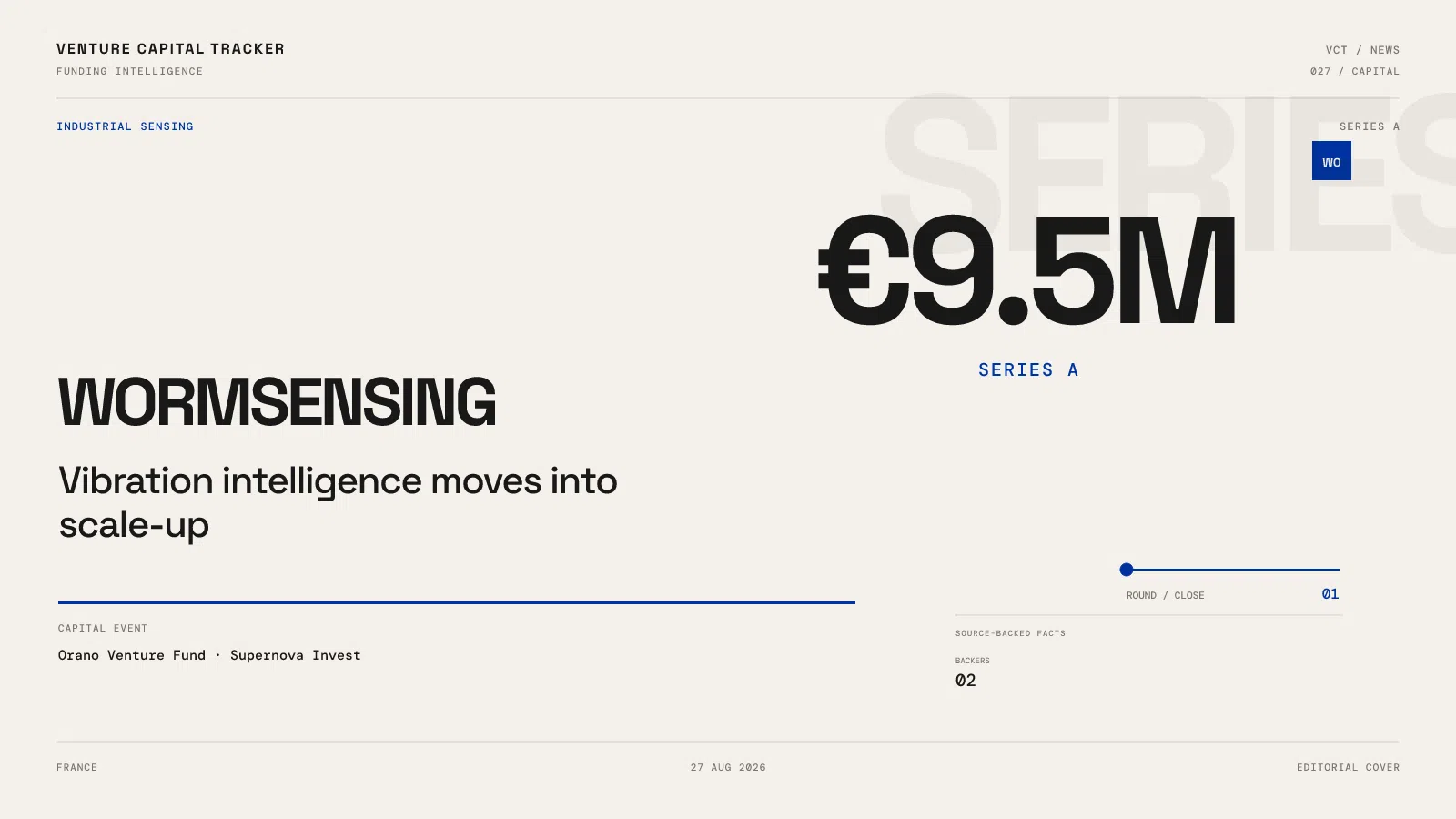
Wormsensing announced a €9.5 million Series A on October 27, 2026, led by Orano Venture Fund and managed by Supernova Invest. At the European Central Bank’s reference rate for that date, the round was worth about $10.6 million. The Grenoble company makes thin vibration sensors and monitoring software designed to spot machine problems that ordinary measurements can miss. The round matters because Wormsensing is moving from proving its sensor in industrial tests to selling a fuller monitoring system internationally.
The company’s dated announcement says French Tech Seed, the Fonds Régional Avenir Industrie Auvergne-Rhône-Alpes, Innovacom, KBC Focus Fund and CEA Investissement also participated. Valuation, revenue, pricing and individual cheque sizes were not disclosed.
What manufacturers would buy
Wormsensing’s Dragonfly sensor is a thin piezoelectric device that measures tiny changes in strain. Its industrial IO version connects to standard industrial equipment, while the company’s software turns the signal into machine-health indicators.
The practical workflow is straightforward. A maintenance team traditionally relies on periodic inspection or a conventional accelerometer. A Dragonfly sensor stays on the machine, captures both slow mechanical forces and higher-frequency vibration, and sends selected measurements to a monitoring system. Engineers then look for changes that may signal wear, poor lubrication or an unstable operating condition before the machine fails. This is an illustrative workflow based on Wormsensing’s product materials; public pricing and deployment terms are unavailable.
The same hardware can support testing and quality control. Wormsensing’s technical library describes company-run or partner tests with Airbus Defence and Space, Schneider Electric’s F-Lab, an aerospace manufacturer and several research institutions. In one milling-machine test, the sensor reportedly identified excessive spindle forces linked to incorrect tool coordinates while also capturing conventional vibration metrics.
Those examples show technical range, but they are not independent proof of commercial scale. Wormsensing says its technology can be up to 1,000 times more sensitive than a traditional strain gauge and reports average operational gains of roughly €100,000 per machine a year. Both figures are company claims. The announcement does not provide customer-level economics, sample sizes, subscription revenue or audited savings.
Why Orano’s fund invested now
The lead investor fits the round unusually closely. Orano and Supernova Invest launched their €50 million venture fund in 2024 to back European seed and Series A companies in circular economy and advanced industrial technology. Its published mandate explicitly includes predictive maintenance, process control and industrial optimization.
That helps explain the timing. Wormsensing says its French Hyperion production line can make up to two million Dragonfly sensors a year and that the new capital will fund international expansion, digital services and continued product development. Capacity is not the same as output or demand, however. The useful milestones will be recurring monitoring contracts, repeat orders and disclosed production utilization.
A close comparison: Feelit
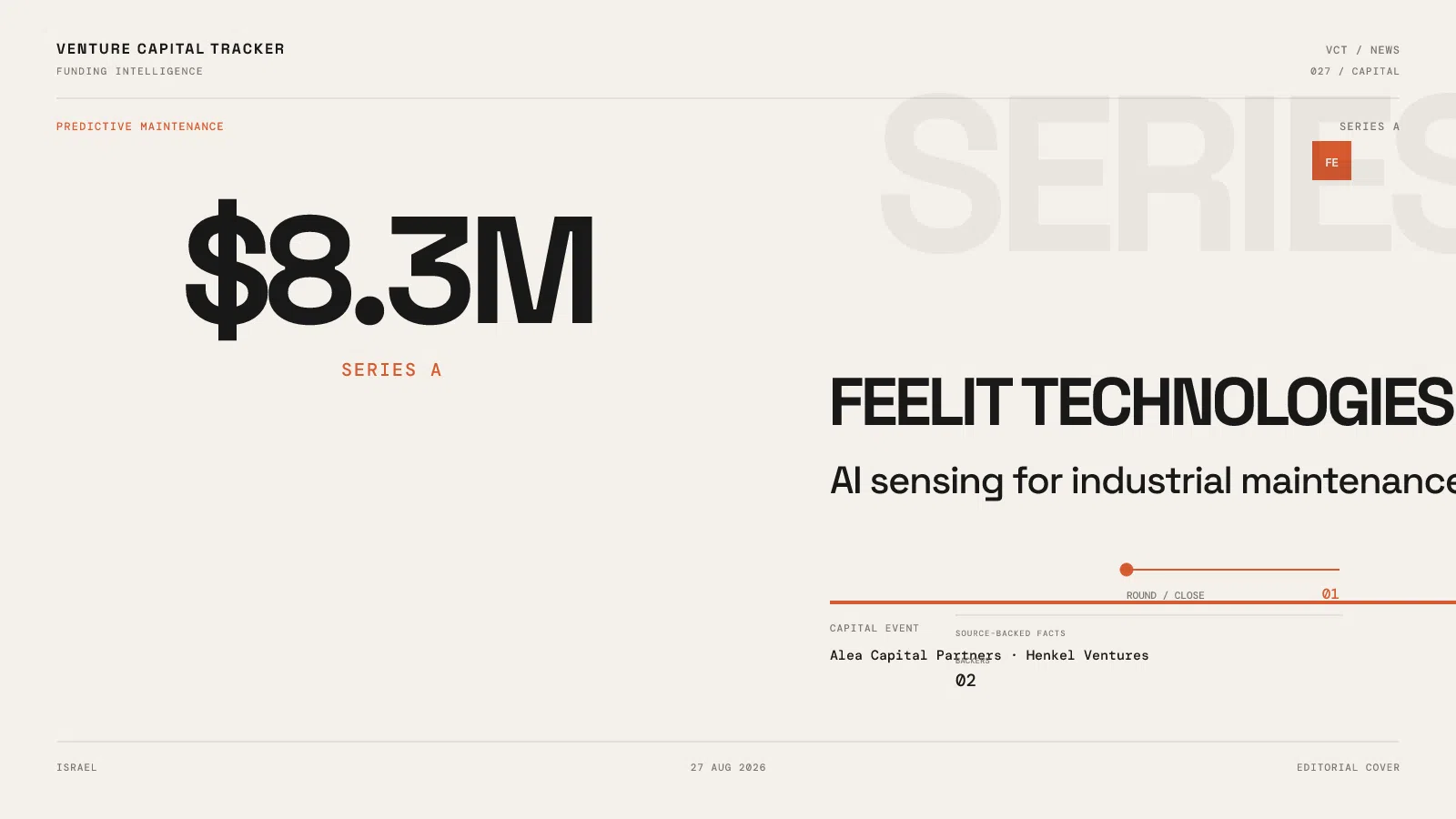
Feelit Technologies’ $8.3 million Series A is a useful same-market comparison. Feelit attaches flexible “sticker” sensors to industrial assets and sells an AI-based monitoring service. Wormsensing emphasizes unusually sensitive, wide-band strain measurement and sells both sensors and a monitoring platform. The two companies overlap in predictive maintenance but gather different physical signals and disclose different evidence.
Feelit’s 2025 financing was led by Alea Capital Partners, with Henkel Ventures and Takwin participating. Like Wormsensing, it raised capital to expand internationally after reporting deployments with industrial customers. Neither company has published enough pricing, retention or gross-margin data to compare the strength of its software economics.
Wormsensing’s next test is commercial rather than scientific: whether a sensitive sensor and a large production line can become repeatable monitoring revenue across factories, fleets and test environments.
Follow Venture Capital Tracker on Google
Add VCT as a preferred source to see more of our venture-capital reporting in Google Search.
Editorial note: AI tools assisted with research, structure, or drafting. Venture Capital Tracker retains human editorial responsibility for factual accuracy, relevance, and source quality before publication.