· 11 sources · Verified
Vercel AI Accelerator 2026: All 35 Named Startups, Winners, Funding and Acquisitions
Vercel selected 39 teams in 2026 and named 35 publicly. Browse the full founder roster, 2026 Demo Day winners, Alloy's $8M raise and Smithery's acquisition.

By Venture Capital Tracker
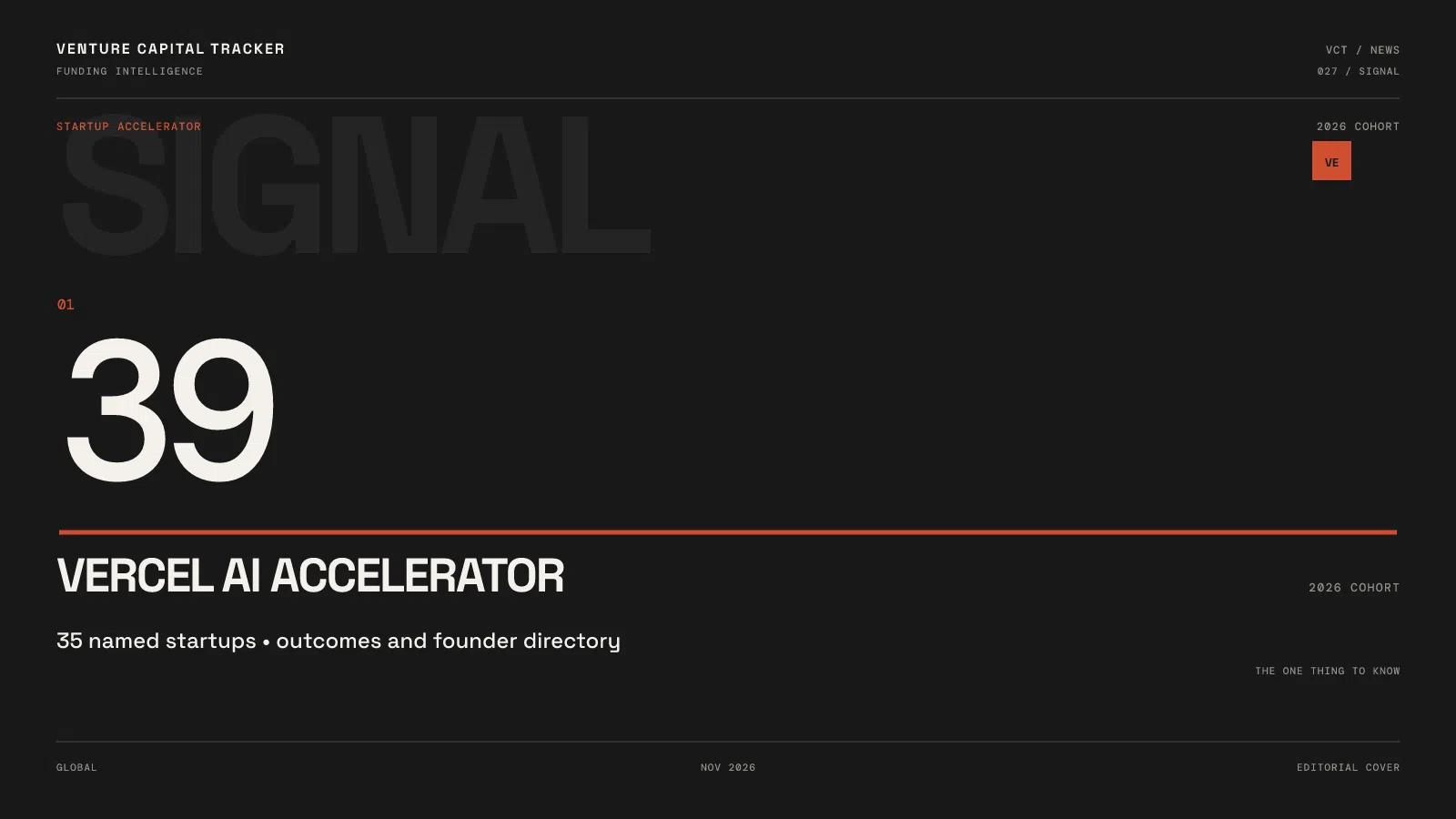
Vercel selected 39 companies for its 2026 AI Accelerator, but publicly named only 35 in the March 16, 2026 cohort announcement. The remaining participants were not individually identified on that page; Vercel said some were building in stealth. The six-week program culminated in an April 16, 2026 Demo Day, where Rex finished first, Hacktron AI second and Roots third.
Deal details & investors
Funding event
Alloy Robotics
Led by Square Peg
Reported valuation $80M
This is a curated historical alumni directory, not an estimate of how many firms remain active, a list of investments Vercel automatically made, or the roster of the new 2027 Vercel X cohort. Names, founder credits and product descriptions below reflect what Vercel published in March 2026. Updated with independently attributable later developments through November 18, 2026.
Useful links: Vercel's original 2026 cohort roster · Official 2026 Demo Day recap · Vercel X 2027 application, eligibility and credits guide.
All 35 publicly named Vercel AI Accelerator startups from 2026
The table is organized alphabetically and lists every company named on the official March 2026 roster, with the participating founders and the original product focus. Where VCT has a source-backed company profile, the name links to it. Other names remain unlinked rather than pointing to an unverified company website. Company products and ownership may have changed since the March announcement.
| Startup | Founders | Product focus in March 2026 |
|---|---|---|
| Alloy Robotics | Joe Harris | Robot-fleet telemetry analysis and failure diagnostics |
| Archival | Pablo Diaz-Granados; Jay Katyan; Griffin Ogura | Workplace AI adoption and usage analytics |
| Ares | Tony Hunter | Revenue operations and sales agents |
| Blueprints AI | Al Dram; Coco Cao | Autonomous generation of construction blueprints |
| Carbyn AI | Jungkeun Hong; Tim Phuan | AI tools and glasses for machinist workflows |
| Cloudglue | Amy Xiao; Kevin Dela Rosa | Developer infrastructure for contextual video AI |
| CodeYam | Nadia Eldeib; Jared Cosulich | AI-native software engineering simulations |
| Coreviz | Wassim Gharbi | AI-native photo and video workspace |
| Grid58 | Mani HK; Sures Kumar TS | AI-driven software planning, design and coding |
| Hacktron AI | Zayne Zhang; Mohan Pedhapati; Harsh Jaiswal | AI-assisted application security testing |
| HiveBase | Nick Bae; Tim Tong | Company context and AI chief-of-staff agents |
| Hotfix | Sam Forrester; Evan Eissler; Jack Neil | Production incident diagnosis and PR patching |
| Integrated Reasoning | David Cox | Wafer-scale mathematical optimization solver |
| Judea | Maggie Chen | Product optimization agents |
| Kinect | Kratik Agrawal; Varun Kandula | Adaptive brand storefronts for humans and agents |
| Kuvia | Martina Belluomini; Ana Gorodisch | AI pathology and cancer biomarker analysis |
| Lane | Jack Clark; Jorge Armenta | Commerce and payment rails for agents |
| Mighty | Johnny Hung; Munam Wasi | AI agent security and fraud prevention |
| Milq | Juan Djuwadi; Neel Makhecha | AI-assisted Swift and iOS app building |
| Niyam AI | Samarth Shyam; Agrim Singh | Manufacturing workflow control plane |
| Nura | Usman Ahmed | AI zoning and feasibility software for real-estate developers |
| OpenVet | Adam Sager | Veterinary intelligence and outcome datasets |
| Orchestra Research | Zechen Zhang; Amber Jiachen Liu | AI science research assistants |
| Pai | Gigi Grimes; Everhett Grimes | Synthetic customer research and digital twins |
| Partly | Shivani Bajaj; Shantanu Prakash | Data for agent-assisted hardware commerce |
| Penelope Health | Sohum Patel; Mattijs De Paepe | US healthcare payer-policy API and MCP infrastructure |
| ProxieLabs | Alex Junod; Cristian Besliu | AI market research and conjoint analysis |
| Rex | Merlin Kafka; Lewis Blackwood | AI accounts-receivable and finance operations |
| Roots | Lauren Self; David Golovin | Property buying, selling and mortgage-assumption services |
| Sentia Labs | Akshay Murthy; Sarthak Gupta | Product-team behavioral intelligence |
| Smithery | Henry Mao; Anirudh Kamath | MCP registry; acquired by Arcade, hosted connections retired |
| Takeoff | Brad Bitler | AI trip planning and hotel discovery |
| Truli | Catherine Zhou; Michael Wu | Regulatory compliance agents for food and supplement brands |
| Vakoi AI | Ao Fu; Gagan Devagiri | Personalized advertising in video games |
| Zomma | Jihyun Kim; Cashel Fitzgerald | Computer-use agents for enterprise customer support |
Count methodology: 39 is Vercel's reported number of selected teams, while 35 is the number of individual companies actually named in its public March 16 announcement. Vercel says some participants were undisclosed because they were building in stealth. It is incorrect to invent names for the four unlisted teams or treat this as a complete 39-company roster.
Who won the 2026 Vercel AI Accelerator?
Vercel's April 28 recap confirms that 39 teams presented at Demo Day on April 16. Judges considered problem validity, technology fit, product quality and pitch. It says the three winning teams received $100,000-plus in credits and prizes, and the winner also received an investment from Vercel Ventures.
| Place | Startup | What was verified |
|---|---|---|
| 1st | Rex | AI operations for accounts receivable; Vercel Ventures also invested, with check size and instrument undisclosed. |
| 2nd | Hacktron AI | AI teammate for application security, targeting exploitable defects in code. |
| 3rd | Roots | Real estate buying, selling and mortgage-assumption workflows; historical Demo Day placement is independently confirmed by Vercel. |
A Demo Day position does not establish revenue, follow-on investment or company survival. Vercel confirmed an investment for Rex; the recap did not independently disclose equivalent equity investments in the two runners-up.
Which alumni raised money or were acquired afterward?
The strongest way to evaluate a startup accelerator is to distinguish individually verifiable company milestones from promotional cohort-wide claims.
| Company | Event and date | Evidence quality |
|---|---|---|
| Alloy Robotics | $8 million financing at an $80 million valuation, announced August 13, 2026. Square Peg led, with Blackbird, Airtree and Skip Capital returning. | Company-issued release. Alloy reported ~$10.5 million cumulative financing, close to 1,000 robots supported and 10,000-plus missions analyzed as of that August announcement. |
| Smithery | Acquired by Arcade.dev on August 5, 2026, with price undisclosed. | Acquirer announcement. Smithery's subsequent official notice says hosted connections and its API/SDK/CLI were shut down October 31; the public registry remains. |
| Rex | Vercel Ventures investment, disclosed in the April 28, 2026 recap. | First-party Vercel confirmation, with no published investment amount or instrument. |
| Cloudglue | Cohort participation in 2026 following Y Combinator's Summer 2024 batch. | Confirmed separately by YC and Vercel; accelerator membership alone is not a funding round. |
| Hotfix | Cohort participation with an AI production-incident assistant. | Vercel confirmed founders and product; a financing amount was not established. |
Other notable alumni from previous years: Cervo AI was acquired by Altana in July 2026. Stably AI, winner of the 2025 Vercel accelerator, confirmed Vercel Ventures investment in August 2025. Neither company should be falsely added to the 35 publicly named March 2026 teams solely because it appears among earlier alumni.
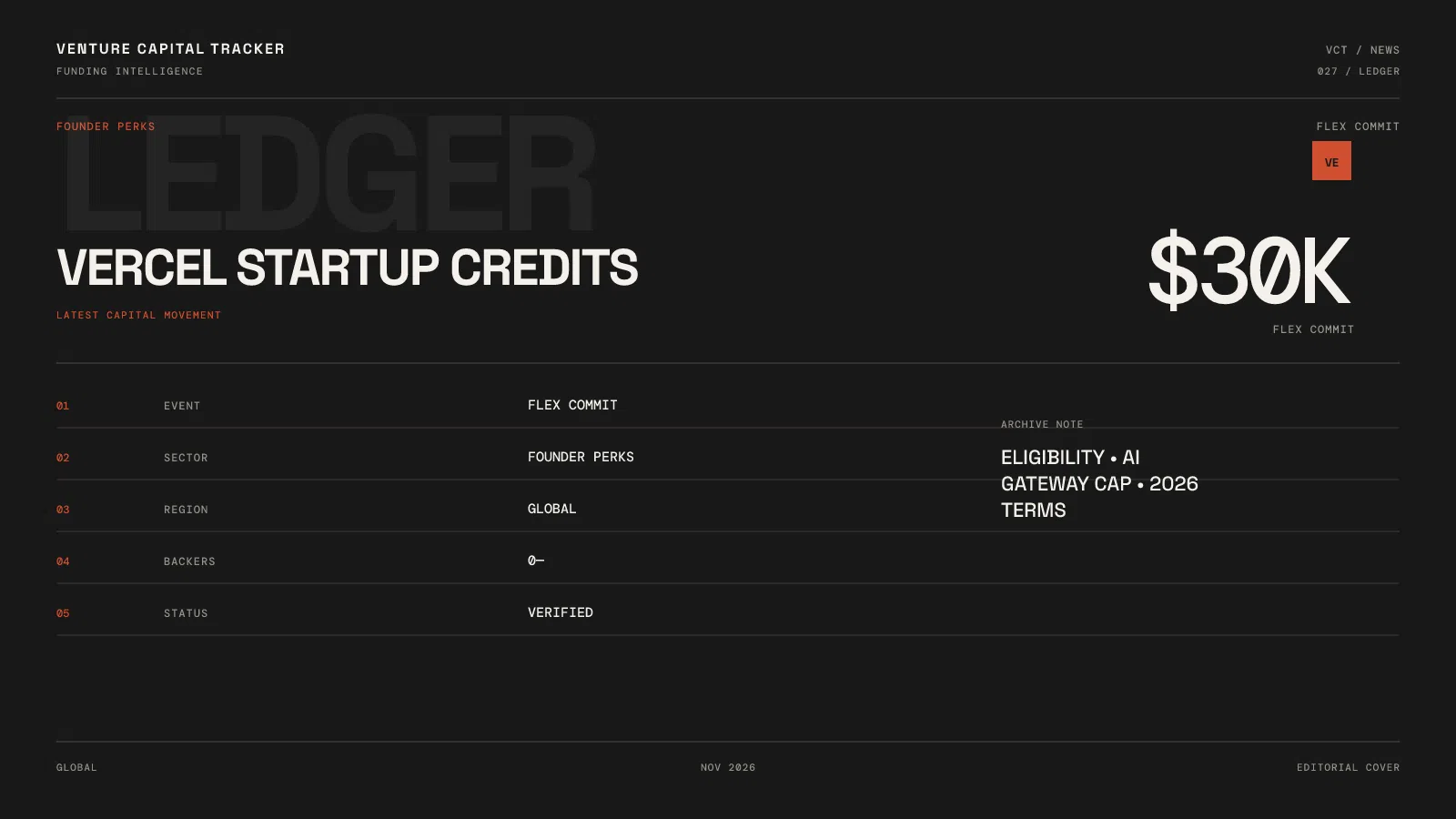
The Vercel Ventures investor profile now distinguishes two publicly confirmed accelerator-backed investments—Stably and Rex—from the venture financing raised independently by other cohort members. Amounts and assets under management remain undisclosed.
How did the 2026 accelerator work?
Vercel's retrospective says the six-week 2026 program combined a weekly hands-on technical workshop with a weekly conversation with founders, engineers or investors, covering product building, pricing, sales, marketing, legal and fundraising. Industry guests included Peter Steinberger and the Windsurf team. The cohort also participated in a San Francisco Builder Day and ended with the April 16 Demo Day.
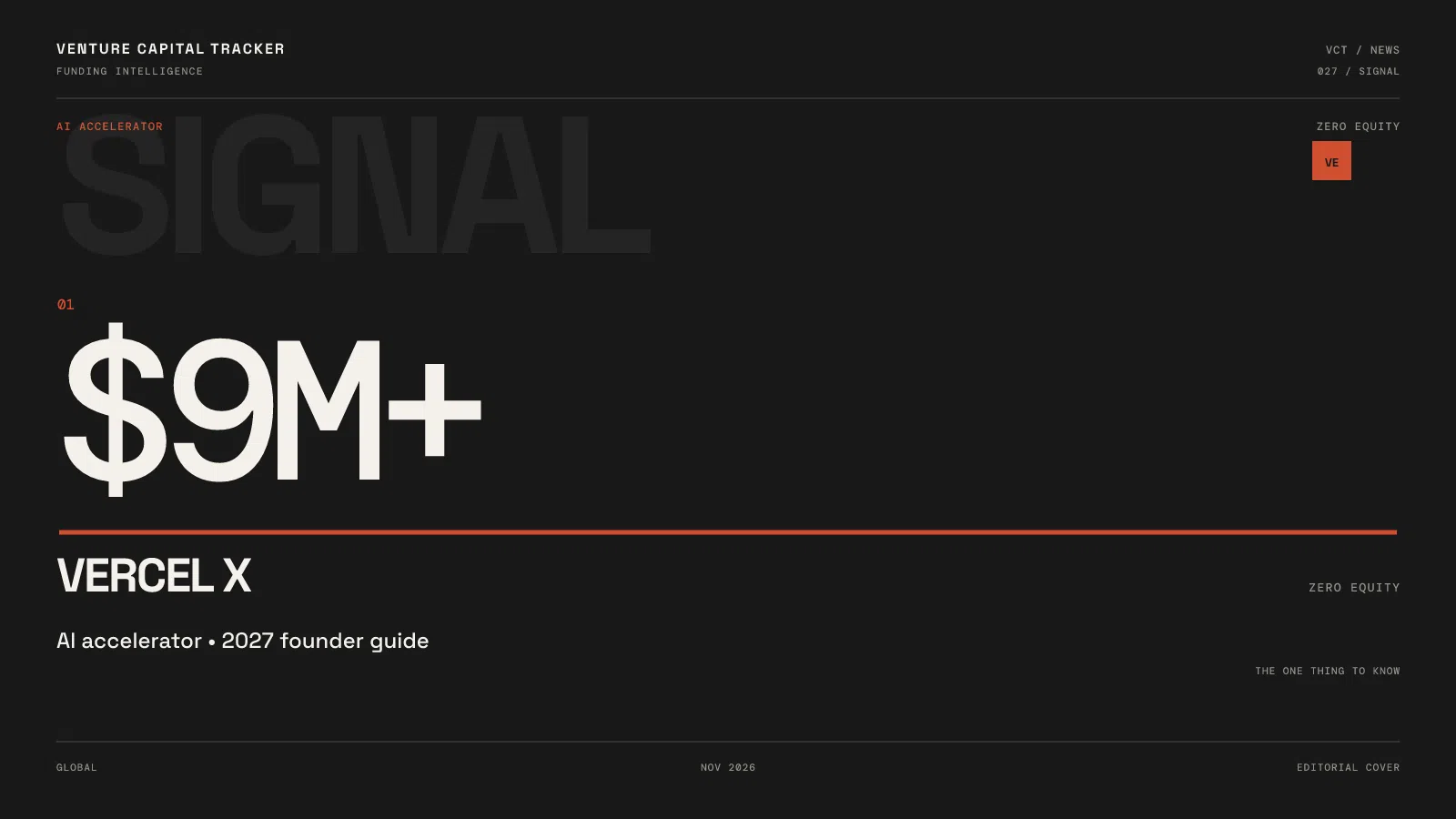
The program advertised an $8M-plus combined partner-credit pool with AWS, Anthropic, OpenAI and others, and Vercel stated that each team had access to over $200,000 in tools and credits. These are promotional service allocations, not cash distributed to each company. They differ from the new Vercel X 2027 offering, which advertises more than $9M in combined partner credits and a January 19–March 2, 2027 schedule.
Did 2026 participants have to be pre-YC and pre-seed?
Do not apply the 2027 eligibility rules retroactively. Cloudglue appears on YC's Summer 2024 company roster and Vercel's March 2026 accelerator roster. In contrast, Vercel X 2027 explicitly excludes founders who previously completed a traditional VC accelerator or raised an institutional seed round. That is a documented difference across application cycles, not evidence that 2027 made exceptions for Cloudglue or other earlier participants.
What is known about the 2025 cohort?
Vercel's February 2026 article says its second accelerator cohort in 2025 contained around 40 early-stage teams. The company singled out Stably AI as a 2025 winner, and its 2026 recap says an earlier 40-company cohort had collectively raised more than $100 million by April 2026.
That $100M-plus figure is company-reported aggregate later financing, with no public complete company-by-company source breakdown in the recap. It is not the amount Vercel invested, audited accelerator performance or evidence of a causal uplift. Stably's verified Vercel Ventures backing is a different, individually attributable fact.
Should founders use the old cohort roster when deciding on Vercel X 2027?
Use it to understand what types of businesses Vercel has supported, not to predict a selection probability or infer that historical rules still apply. The 2026 roster is notable for vertical AI outside traditional software—robotics, manufacturing, real estate, medical workflows and logistics—alongside developer tooling and agent infrastructure.
A 2027 founder can compare that history with current eligibility, zero equity for participation, travel and cost requirements, and the actual questions in the Vercel X application guide. Applications for that new program close November 29, 2026, at 11:59 p.m. PT. The 2027 cohort has not yet been announced.
Methodology and limitations: This directory transcribes names, founder attribution and original company focus from Vercel's official March 16, 2026 announcement. VCT verifies later financing, acquisitions and program-backed investments separately through first-party disclosures. Company statuses and private valuations may have changed since those disclosures. We do not equate absence of news with company failure or list undetermined investment amounts as zero.
Last reviewed November 18, 2026.
Editorial note: AI tools assisted with research, structure, or drafting. Venture Capital Tracker retains human editorial responsibility for factual accuracy, relevance, and source quality before publication.