· 5 sources · Updated · Verified
Torus $500M Funding: Foundry AI Data Centers, Power Constraints and Reality Check
Torus announced $500M growth capital for modular Foundry AI compute. Analyze 12–16-week deployment, 1–20 MW sites, grid constraints, funding structure and realistic milestones.

Editorial team
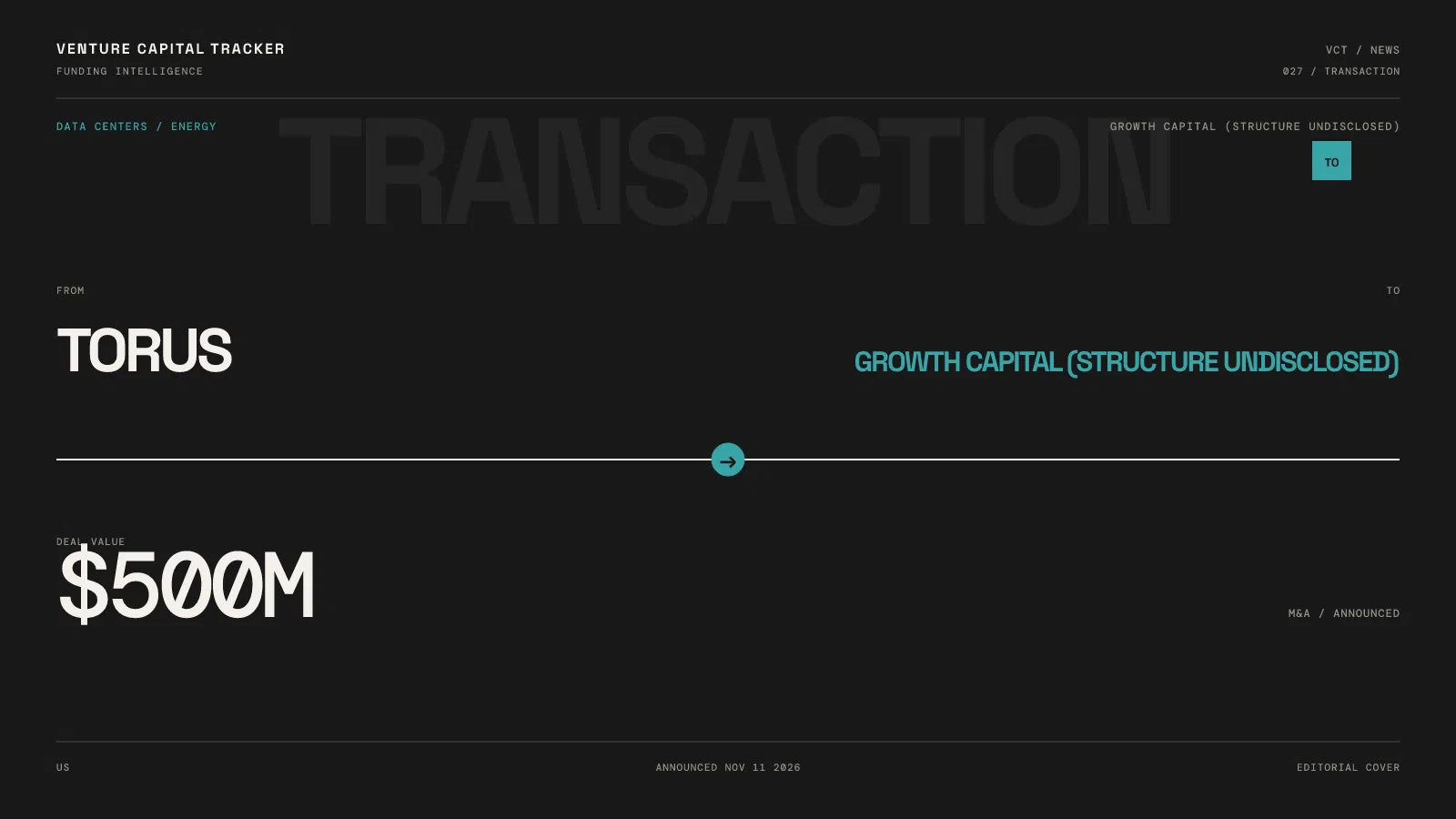
Torus said it secured $500 million in growth capital on November 11, 2026, led by Magnetar, as it launched Foundry, a modular AI-inference data-center offering. The central idea is to bring compute to existing electrical capacity instead of waiting years for an entirely new grid connection. The important caveat: faster-to-install equipment does not make every prospective site suitable, and the funding announcement is not proof that $500M is all equity.
Deal details & investors
Funding event
Torus
Led by Magnetar
The short version
- For founders: validate power and fiber before reserving accelerators.
- For buyers and users: compare firm capacity and total electricity bills, not only the delivery headline.
- For investors: distinguish contracted megawatts and paid GPU-hours from factory capacity and growth capital.
The $500M financing: known versus unknown
| Question | What is publicly supported |
|---|---|
| How much? | $500M in growth capital |
| When announced? | November 11, 2026 |
| Lead | Magnetar |
| Other named participants | ICONIQ; Origin Ventures; Ridgeline Partners; Trinity Capital |
| Is it Series C? | Some independent coverage uses 'Series C'; the issuer describes 'growth capital' |
| Equity versus debt? | Instrument breakdown not disclosed |
| Valuation? | Not disclosed in the company announcement |
Torus's prior $200M Magnetar investment in 2025 and its older $67M mixed financing package are different events. Do not add those historical figures again to 2026 fundraising. For venture databases, retain the company's more precise growth-capital description, mark the Series C characterization as third-party reporting, and keep the equity-only amount as unknown.
What does Torus Foundry provide?
Foundry is described as a prefabricated package that can include power systems, energy storage, cooling, networking and AI accelerators. It is positioned primarily for inference workloads distributed across commercial and industrial sites with usable existing connections.
Torus advertises 1–20 MW of inference capacity per site and a 12–16-week contract-to-compute target. The smallest unit is described as roughly cargo-van-sized. These are vendor-stated specifications and timelines, not independently audited averages.
| Delivery model | Supplied scope | Buyer question |
|---|---|---|
| Strategic | Powered shell without GPUs | Who purchases and services the accelerators? |
| Partner | Turnkey bare-metal system, including GPUs | Who guarantees hardware availability and refresh cycles? |
| Direct | Dedicated, single-tenant inference capacity | How are location, isolation, reserved utilization and pricing contracted? |
A powered shell and a dedicated managed-inference service involve different assets, accounting and counterparties. Articles that treat them as equivalent 'GPU rentals' miss the economics.
The arithmetic behind a 5 MW Foundry site
Torus cites 1–20 MW of inference capacity per site. To make that scale tangible, consider an illustrative 5 MW IT load averaging 90% of its nameplate power over one year:
| Calculation | Illustrative result |
|---|---|
| IT power at 90% average load | 4.5 MW |
| Annual IT electricity | 4.5 MW × 8,760 hours = 39,420 MWh |
| IT electricity at an assumed $0.08/kWh | $3.15 million/year |
| Cooling, UPS losses, demand charges, networking, GPUs, financing | Not included |
This is our scenario, not Torus operating data or an actual tariff. The example shows why a deployment advertised in weeks still needs site-level energy economics. Power-usage effectiveness, availability and local electricity prices can change the answer materially.
Torus says it plans more than 47,000 deployed GPUs by the end of 2027. That is a future target. The milestones investors should seek are commissioned MW, contractually committed customers, paid GPU-hours and uptime, not only announced manufacturing capability.
How to verify Torus Foundry's deployment timeline
Before treating the advertised 12–16 weeks as an achievable delivery schedule for a specific site, ask for an evidence-backed implementation plan:
- Verify available power. Obtain utility-approved connection capacity, historical site load, transformer headroom and applicable tariffs—not just a theoretical transformer rating.
- Match the real compute workload. Budget GPUs, cooling, networking and conversion losses, with allowances for peaks and hardware failures.
- Check external dependencies. Record required permits, site access, fiber delivery, equipment allocation, utility permissions and commissioned acceptance tests.
- Agree on the clock. Document when the contractual deployment timer starts and what milestones must occur before billable inference service begins.
- Stress-test the financial case. Estimate billable GPU-hours and total costs, including electricity, financing, support, idle capacity, depreciation and any site rent.
For example, a site with 5 MW of intermittent spare headroom cannot automatically support a continuous 5 MW inference workload. Batteries can smooth short-lived peaks but do not create sustained power. The question raised by Torus Energy's $500M announcement is whether enough suitable real-world sites can meet all the constraints at an attractive cost.
Why electrical headroom, not just chip supply, is crucial
An inference deployment needs continuous electricity, cooling, fiber, safe power quality and suitable hardware. Building a conventional hyperscale campus can require major new utility infrastructure. Foundry instead targets available headroom at existing sites. Torus says its Reserve system pairs flywheels and batteries to smooth demand peaks and provide redundancy, potentially permitting more useful compute on an existing connection.
But load shaping does not generate unlimited energy. A site with insufficient sustained headroom, adverse demand charges, unavailable fiber or restrictive interconnection terms may still be uneconomic. The company can assemble and deliver a module quickly while utility approval, electrical modification and commercial contracting remain the longer path.
What would an independent validation look like?
A credible field study should document:
- Grid access: signed site rights, transformer ratings, utility approvals, firm versus interruptible power and historical load data.
- Economics: local energy tariff, demand charges, peak-shaving savings, paid utilization and financing terms.
- Delivery: contractual start date, commissioning date, equipment lead times, grid work, testing and who pays for delays.
- Technical performance: GPU models, network topology, storage, p95 inference latency, availability and service-level penalties.
- Environmental claims: measured water and energy use under realistic climate and load conditions.
- Balance-sheet exposure: who holds the depreciating GPUs, who guarantees minimum utilization and whether contract terms cover replacement cycles.
Public infrastructure discussions emphasize grid interconnection uncertainty and local concerns over power and water. Those discussions are useful questions to investigate, not proof that a specific Torus site is failing.
Foundry versus conventional AI infrastructure
| Route | Primary advantage | Key limitation |
|---|---|---|
| New hyperscale campus | Scale and fully customized facility design | Land, permits, grid construction, capital and years of lead time |
| Existing colocation | Established operations, connectivity and contracts | Scarcity of high-density rack power where needed |
| Rented GPU cloud | Burstable capacity and familiar developer workflows | Cloud availability and cost do not independently solve physical power constraints |
| Prefabricated modular sites | Potentially rapid deployment on available power | Every site still needs sufficient and lawful power, cooling and connectivity |
There is no universal winner. Tightly coupled training clusters can have different network and density requirements from geographically distributed enterprise inference.
Factory capacity and deployment goals are not sales
Torus says Foundry units are made at its Utah GigaOne facility. It reports thousands of GPUs already deployed and a goal of more than 47,000 GPUs in Foundry units by the end of 2027. The 47,000 figure is explicitly a future goal, not an installed fleet in November 2026.
Investors should compare commissioned megawatts, operational GPUs and sustained paid GPU-hours with announced manufacturing potential. A gigawatt of potential factory throughput is not a gigawatt of approved, contracted or revenue-generating customer sites.
What the round could mean
The $500M package signals capital availability for manufacturing and deployments but does not reveal dilution, post-money valuation, borrowing covenants or how much capital will ultimately be drawn. Strong execution would turn unused electrical headroom into commercially reliable inference capacity; weak execution could be exposed by site-by-site power constraints, utilization volatility, capex burdens and a changing accelerator market.
FAQ
Did Torus raise a $500M Series C? The issuer announced $500M growth capital. Independent outlets call it Series C, but full financing instruments were not disclosed.
How quickly can Foundry go live? Torus says 12–16 weeks from contract to compute at suitable sites. This is a company target and not a universal guarantee.
Does Foundry bypass grid capacity limits? No. It tries to use existing headroom more efficiently; continuous power and approvals remain necessary.
What is Torus's valuation? The November 11 announcement did not provide a verified valuation.
Research method and limitations
This VCT analysis compares the dated company/investor disclosures with publicly available product information and market reporting. Any calculations identified as illustrative use explicit assumptions and are not audited company results or independent product tests. Pricing, roadmaps and private-company valuations may change. The announcement date of the financing is distinct from the date this article was written or updated.
Follow Venture Capital Tracker on Google
Add VCT as a preferred source to see more of our venture-capital reporting in Google Search.
Last updated:
Editorial note: AI tools assisted with research, structure, or drafting. Venture Capital Tracker retains human editorial responsibility for factual accuracy, relevance, and source quality before publication.