Supabase Is Acquiring Turso, Raises $150M for AI Agent Databases
Supabase announced its Turso acquisition and a separate $150M round led by GIC. Explore the deal terms, SQLite and Postgres products, and implications for AI agents.
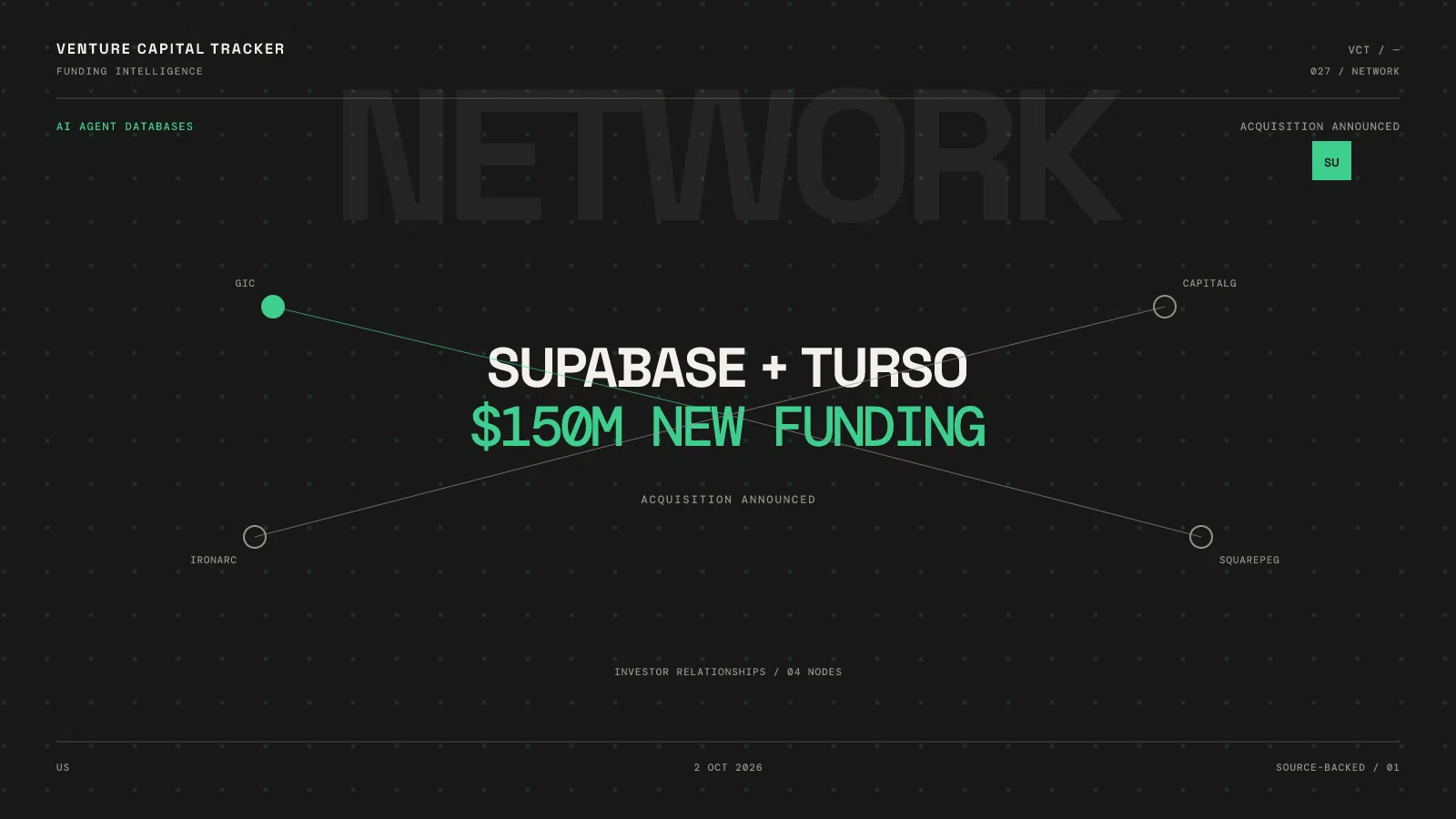
Supabase announced on 2 October 2026 that it is acquiring Turso, bringing a SQLite-compatible database business into its Postgres ecosystem. The company also disclosed a separate $150 million financing led by GIC. The acquisition consideration was not disclosed: the funding amount should not be read as Turso's purchase price.
For founders, the combination is a bet on a changing infrastructure unit: an isolated database for each agent, task or customer, alongside the larger relational systems that production applications need.
The deal and financing, separated
| Item | What was disclosed |
|---|---|
| Acquirer | Supabase |
| Target | Turso, the database business behind the many-database architecture |
| Announcement | 2 October 2026 |
| Acquisition price | Undisclosed |
| Separate financing | $150 million |
| Financing investors | GIC led; CapitalG, IronArc and SquarePeg participated |
| October valuation | Not disclosed |
| Legal closing date | Not specified in the reviewed announcements |
The company-issued funding release also says the round will provide employee liquidity. It does not quantify the division between capital for the business and employee share sales. VCT therefore records the disclosed round size without treating all of it as newly deployable operating cash.
Turso's announcement names Glauber Costa as Supabase's Head of Agentic Services, joining with co-founder Pekka Enberg and the team.
What Supabase and Turso provide
Supabase supplies a Postgres backend with authentication, storage, edge functions, realtime subscriptions and vector search. It bundles services that developers would otherwise integrate separately.
Turso focuses on large fleets of small, SQLite-compatible databases. Its product overview describes an open-source engine, managed Turso Cloud and embedded replication between devices and the cloud. Features include concurrent writes, native vector search and browser execution.
This is also a product-history distinction: Turso's earlier libSQL fork and its newer Rust engine are different implementations. The company explained its transition in its January 2025 rewrite announcement. Buyers should check which implementation and feature set their deployment uses.
| Starting need | Relevant product approach |
|---|---|
| Application backend with accounts, files and shared relational data | Supabase's integrated Postgres platform |
| Independent agent memory or task state | Turso's database-per-agent approach |
| A separate datastore for every customer or generated app | Turso's many-database architecture |
| Device-local data and offline operation | Embedded execution and synchronization |
| A larger application that needs standard Postgres | The intended path into the Supabase ecosystem |
These are evaluation starting points, not universal performance recommendations. Turso's solutions page also highlights per-user privacy and data-residency use cases.
Why the acquisition matters now
In its acquisition blog, Supabase says it launches more than one million databases per week. It argues that small agent workloads should not need a dedicated machine each.
The October press release reports more than 13 million developers, over four million new databases per month and a 70% share created by agents or AI tools. These are company-reported adoption figures. Database creation counts do not measure paid retention, revenue or profitability.
VCT analysis: the strategic opportunity is to capture a project early, when its database is tiny, then retain the relationship as it develops into a larger application. This could expand Supabase's addressable workloads beyond conventional app backends. Whether it improves margins depends on storage, provisioning, support and the percentage of projects that become paying production applications.
What changes for existing users?
The companies say Turso continues operating, Supabase remains focused on Postgres and Turso's database stays open source. Turso describes deeper integration over the coming months.
The migration direction is clear, but the announcements are not a specification for an automatic SQLite-to-Postgres conversion tool. Schema differences, application queries, extensions and identity integration still require validation. A stated path into Postgres should not be mistaken for a zero-work migration guarantee.
For an operating team, useful checks include:
- Which database engine and features are available in the chosen service.
- How exports and restores work for an individual database and for the whole fleet.
- How schemas and migrations are coordinated across tenants.
- How usage charges behave when many databases become active simultaneously.
- How cross-customer reporting works when data is stored separately.
Company and funding background
Turso's company page identifies Costa and Enberg as founders with Linux-kernel and ScyllaDB experience. The business is globally distributed and describes itself as San Francisco based.
A ChiselStrike press release verifies a $7 million seed round announced on 27 July 2022, led by Norwest Venture Partners. Participants included Blumberg Capital, Netlify's Jamstack Innovation Fund, Essence VC, First Star Ventures and Mango Capital. This historical round does not establish Turso's complete lifetime funding total.
Supabase's latest financing follows its June 2026 Series F: $500 million at $10 billion pre-money, or $10.5 billion post-money. Its October 2025 Series E raised $100 million. The three announced round amounts sum to $750 million; that arithmetic is not a measure of cash remaining.
Read VCT's earlier Supabase Series F coverage.
What investors should watch
VCT analysis: database infrastructure is benefiting from AI-assisted software creation, but creating more databases is only the first step. The useful follow-through measures are paid conversion, retained workloads, support cost per active project and success in moving small workloads into production.
The announcement leaves the purchase price, October valuation and definitive closing date undisclosed. Without those terms, acquisition multiples and investor returns cannot be calculated reliably.
Published 5 October 2026. The event was announced 2 October. Operating metrics are attributed to the companies; analysis is identified separately.
Follow Venture Capital Tracker in Google
Add VCT as a preferred source to make our venture-capital coverage easier to find in Google Search.
Editorial note: AI tools assisted with research, structure, or drafting. Venture Capital Tracker retains human editorial responsibility for factual accuracy, relevance, and source quality before publication.