· Venture Capital · 6 sources · Verified
Star Therapeutics Raises $200M After Vega Sale
OrbiMed and Janus Henderson co-led Star Therapeutics’ $200M private financing after the Vega sale. What the new preclinical pipeline still has to prove.

By VCT Editorial
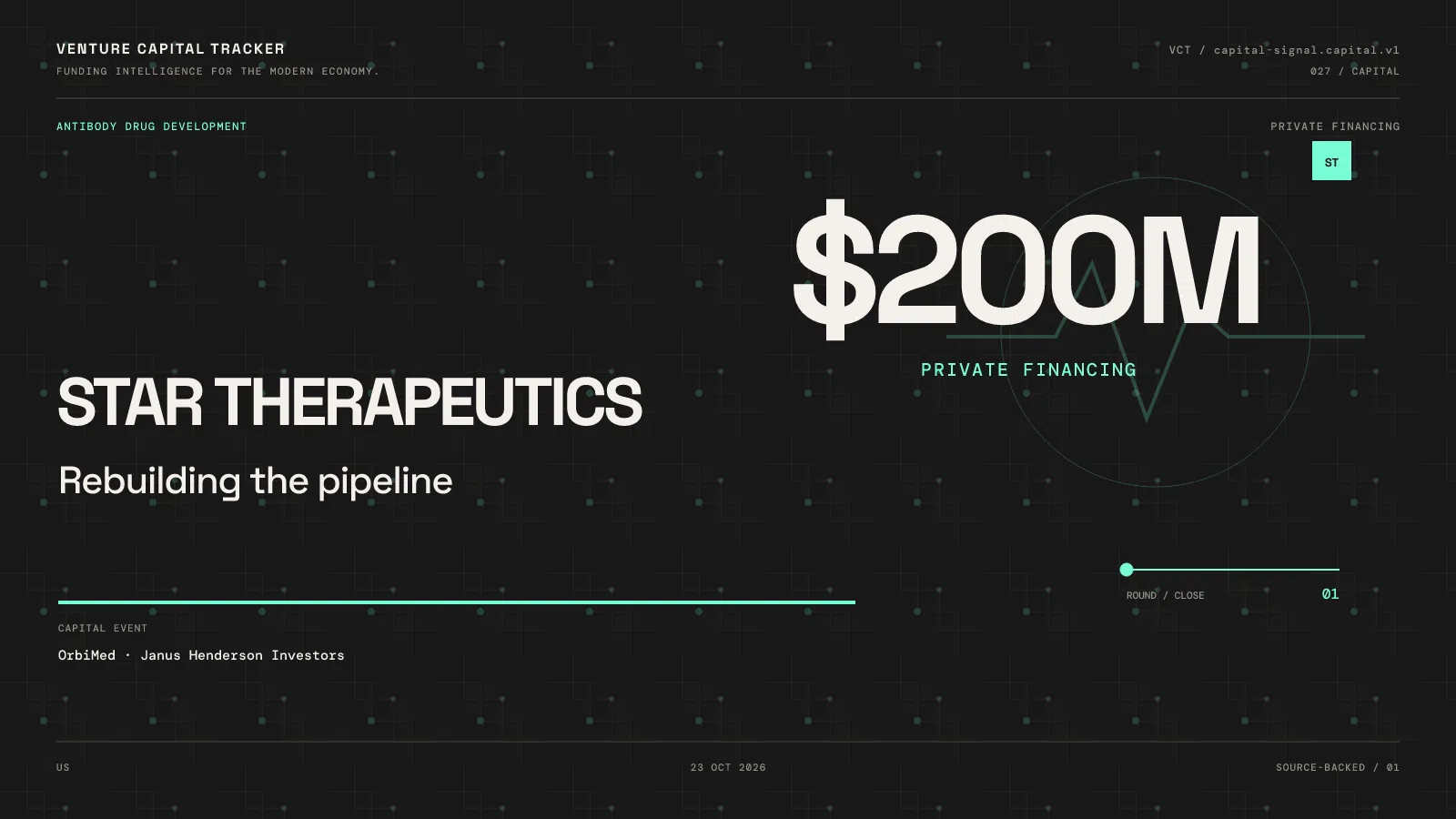
Star Therapeutics announced $200M in private financing on October 23, 2026, co-led by OrbiMed and Janus Henderson Investors. The money will advance preclinical programs toward human testing and expand its pipeline, according to the company announcement.
The unusual feature is what happened first. In July, Star sold Vega Therapeutics, the subsidiary holding its lead clinical program, to Incyte. Star now has capital to develop another generation of drugs—but the scientific risk has moved back toward the beginning.
New financing after an asset sale
Other named investors are Agent Capital, Catalio Capital Management, Cormorant Asset Management, New Leaf Venture Partners, NYBC Ventures, RA Capital Management, Redmile, Sofinnova Investments and Soleus Capital. An unnamed sovereign wealth fund also participated.
Star describes the transaction as private financing. It does not identify a lettered series, disclose a valuation or provide individual investor allocations. Those omissions matter when comparing the announcement with databases that assign their own round labels.
The Vega acquisition closed on July 6. Incyte disclosed $1.25B upfront, plus up to $750M in payments conditional on sales milestones. The often-quoted “up to $2B” acquisition value combines those two components; it is not $2B of guaranteed cash.
The new $200M is a separate financing. Neither announcement establishes how much acquisition cash Star retained after distributions and other uses, or its current spending rate. Adding the sale price to the financing would therefore produce neither a reliable cash balance nor a runway estimate.
What Star actually builds
Star develops antibodies: medicines designed to bind particular biological targets. Its stated research approach starts with patient samples and disease biology, then selects targets around which it can build therapeutic programs. It aims to pursue more than one disease with an individual drug.
That approach can create several development opportunities from a molecule, but each indication still needs its own supporting evidence. A promising biological mechanism does not establish that a treatment is safe, effective or commercially viable.
Vega provides a concrete example of the business model. Its investigational antibody, VGA039, had reached Phase 3 development for von Willebrand disease when Incyte acquired the company. Incyte bought a development program it could add to its hematology business, rather than a finished, approved product.
In BioPharma Dive’s interview, CEO Adam Rosenthal said Incyte had stronger clinical and commercial resources for a potential launch. He also described Star’s new work as an early-stage reset and said it would return to stealth. The report identifies hematology and immune conditions as areas of interest; individual new programs remain undisclosed.
Star’s business depends on advancing medicines far enough to support partnerships, an acquisition or eventual commercialization. The reviewed disclosures do not establish a selling price or launch date for the new pipeline.
Why the investors came back
OrbiMed managing partner Carl Gordon says in Star’s release that he has worked with the team across three companies. Janus Henderson’s Vish Sridharan, who is joining as a board observer, says the firm rarely invests at this development stage but has confidence in the team’s ability to identify opportunities and develop therapies.
Those are firsthand statements of investor conviction, published in the company announcement. They support an explanation of why these investors participated; they do not independently validate the undisclosed drugs.
Our analytical view is that the Vega sale makes the financing easier to understand. Investors have a recent example of the team advancing an asset far enough to attract a pharmaceutical buyer. The next test is whether that capability can be repeated without relying on the sold program.
Relevant financing benchmarks
Bambusa Therapeutics completed an approximately $90M Series A in February 2025, led by RA Capital, to advance bispecific antibodies for immunological and inflammatory diseases. Janus Henderson and Redmile participated. That is a relevant antibody-development comparison, although its molecules and disease targets differ from Star’s undisclosed programs.
Mirador Therapeutics disclosed a $250M Series B in January 2026, specifying that it closed in the third quarter of 2025. It supports a portfolio of immunology and inflammation programs. Mirador’s clinical-stage portfolio represents a different evidence position from Star’s newly funded preclinical work.
The financing amounts show that private investors will fund substantial portfolios in this field. They do not make the programs interchangeable. For Star, the decisive milestones are which candidates enter human studies, what the first data show and how much capital is required to get there.
Follow Venture Capital Tracker on Google
Add VCT as a preferred source to see more of our venture-capital reporting in Google Search.
Editorial note: AI tools assisted with research, structure, or drafting. Venture Capital Tracker retains human editorial responsibility for factual accuracy, relevance, and source quality before publication.