· Venture Capital · 8 sources · Verified
Pathos AI Raises $237M Series E at About $3B Valuation
Bristol Myers Squibb led Pathos AI’s $237M Series E. How its drug pipeline, pharma partnership and separate Tempus data agreement fit together.

By VCT Editorial
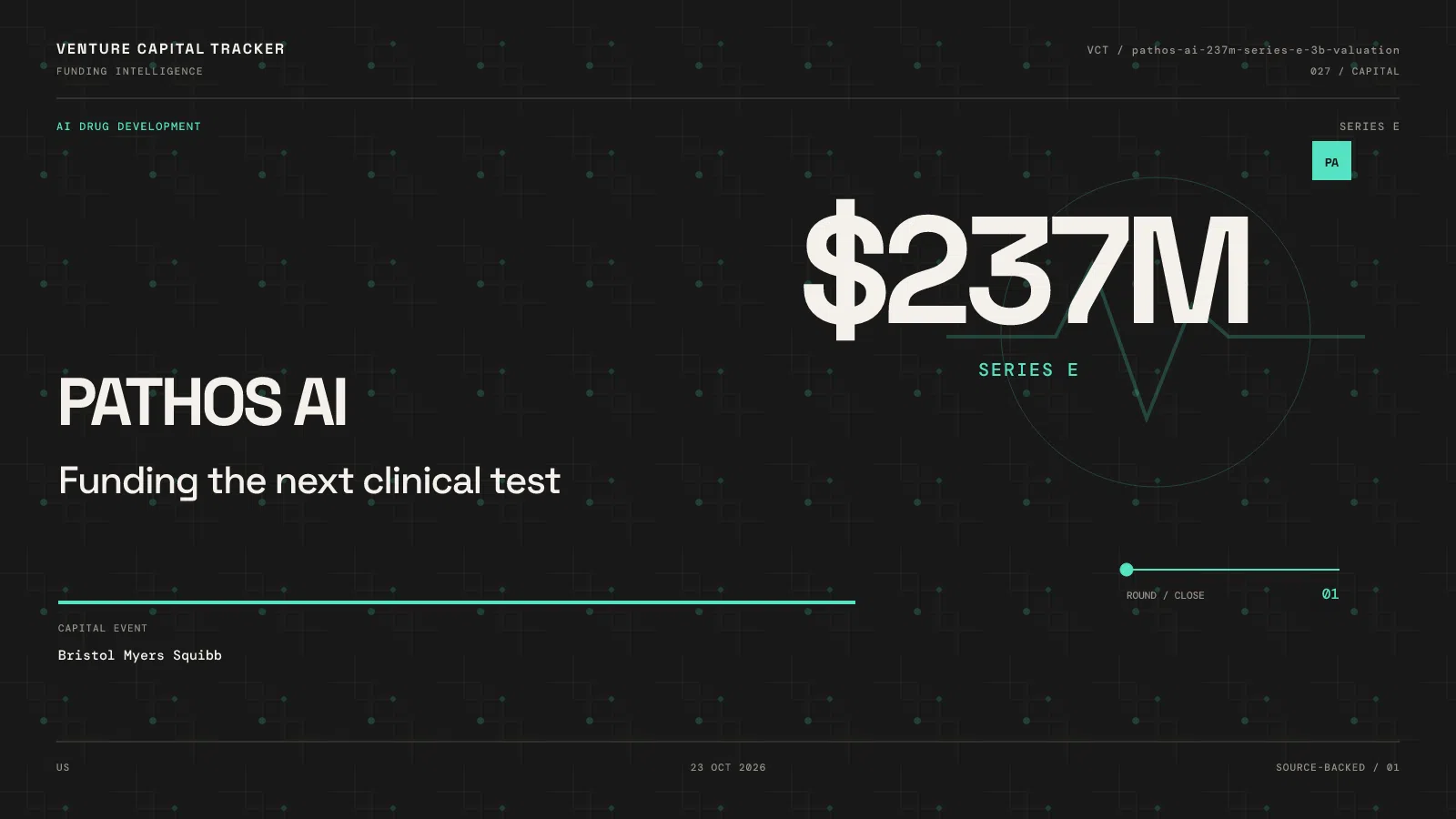
Pathos AI closed a $237M Series E at an approximately $3B post-money valuation, the company announced on October 23, 2026. Bristol Myers Squibb led, alongside unnamed existing investors. The distinctive feature is BMS’s dual role: it is backing Pathos financially while gaining access to its drug-development platform.
The investment funds a demanding proposition: use AI to make better decisions about which experimental medicines to develop, which patients to study and when to change course. Pathos also takes on the expense and risk of advancing its own drug pipeline.
What the financing buys
The new capital follows a $365M Series D announced in May 2025 at an approximately $1.6B post-money valuation. Those are financing valuations at different dates, not evidence that revenues or clinical performance grew at the same rate. Pathos did not disclose current revenue, the Series E investors’ individual commitments or the other participating investors’ names.
The company says the proceeds will expand Foundry, its AI platform, and advance four clinical assets. A priority is moving JSKN016 toward registrational studies: trials intended to generate evidence for an approval application. That is a development plan, not an approval or a demonstrated treatment benefit.
The round and the newly announced data arrangements involve different flows of money:
| Arrangement | Amount and direction |
|---|---|
| Series E financing | $237M raised by Pathos |
| Neurology data agreement | Pathos may pay Tempus up to $55M over five years |
Tempus’s October 23 SEC filing specifies a target of 500,000 de-identified patient records. The fees comprise $50M at $100 per delivered record, plus $5M for availability of updates. Delivery determines how much Tempus earns. These are potential operating payments, separate from the financing, and should not be added to the capital raised.
The business is more than selling software
Foundry combines clinical, genomic and other information to guide development decisions, according to Pathos. In a conventional workflow, specialists reconcile evidence across studies and datasets; Pathos’s proposed alternative is continuously updated analysis that helps teams select programs, patient groups and trial designs. This is the company’s intended workflow, not an independently measured productivity result.
JSKN016 makes the model concrete. Alphamab developed the experimental cancer drug; Pathos licensed it after using Foundry to prioritize it. Pathos agreed to a $125M upfront payment in August 2026 and took responsibility for development and commercialization in its licensed territories, with potential milestones and royalties.
That distinction matters: AI-assisted selection of a drug developed elsewhere is different from inventing the molecule. It also means Pathos needs capital for licenses and clinical execution as well as computing. The August payment is a separate transaction, not an additional component of today’s Series E or a basis for calculating remaining runway.
BMS provides a second commercial route: platform access for an established pharmaceutical company. The partnership announcement describes non-exclusive access across its broader portfolio and three-year exclusive rights supporting neuroscience development. The price and payment terms for BMS’s platform access were not disclosed.
Why BMS is investing now
In the partnership release, BMS data-science head Simon Davies links its investment to combining high-quality data, AI and disease expertise to improve disease understanding and trial design. That is the investor’s stated rationale, rather than an independent assessment of Foundry’s performance.
The immediate catalyst is a package of capital, pharmaceutical expertise and specialized neurological data. Our analytical view is that the combination gives Pathos a route to test its system outside oncology while retaining a drug pipeline on which its decisions can be judged.
Data delivery alone will not establish that the platform works. As with Probably Genetic’s rare-disease data business, research value depends on usable records, consistent definitions and outcomes that can be followed.
Comparable funding, different scientific tasks
Isomorphic Labs announced $600M in March 2025, led by Thrive Capital, to develop its AI drug-design engine and advance therapeutic programs. Insilico Medicine’s June 2025 company release put its completed Series E at around $123M, led by a Value Partners private-equity fund, for its AI platform and drug pipeline.
Both are relevant AI drug-R&D comparisons; their emphasis on discovery and molecular design differs from Pathos’s clinical-asset selection and development decisions. Financing size alone cannot rank their scientific progress.
Pathos also faces governance and execution questions. Tempus disclosed overlapping executive leadership and equity ownership between the companies, with a special committee of disinterested directors approving the relevant agreements. The oversight is disclosed; it does not substitute for evidence of commercial value.
The decisive measures now are clinical milestones, usable data delivery, repeat pharmaceutical demand and cash required per advancing program. BMS’s participation finances that test and supplies a partner. Whether Foundry improves drug-development outcomes still has to be demonstrated.
Editorial note: AI tools assisted with research, structure, or drafting. Venture Capital Tracker retains human editorial responsibility for factual accuracy, relevance, and source quality before publication.