· Venture Capital · 6 sources · Verified
Slingshot Raises $27M to Cut the Cost of Small Insurance Policies
Rally Ventures and Skyward co-led Slingshot Insurance’s $27M seed. Its bet is that better infrastructure can make small checkout policies economical.

By Venture Capital Tracker Editorial Team
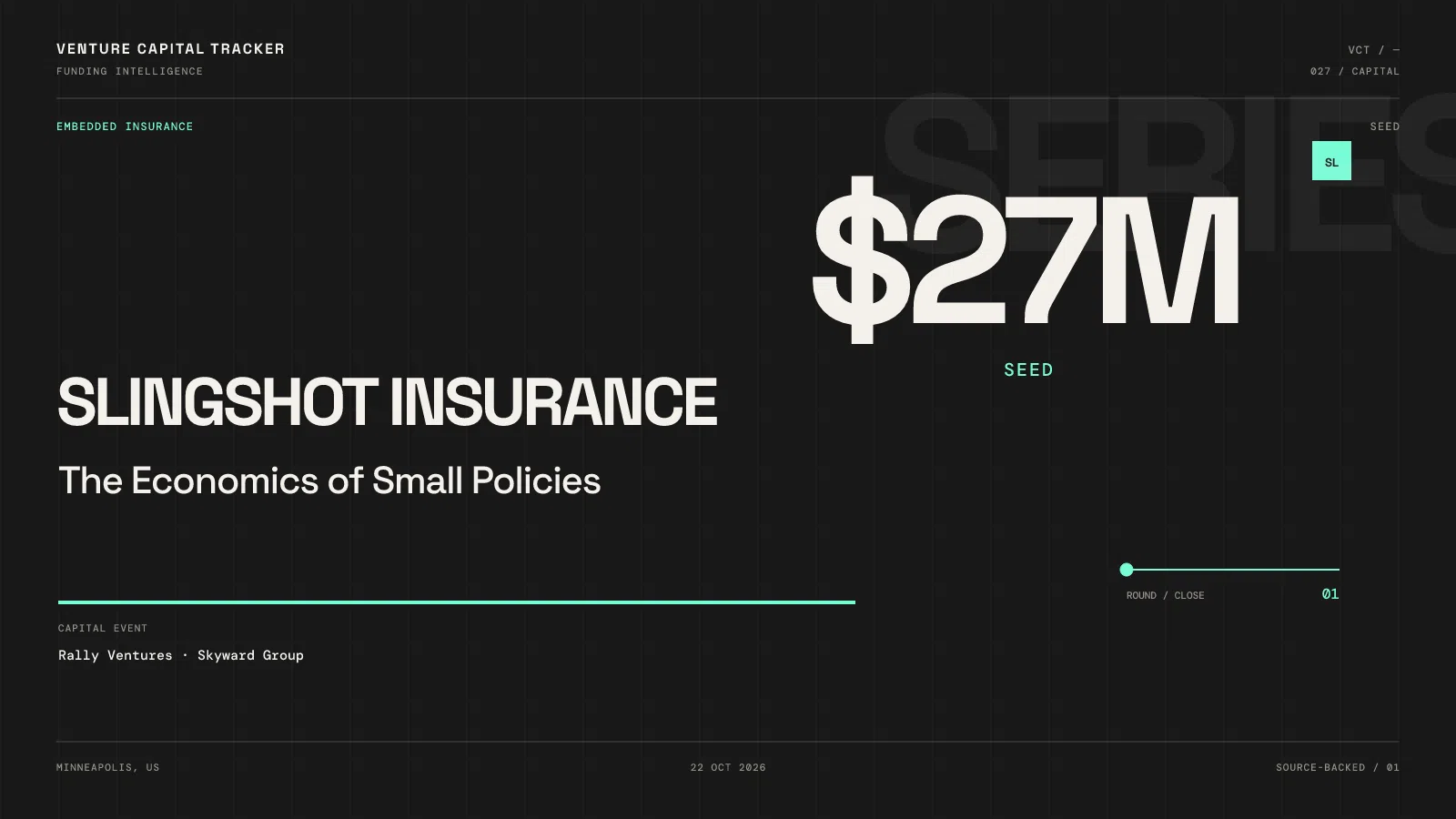
Slingshot Insurance announced $27M in seed financing on October 22, backing a business built around a difficult calculation: can a small insurance policy cover the cost of issuing and administering it? Its early design partner, Vertical Insure, serves more than 750,000 customers at an average premium of $25, according to Slingshot’s announcement.
Rally Ventures and Skyward Group co-led the round, with insurance veterans including Jim Hays participating. Hays will join the board. The Minneapolis company did not disclose a valuation, individual investment amounts or an exact legal closing date.
The work behind a checkout policy
Embedded insurance offers coverage during another purchase, such as a trip booking or sports registration. The checkout button is only the visible part. Someone must price the risk, arrange insurer backing, record policies and reconcile the figures.
Vertical Insure, a managing general agent—an intermediary with delegated insurance authority—helped shape Slingshot’s product. Its CEO, Brock Noland, says carrier approvals have delayed new offerings. This is a named customer’s account of the problem, rather than independent evidence that Slingshot has already solved it.
Slingshot’s product site describes a shared system connecting distributors and capital providers through APIs, or software connections. It offers actuarial support, program monitoring and versioned records of changes, replacing separate spreadsheets, emails and systems. It advertises no minimum fees.
For an illustrative sports-registration program, the operational change would be moving policy and premium data between partners in one system rather than reconciling separate files. That would not remove the need for underwriting judgment, regulatory permissions or capital to pay claims.
In an October 22 Crunchbase News interview, CEO Ethan Genteman described a 5% technology fee for administering programs. Detailed contract terms were not published. Premiums paid for insurance are not Slingshot’s software revenue, and Vertical Insure’s customer count is not Slingshot’s paying-customer count.
Genteman also said the first program was due to launch that month. Slingshot was working with outside insurers and pursuing a carrier acquisition; he explicitly said it was not yet a carrier. A completed acquisition and its price were not announced.
Why Rally is building this now
Rally co-founded Slingshot. Its managing director, Justin Kaufenberg, argues that software companies can earn additional revenue by offering insurance during transactions they already handle. He told Crunchbase News that insurance became an important revenue source when he ran SportsEngine.
That fits Rally’s own AI+ investment focus: using AI-based platforms to offer additional products and revenue streams. VCT’s reading is that Slingshot targets the operating infrastructure needed to make those add-ons economical. Investor conviction does not establish profitable underwriting.
The niche already attracts capital. Cover Genius announced a $100M capital raise backed by Vista Credit Partners on July 14, 2026, at a $1.9B valuation. Its release describes a broader platform connecting merchants and carriers; it does not identify the raise as a lettered equity round.
Qover announced the extension of a $12M CIBC growth-capital facility on March 31, 2026. Its company release concerns European insurance orchestration. That facility is a financing alternative, not another seed-equity comparison or proof that all available credit was drawn.
VCT has also covered Axle’s insurance-verification infrastructure, an adjacent task rather than checkout distribution.
Slingshot has not published revenue, independently verified cost savings or program loss ratios. Its test is whether faster launches produce policies that remain economical after servicing and claims—and whether that result repeats beyond a design partner.
Follow Venture Capital Tracker on Google
Add VCT as a preferred source to see more of our venture-capital reporting in Google Search.
Editorial note: AI tools assisted with research, structure, or drafting. Venture Capital Tracker retains human editorial responsibility for factual accuracy, relevance, and source quality before publication.