Salesforce Agrees to Acquire Loops for Reported $30M
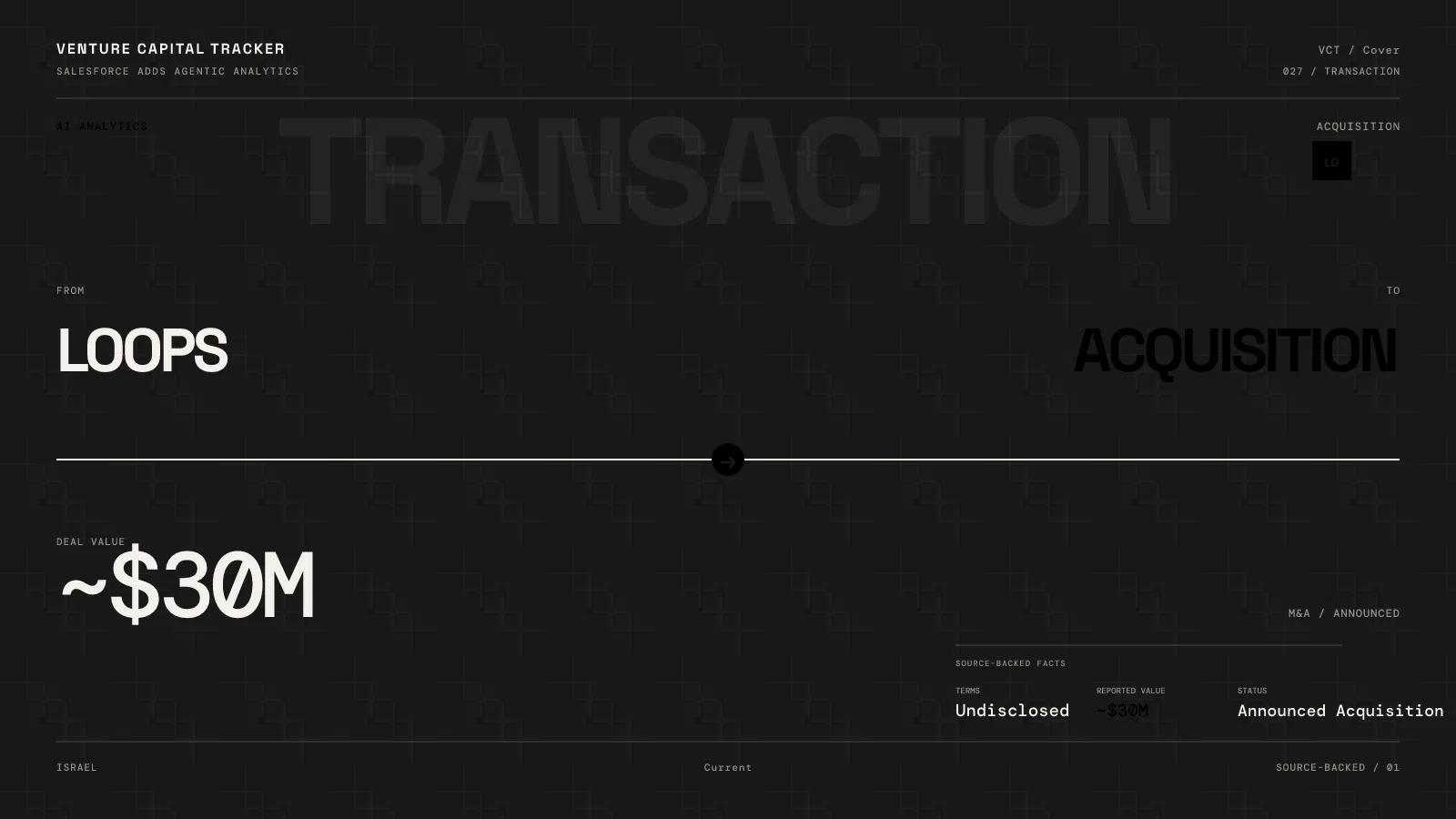
Salesforce signed a definitive agreement to acquire AI analytics startup Loops for Tableau. Terms are undisclosed; Calcalist estimates about $30M.
Salesforce has signed a definitive agreement to acquire Loops, an AI analytics startup whose software monitors business performance, explains why key metrics changed and recommends what to do next.
The transaction is announced but not closed. Salesforce did not disclose financial terms. Calcalist estimates the deal at approximately $30 million; that figure is a media estimate rather than confirmed consideration. Salesforce expects closing in early November 2026, subject to customary conditions.
Deal snapshot
| Item | Detail |
|---|---|
| Buyer | Salesforce |
| Target | Loops |
| Status | Definitive agreement signed; not yet closed |
| Official consideration | Undisclosed |
| Reported estimate | Approximately $30 million |
| Expected close | Early November 2026 |
| Destination | Tableau |
| Prior disclosed funding | $14 million seed round |
| Founders | Tom Laufer and Ido Adiv |
This is a small acquisition by Salesforce standards, but it is strategically revealing. Salesforce is buying an analytics system designed to operate continuously and push explanations into work—not another dashboard that waits for a user to query it.
What Loops adds to Tableau
Traditional business-intelligence software is strongest at organizing data and showing what changed. The expensive part often begins after the chart appears: an analyst has to investigate possible causes, rule out noise, identify an intervention and communicate it to the team that can act.
Loops tries to compress that sequence. Its platform connects to company data sources, monitors key performance indicators, flags trends and anomalies, and uses machine-learning and causal-analysis methods to surface likely drivers. Its Scout capability can distribute findings through Slack and email.
Salesforce says it will bring Loops's technology and specialized team into Tableau after closing. The product logic is clear:
- Tableau supplies enterprise data access and visualization.
- Loops supplies continuous monitoring and explanations.
- Salesforce workflows and Slack provide places to route the next action.
- Agentforce can become the execution layer if customers trust the diagnosis.
The important word is if. An analytics agent that identifies the wrong cause can automate a bad business decision faster than a passive dashboard could.
Why the reported $30 million price needs care
Salesforce has not confirmed the purchase price or consideration structure. Calcalist's approximately $30 million estimate should therefore be treated as reported—not as a disclosed cash payment.
Loops announced a $14 million seed round in November 2022 led by Scale Venture Partners, with Cardumen Capital and a group of product and growth executives participating. Comparing the reported transaction estimate with disclosed capital produces a rough 2.1x transaction-value-to-funding ratio.
That is not an investor return calculation. It does not reveal:
- how much equity founders, employees or investors own;
- whether the deal includes retention packages or earnouts;
- liquidation preferences;
- secondary share sales;
- debt or other liabilities; or
- whether every dollar of the estimated price goes to shareholders.
The modest reported value may indicate that Salesforce is primarily acquiring a specialized product and team. It could also reflect undisclosed economics that the simple headline excludes.
From dashboards to agentic analytics
Salesforce describes the acquisition as part of Tableau's move toward an "agentic analytics" model. The category promises three changes from conventional BI:
| Conventional BI | Agentic analytics |
|---|---|
| User opens a dashboard | System monitors continuously |
| User notices a change | Agent detects an anomaly |
| Analyst investigates drivers | Agent proposes explanations |
| Team decides what to do | Agent recommends or triggers action |
The first two transitions are technically achievable. The latter two create the harder governance problem.
Correlation is not causation, even when a machine-learning model presents a clean narrative. Business metrics often move because of several overlapping causes: pricing, product changes, seasonality, acquisition mix, marketing attribution or data-pipeline errors. Enterprise customers will need to know which evidence supports a recommendation and how reliably the system distinguishes a driver from a coincidence.
The strategic fit—and the integration risk
The acquisition could strengthen Salesforce in three ways.
1. Tableau gets a proactive layer
Tableau historically requires users to build or inspect analytical views. Loops can help turn those views into always-on monitoring and explanation.
2. Slack becomes a delivery channel
Loops already supports Slack and email triggers. Salesforce can insert analysis into the place where teams discuss performance, reducing the need to open a separate BI interface.
3. Salesforce can connect insight to workflow
The highest-value outcome is not a better chart; it is a reliable action. Salesforce owns CRM records, workflow automation and agent infrastructure that could let customers respond to an identified issue.
Integration is also the central risk. Loops's usefulness depends on trusted access to warehouses, consistent metric definitions and enough context to avoid false explanations. Salesforce must decide whether the product remains data-stack neutral or becomes tightly optimized for Tableau and Salesforce clouds. Customers using Snowflake, Databricks or competing BI tools will watch that choice closely.
Competitive implications
Loops competes at the boundary between product analytics, business intelligence and AI decision support.
- Amplitude and Mixpanel already own product-behavior analytics workflows.
- Pendo combines product analytics with guides and feedback.
- ThoughtSpot and other AI analytics vendors emphasize natural-language access to enterprise data.
- Microsoft Power BI can connect analytics with Microsoft 365 and Copilot distribution.
- Tableau already has the installed base but needs to prove it can move from visualization into dependable, proactive analysis.
Buying Loops gives Salesforce a focused team and product architecture without waiting for the category to mature. But the advantage will be temporary if rivals can reproduce monitoring and explanation features on top of the same data warehouses and foundation models.
What to watch before and after closing
The next milestones are more important than the reported headline price:
- Closing confirmation: The deal remains subject to customary conditions.
- Product availability: Salesforce has not disclosed when Loops capabilities will reach Tableau customers.
- Pricing: It is unclear whether the functionality will be bundled, sold as a premium Tableau tier or metered through agent consumption.
- Data-stack support: Neutral connectivity would preserve Loops's broader market; tighter Salesforce integration could improve execution but narrow reach.
- Explanation quality: Customers need auditable evidence behind causal claims and recommended actions.
- Human control: Enterprises will distinguish between agents that suggest an action and agents allowed to execute one.
Bottom line
Salesforce's agreement to acquire Loops is less about buying another analytics dashboard than about making Tableau monitor, explain and eventually act. The deal is signed but not closed, and the approximately $30 million figure is reported rather than official.
The strategic question is whether Salesforce can turn Loops's causal and agentic analytics into a trusted enterprise control layer. If it can, Tableau becomes more active inside daily operations. If it cannot, the acquisition risks becoming another feature set in an already crowded business-intelligence stack.
Follow Venture Capital Tracker in Google
Add VCT as a preferred source to make our venture-capital coverage easier to find in Google Search.
Editorial note: AI tools assisted with research, structure, or drafting. Venture Capital Tracker retains human editorial responsibility for factual accuracy, relevance, and source quality before publication.