· Venture Capital · 7 sources · Verified
Phononic Vibes’ ~$28M Deal Backs Lighter Noise Control
Jolt led Phononic Vibes’ roughly $28M growth and secondary deal. Deutsche Bahn’s own evidence shows why better noise barriers can still carry a higher panel price.

By Venture Capital Tracker Editorial Team
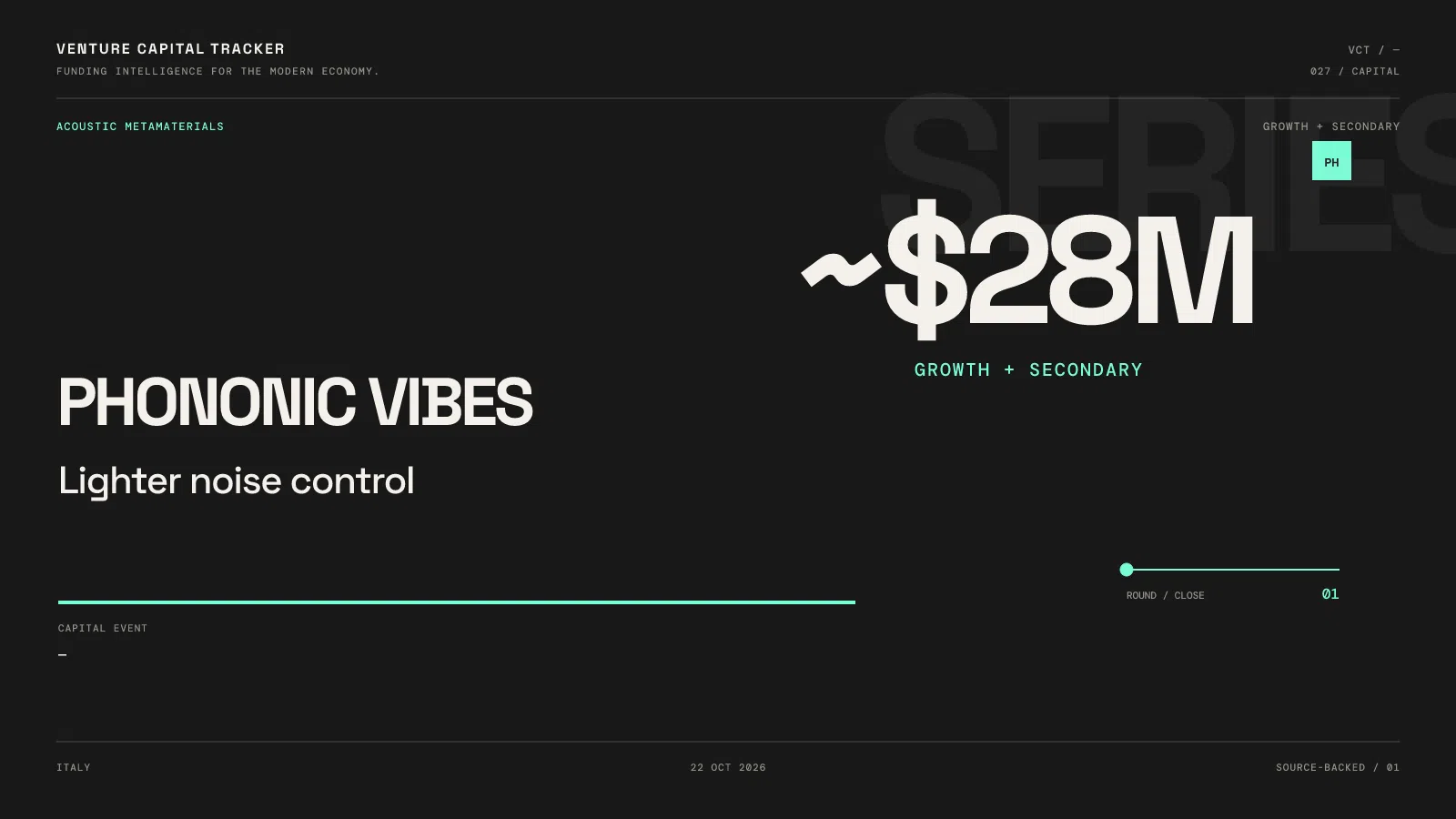
Phononic Vibes announced an approximately $28M transaction led by Jolt Capital on October 22, 2026 to expand its noise-control business. The deal combines growth financing with the purchase of early investor 360 Capital’s stake. The split is undisclosed, so the headline amount should not be read as cash entirely available to build the business.
The Milan company makes acoustic metamaterials: structures engineered to control sound and vibration through their geometry. The investment question is whether lighter or more transparent products can win industrial contracts on total project cost, even when the panels themselves cost more.
The company’s announcement names Eureka! Venture SGR, CDP Venture Capital SGR and Simest alongside Jolt. It discloses neither a valuation nor a lettered funding stage. The original amount is €25M; $28M is rounded from $28.0125M at the ECB’s October 22 reference rate of $1.1205 per euro.
What the customer is buying
Phononic Vibes sells physical noise barriers, vibration-control modules, industrial enclosures, silencers and vehicle insulation. Its product catalogue offers delivery or installation, while its engineering workflow runs from acoustic measurements through design, prototyping, certification and manufacturing. The buyers include infrastructure contractors and industrial equipment makers. Public prices, contract sizes and the revenue split between engineering and product supply are not disclosed.
MetaWindow illustrates the buying decision. Conventional opaque barriers can absorb noise but obstruct views; transparent barriers have historically offered weaker absorption. In its May 2024 announcement, Deutsche Bahn confirmed that it developed MetaWindow with Phononic Vibes from research through approval.
DB described a highly absorbing barrier with 34–37 decibels of sound insulation and up to 72% transparent surface area. Those are different measures: sound insulation, absorption and transparency should not be collapsed into one performance score.
DB also supplied the commercial caveat. The panels cost more because of their more elaborate construction. Its argument was that greater local acceptance could shorten approval procedures and offset the premium across the whole project. That is a customer’s stated economic rationale, rather than proof that every installation saves money.
Phononic Vibes separately claims its product range can deliver equivalent acoustic performance with up to 30% less weight. The reviewed customer announcement does not independently establish that claim across the range.
Why Jolt is backing industrial expansion
In Jolt’s announcement, managing partner Andrea Traversone connects the investment to demand for quieter infrastructure within tighter weight and space constraints. The company plans international expansion, new applications and targeted acquisitions to add industrial capabilities.
That is a manufacturing-and-qualification thesis. Buyers need parts that fit existing structures, meet applicable approvals and arrive on schedule. A promising laboratory result is only the beginning of that process, a distinction also explored in our analysis of physical-technology investing.
Company and investor materials report annual revenue doubling since 2018 and break-even in 2025, but disclose no revenue base or definition of break-even. These claims cannot establish audited profitability or manufacturing margins.
A close alternative, with different financing
Ireland’s Lios also targets lightweight acoustic control through SoundBounce. Its June 2025 EIC announcement distinguishes an awarded grant from recommended equity funding. Recommended equity is not evidence of a completed investment, and the package should not be compared with Phononic Vibes as though both were identical venture rounds.
For Phononic Vibes, the next useful evidence is repeat orders at viable margins. Certification can slow competitors, but new markets still demand qualification, production capacity and working capital. The key test is whether customers consistently pay for the system-level benefit after installation costs, panel premiums and delivery risk are included.
Follow Venture Capital Tracker on Google
Add VCT as a preferred source to see more of our venture-capital reporting in Google Search.
Editorial note: AI tools assisted with research, structure, or drafting. Venture Capital Tracker retains human editorial responsibility for factual accuracy, relevance, and source quality before publication.