· Venture Capital · 9 sources · Verified
Pennant Raises $5M Seed for AI Behind Shareholder Votes
Urban Innovation Fund led Pennant’s announced $5M seed. How its proxy-voting research works, where people stay involved and what its funding figures leave unclear.

By Venture Capital Tracker Editorial Team
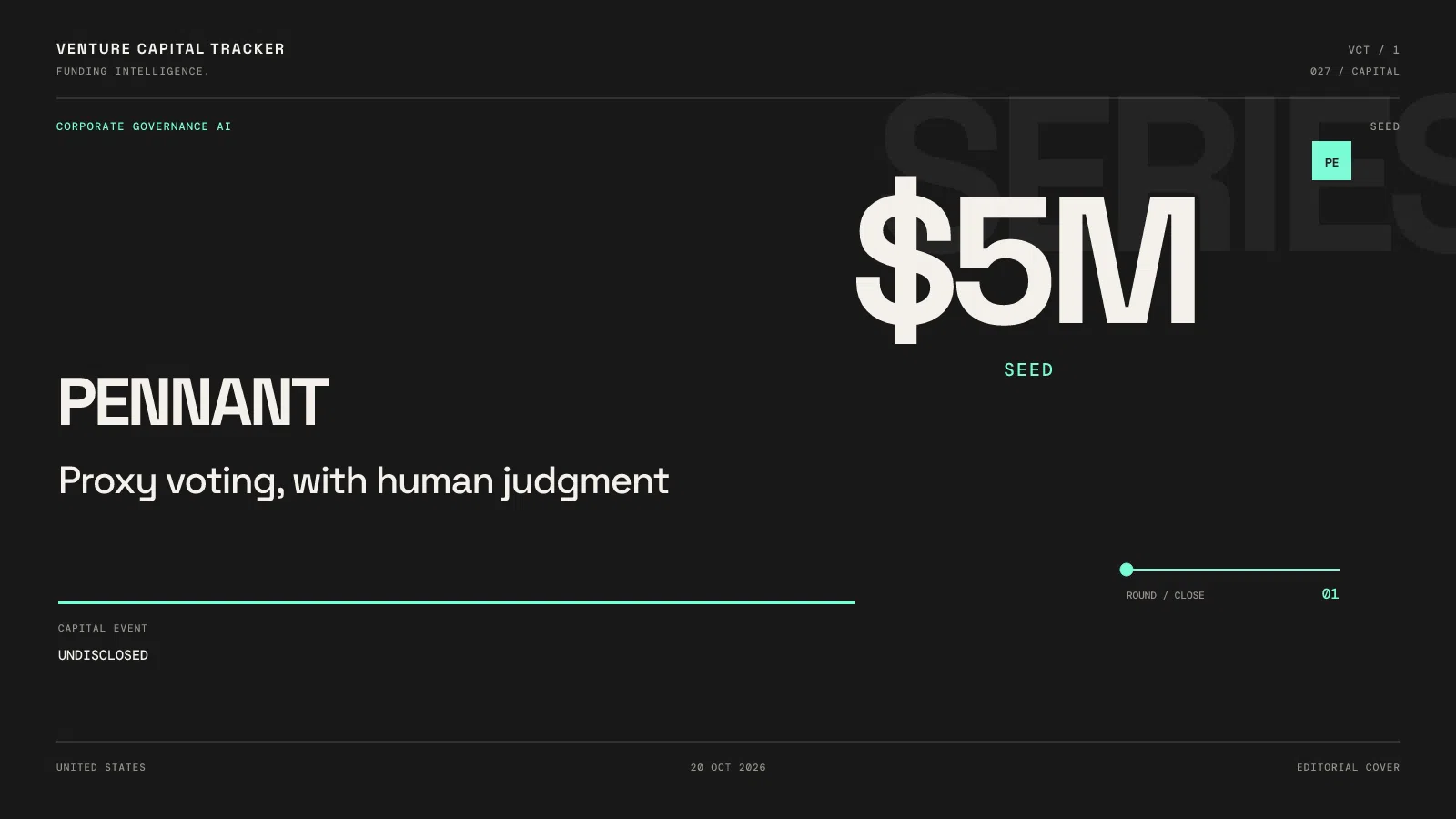
Pennant announced a $5M seed round on October 20, 2026, led by Urban Innovation Fund, with Y Combinator participating. Its target is the research behind shareholder votes: helping pension funds and asset managers apply their own policies, while keeping people responsible for the decisions.
The company announcement also names angels with affiliations at Marvell Technology, Legal & General, OpenAI, Kirkland & Ellis and NVIDIA. Those individuals invested personally; their employers did not thereby invest or endorse Pennant.
There is a discrepancy in the disclosed amount. Pennant calls this a $5M seed; Bloomberg’s accessible article excerpt reports $5.2M. The reviewed material does not explain the difference. This article uses Pennant’s announced figure. Valuation, investor allocations and the legal financing instruments were not disclosed.
What changes for a voting team
Proxy voting lets shareholders decide matters such as director appointments and executive pay without attending meetings. For an institutional investor holding many companies, the challenge is applying a consistent policy while recognizing exceptions.
Pennant’s product site describes a workspace combining filings, proposals, voting guidelines and previous decisions. It generates policy-aligned recommendations, coordinates human review and records sources, approvals and overrides. Compliance features include exports for Form N-PX, a proxy-voting disclosure form.
Consider an illustrative director election. An analyst might otherwise search filings, consult a policy document and recover last year’s reasoning from separate records. Pennant proposes assembling that evidence, flagging a policy exception and preserving the reviewer’s explanation. This is a product-workflow illustration, not a measured customer result.
Pennant says its clients include US pension funds, institutional asset managers, and governance and legal advisers. The reviewed announcement does not name customers or disclose revenue. The website invites buyers to book a demonstration but publishes no contract prices or billing unit. Commercial demand is therefore less measurable than the product description.
Why customized voting creates an opening
There is evidence that investors want more choice over how shares are voted. In its February 2026 Investor Choice update, Vanguard said its program covered 32 equity index funds. No single policy option attracted more than 35% of selections in 2025. This supports demand for different policies; it does not establish demand for Pennant specifically.
Urban’s published strategy emphasizes seed investments in regulated industries, including fintech and regtech. Its portfolio confirms Pennant. VCT’s interpretation is that governance software fits that strategy because buyers need reliable records alongside faster analysis. No detailed investment memo explaining the partners’ decision was located.
Pennant also faces alternatives. Iconik offers customized voting rules and policy-alignment analysis. Pennant’s proposed distinction is the research and review history surrounding recommendations; the reviewed sources do not demonstrate superior accuracy or cost.
Capital is also backing the voting infrastructure
Proxymity announced a $36M Series C in July 2025, led by Mitsubishi UFJ Trust and Banking. In February 2026, Euroclear acquired a minority stake; that announcement disclosed no amount. The latter is a separate strategic investment, not another quantified venture round.
Proxymity focuses on voting communications and shareholder disclosure infrastructure. Pennant focuses on the analysis and institutional reasoning around votes. Both address the same process, but their products are not interchangeable.
As with Cognitive Credit’s source-linked financial research, an audit trail makes an answer inspectable without proving it correct. Pennant must show that analysts spend less time checking recommendations, that policy exceptions remain visible, and that customers renew at prices covering the cost of research and AI delivery.
Follow Venture Capital Tracker on Google
Add VCT as a preferred source to see more of our venture-capital reporting in Google Search.
Editorial note: AI tools assisted with research, structure, or drafting. Venture Capital Tracker retains human editorial responsibility for factual accuracy, relevance, and source quality before publication.