· 10 sources · Verified
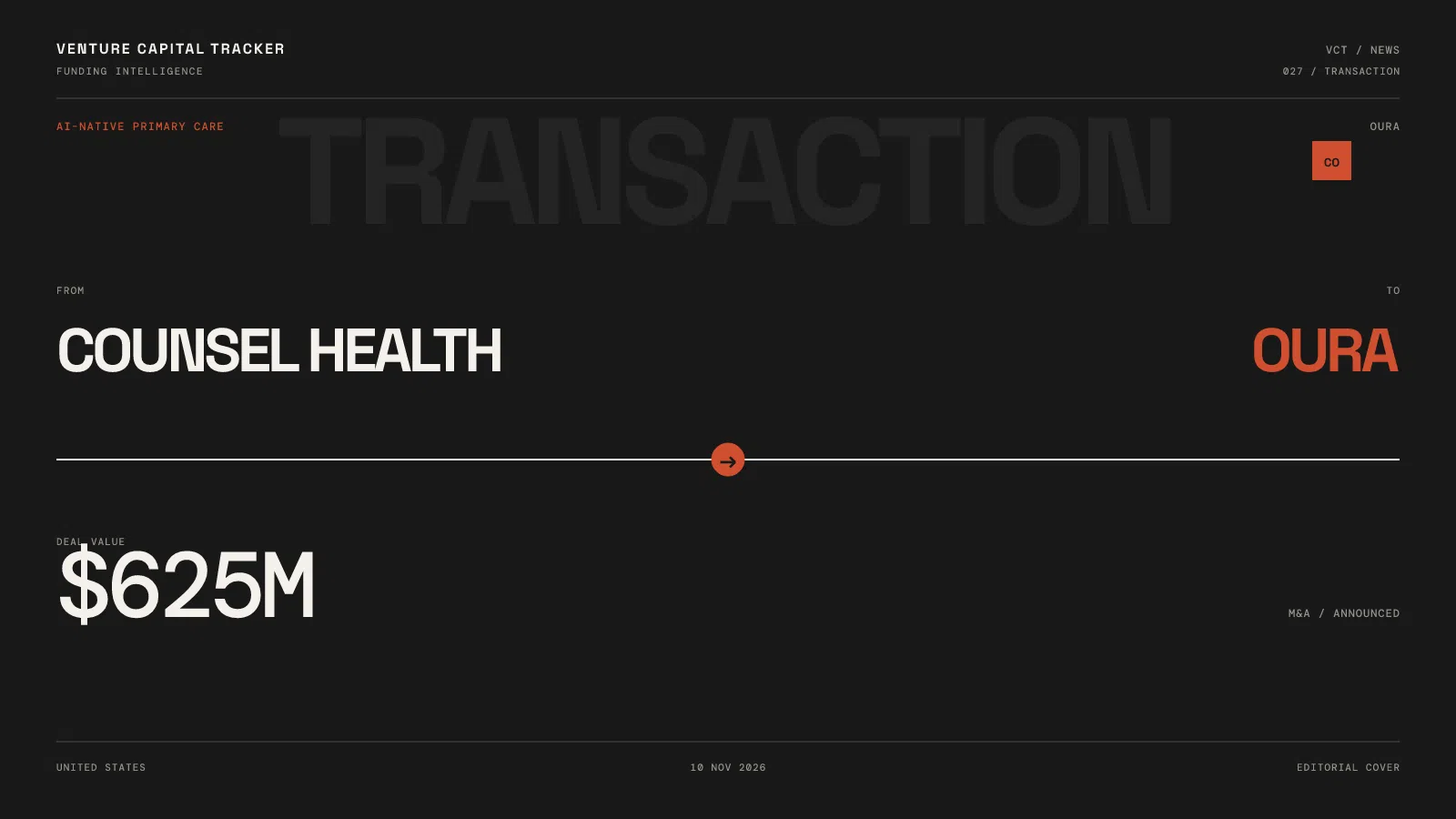
Oura to Buy Counsel Health for $625M: How Its AI Doctors Work
The smart-ring company is buying access to a physician-supervised care workflow, not merely a chatbot. Existing integration and clinical distribution make the deal strategically plausible, but neither a completed acquisition nor independently proven health outcomes have been established.

Editorial team
A health-tracking ring can tell someone that their sleep, resting heart rate or other biometric patterns have changed. It cannot itself assess symptoms, prescribe medication or decide whether a clinician should intervene. That's the gap Oura wants to close with Counsel Health: an AI-assisted medical messaging service staffed by licensed doctors.
Deal details & investors
Acquisition
Counsel Health
The proposed deal, announced November 10, 2026, adds a care-delivery operation to Oura's sensor-and-subscription business. An Oura member can begin with an observation from the ring, ask Counsel's medical AI a question, and involve a board-certified physician inside the app when clinical judgment or treatment is needed. The two companies were already testing that journey in Oura Labs following a partnership begun in May; a planned broader rollout should not be confused with universally available, fully integrated care today.
Status matters: This is a definitive acquisition agreement, not a confirmed closing. The jointly issued November 10 statement sets a $625 million cash consideration, subject to purchase-price adjustments, with a closing anticipated before the end of calendar 2026, conditional on customary requirements. The transaction is not a new financing round for Counsel.
From ring data to a clinical decision: the actual workflow
The best way to understand the product is through what the patient, AI assistant, and clinician each do. This is an illustrative journey based on the companies' published workflow, not an independently observed treatment session.
- Notice a health change. A member sees an Oura trend—perhaps a changed resting heart rate or disrupted sleep. Wearable signals supply context, not a diagnosis.
- Choose to start a conversation. In the available Oura Labs experience, the member opens Counsel's AI chat and describes the symptoms or question. Sharing relevant ring data for a clinician's review is a matter of user privacy and consent; it is not a blanket transfer of all health information.
- Receive an AI-assisted first response. Counsel's system uses the question, relevant history and medical guidance to suggest the next action. A chatbot response is not equivalent to a physician's medical judgment.
- Bring in a licensed physician. If a question requires clinical action, a doctor joins the text conversation; Counsel says responses can arrive within minutes. A doctor, rather than the ring, handles medical decisions such as prescriptions, lab orders and referrals where appropriate.
- Continue the same thread. Follow-up, test results and next steps remain connected to the original interaction instead of requiring another isolated telehealth appointment.
This is different from merely embedding an AI health summary in a wearable app. Oura is seeking a mechanism to act on its readings with real medical professionals. It is also a change in business model: clinicians, clinical governance, payer relationships and liability become as relevant as hardware margins.
The issuer says that more than 90% of surveyed Oura members using Counsel felt their ring data helped them obtain better care, and people who saw a Counsel doctor rated the experience 4.6/5. These are selected company-reported satisfaction observations. They do not demonstrate fewer hospitalizations, better diagnoses or comparative clinical effectiveness.
What does Counsel cost, and who actually pays?
Counsel publishes prices for its standalone consumer service. AI chat starts free, a physician visit costs $29, and an annual $300 membership offers unlimited physician visits under its advertised terms. A pay-per-visit conversation remains open for seven days. These are current website prices, not a confirmed price list for Counsel inside an Oura membership.
| Standalone choice | Advertised price | Useful purchasing distinction |
|---|---|---|
| AI-only first contact | Free | Does not itself buy a doctor's treatment |
| Doctor visit | $29 | A seven-day ongoing visit thread |
| Annual medical membership | $300/year | Advertises unlimited doctor visits; separate from ring hardware and Oura subscription |
An illustrative consumer using the listed $29 visits would spend $290 for ten visits and $319 for eleven, so the $300 membership becomes cheaper on price alone at eleven visits. That comparison ignores insurance benefits, eligibility, the individual's medical needs, and any bundled Oura plan that may be offered later. It is not a recommendation to seek unnecessary care.
Counsel's second customer is institutional: health insurers, health systems, employers and consumer-health partners can provide access to their populations. The company says its enterprise network gives it distribution beyond people who own a ring. Whether an Oura member eventually pays separately, receives employer-sponsored access or gets a new bundled tier has not been disclosed. Neither partner has published enough data to model patient-level gross margin, reimbursement or clinician capacity reliably.
Why $625 million cannot be treated like another funding round
The historical investment record answers one question that many short acquisition recaps leave unresolved: How much outside capital had actually been disclosed before the sale agreement?
| First disclosed | Financing | Investors / meaning |
|---|---|---|
| October 22, 2024 | $11M Seed | Led by a16z Bio+Health; Asymmetric Capital Partners, Floodgate and Pear participated |
| October 16, 2025 | $25M Series A | Led by a16z and GV; raised to expand physician-supervised AI care |
| November 10, 2026 | Proposed $625M cash purchase | Oura as acquirer; subject to adjustments and closing conditions, not venture funding |
The $36 million sum is a calculation of the two disclosed venture rounds, not a statement of all capital ever invested or the seller's net proceeds. The announced purchase consideration is roughly 17.4 times those disclosed raises. That is not a venture investor return multiple: actual proceeds depend on cap-table ownership, preferences, debt, fees, employees' stakes and any transaction adjustments, none of which are disclosed sufficiently to calculate returns.
That distinction also matters for reading the broader Oura story. The company previously announced more than $900 million of Series E financing at an approximately $11 billion private valuation and postponed a proposed IPO in September 2026. Those are separate transactions. A postponed IPO price indication is not an achieved listed valuation, and the Counsel acquisition is not a $625 million capital raise by Oura.
Oura additionally disclosed approximately $1.75 billion of fiscal-2026 revenue and $533 million for the September quarter in its acquisition statement. Both figures are preliminary and unaudited. At the headline level, $625 million equals about 35.7% of Oura's reported annual revenue, illustrating the scale of the proposed cash commitment. This is not a valuation-to-revenue multiple for Counsel, whose revenue and profitability have not been disclosed.
The strategic thesis: medical action plus enterprise reach
For a wearable company, daily engagement is valuable but a physiological insight can end at a notification. For a clinical provider, a physician often lacks the patient's longitudinal data between visits. The proposed combination offers a way to join those experiences—but only if consenting users trust the integration and clinical decisions remain accountable.
There are two distinct distribution routes. Consumer: Oura's existing member base may use Counsel for questions, prescriptions, lab work, or referrals. Enterprise: Counsel can continue selling access to health plans, employers and other partners, including people who do not own a ring. The second route is especially important because it prevents the investment thesis from depending entirely on converting Oura subscribers to another paid service.
Counsel says its medical model resolves 96% of member concerns without further escalation and that a physician responds in roughly two minutes. These are company-reported operational claims, not audited outcome statistics. The definition of resolution, denominator, case mix, escalation thresholds and longer-term patient outcomes all matter before using these figures to infer savings or quality. An avoided physical consultation is not automatically an avoided necessary consultation.
The transaction is also a bet on clinical operations, not just AI software. A care network must manage state licensing, medical-record security, clinician oversight, prescriptions, urgent-care escalation, payer obligations and malpractice exposure. Oura itself explicitly states that its ring is not a medical device and is not intended to diagnose or treat disease; the physician service is a different regulated activity.
Alternatives buyers should consider
Counsel combines asynchronous medical messaging, AI assistance and an in-house physician network. It is not interchangeable with every telehealth or wearable product.
- K Health offers AI-assisted entry to physician care. A buyer should compare clinical coverage, prescriptions, patient handoff, insurance arrangements and quoted fees—not simply the presence of a chat interface.
- Teladoc Health offers established virtual primary-care services. Its health-plan and employer reach can be attractive, while a prospective customer should compare synchronous versus asynchronous pathways and integration with wearables.
- A conventional primary-care practice may preserve longitudinal continuity and examination access but often cannot provide an on-demand asynchronous answer at the same moment.
- A wearable-only app, including an Oura experience without Counsel, can report biometrics and health trends; it does not supply a licensed doctor who can clinically act on a symptom.
The right comparison depends on the buyer: a consumer seeking occasional advice, a payer trying to route appropriate care, and an employer seeking nationwide clinical coverage do not optimize for the same price, workflow or measured result.
What still needs proof before calling this a success?
Closing: Has the acquisition legally completed, and what was the final cash consideration after adjustments? As of November 15, the original statements establish an agreement, not the completed transfer.
Availability and pricing: When does integrated Counsel leave Oura Labs? Will Oura subscribers pay $29 per visit, receive it through a payer, or see a different bundle? The published standalone fees do not settle those questions.
Quality and safeguards: What is the actual case mix behind the claimed issue-resolution rate? How often is escalation appropriate or missed? What prospective, independently evaluated clinical outcome data exist?
Economics and privacy: Counsel's revenue, margin, claims savings, physician workload, member retention and transaction financing remain undisclosed. User-consented access to biometrics must be implemented and explained precisely, not treated as unrestricted access to sensitive health data.
The most useful way to follow this story is through the Counsel Health financing and product profile and the canonical acquisition record linked to this article. Later legal closing, audited performance or binding subscription terms would justify substantive updates to this URL—not a duplicate article with a refreshed date.
Editorial note: AI tools assisted with research, structure, or drafting. Venture Capital Tracker retains human editorial responsibility for factual accuracy, relevance, and source quality before publication.