· Venture Capital · 4 sources · Verified
Otter.ai Secures $320M in Repayable Growth Financing
General Catalyst’s Customer Value Fund is backing Otter’s enterprise expansion. The capital avoids new equity dilution, but comes with repayment costs.

By Venture Capital Tracker
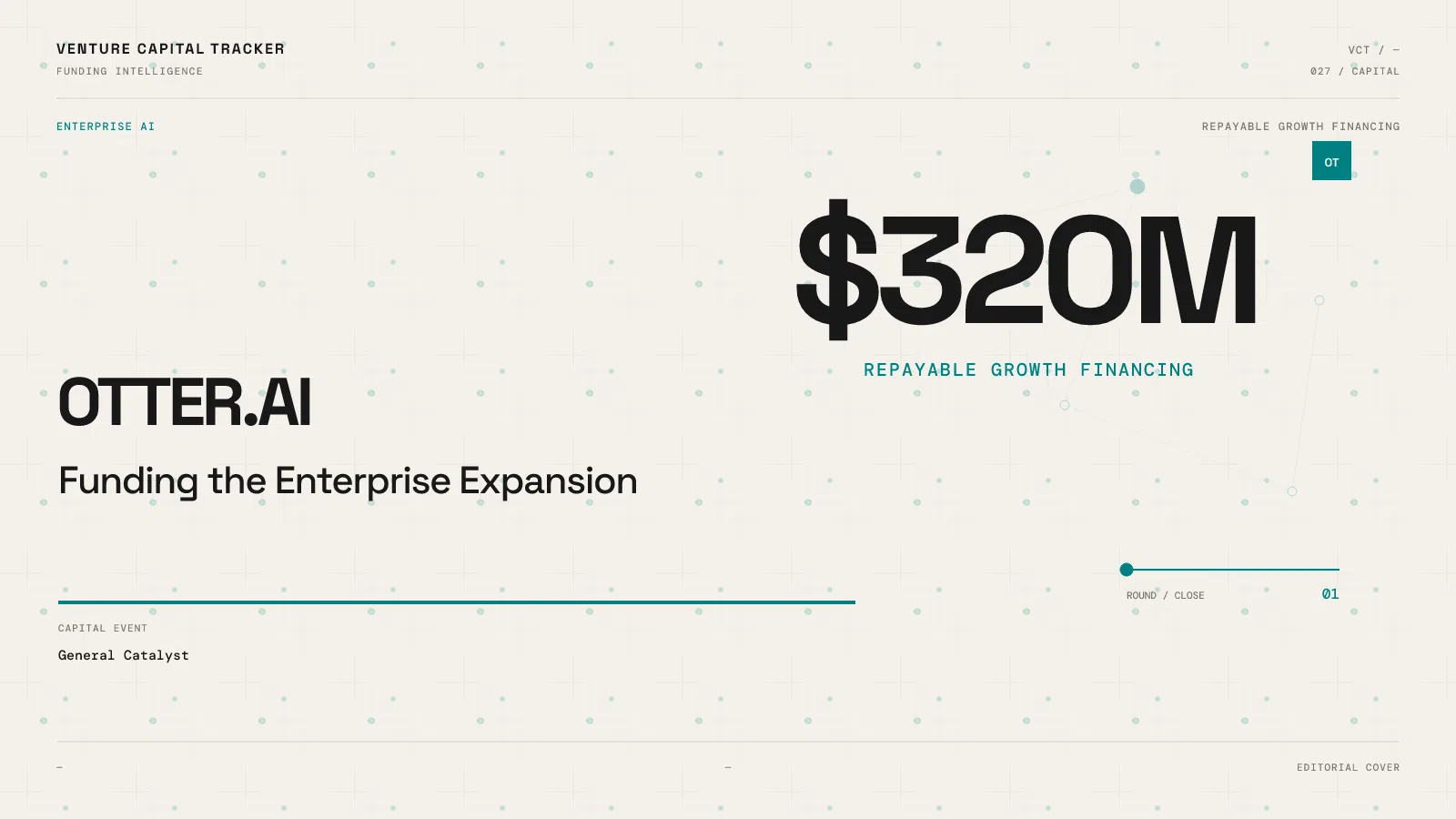
Otter.ai has closed $320 million in repayable growth financing from General Catalyst’s Customer Value Fund, choosing a route that expands its spending capacity without issuing new equity.
The October 20 financing will support the meeting-software company’s enterprise business and international expansion. Its significance lies as much in the repayment structure as in the headline amount.
This is not a new equity round
Otter’s announcement calls the transaction growth financing. CEO Sam Liang told Reuters that the money must be repaid with interest as sales and marketing spending generates revenue.
That separates the transaction from a conventional venture round, where investors buy shares. Existing shareholders avoid dilution from this financing, but the capital still has a cost.
No new valuation was announced. Nor were the interest rate, repayment timetable or full contractual terms disclosed in the reviewed sources. The $320 million therefore cannot be used to calculate a new price for Otter’s shares.
Funding customer acquisition before the revenue arrives
General Catalyst’s description of its Customer Value strategy explains the underlying idea: provide capital for sales and marketing, with a capped claim on the customer value that spending creates.
The timing problem is familiar to subscription businesses. A company pays to win a customer before it collects all the revenue that customer may produce over several years.
Financing can help bridge that gap while preserving equity for product development and other investments. It works economically when the customers acquired generate enough value to cover the cost of winning and serving them, including the financing cost.
General Catalyst’s general strategy description is not Otter’s contract. Its published discussion of payment conditions should not be treated as proof of every protection or obligation in this particular deal.
A large user base is a starting point
Otter says more than 40 million people use its products and that teams at over 86% of Fortune 500 companies have used them. Those figures demonstrate reach; they do not establish an equivalent number of paying enterprise customers.
The distinction is central to the next phase. An employee using a meeting assistant is different from a company purchasing and renewing a contract for a wider team.
Liang told Reuters that Otter plans to increase sales and marketing spending and aims to at least double enterprise revenue next year. The revenue base and proportion of paying users were not disclosed. The growth ambition is a target, rather than a result already achieved.
What will determine whether the financing pays off
The strongest evidence would be more paying teams, repeat renewals and customers expanding their use of the product.
Otter must also cover the cost of providing transcription, AI features and support. More usage creates value only if enough revenue remains after those costs and the financing payments.
This gives the announcement a more specific meaning than a broad vote of confidence in AI. It backs Otter’s ability to turn widespread adoption into a larger enterprise business.
For Otter.ai, the next useful milestones are paid customer growth and durable cash generation. The financing buys more scope to pursue them; its size alone does not establish profitability or a timetable for going public.
Our AI startup funding tracker follows the wider market, with financing structures kept distinct so repayable capital is not confused with new equity.
Follow Venture Capital Tracker in Google
Add VCT as a preferred source to make our venture-capital coverage easier to find in Google Search.
Editorial note: AI tools assisted with research, structure, or drafting. Venture Capital Tracker retains human editorial responsibility for factual accuracy, relevance, and source quality before publication.