OrbiMed Raises $3B Across Two Healthcare Funds
OrbiMed raised about $3B across Private Investments X and Asia Partners VI. The separate mandates matter more than one combined fundraising headline.
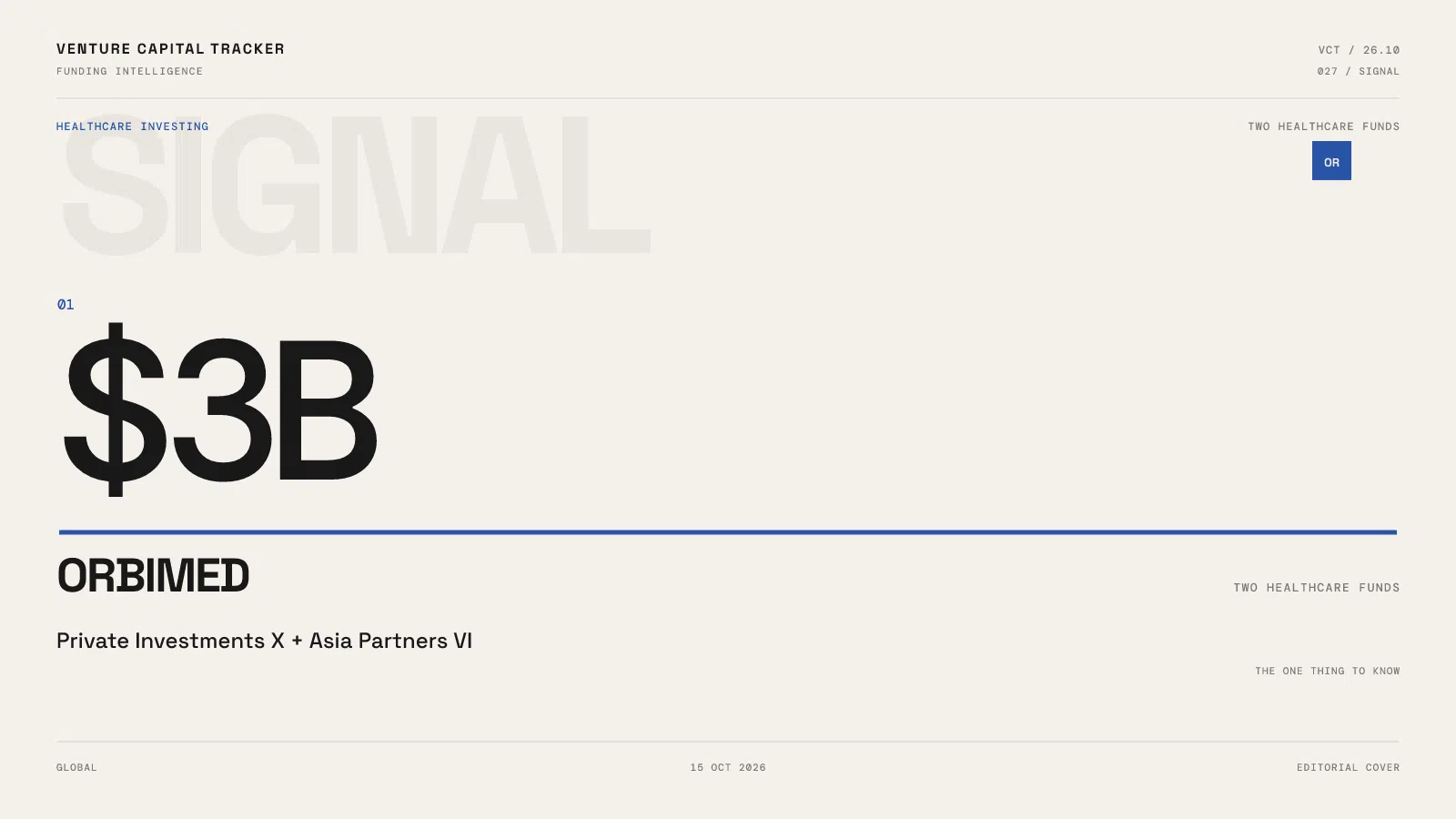
OrbiMed has announced approximately $3 billion in commitments across two new healthcare investment funds. The October 15, 2026 disclosure covers OrbiMed Private Investments X and OrbiMed Asia Partners VI—not a single $3B vehicle and not capital raised by a startup.
The distinction matters because the funds have different geographic mandates and investment opportunities. Combining them describes the manager’s fundraising scale, but it does not make their capital interchangeable.
How is OrbiMed’s $3B divided?
The manager’s announcement gives the following breakdown:
| Vehicle | Announced commitments | Mandate |
|---|---|---|
| OrbiMed Private Investments X | More than $1.9B | US and European life-sciences venture capital |
| OrbiMed Asia Partners VI | More than $1B | Asian healthcare venture capital and growth equity |
These are rounded disclosures. The second fund should not be assigned an exact $1.1B merely by subtracting $1.9B from the combined headline. The release does not explicitly identify a final-close phase or the exact legal closing dates.
The manager describes LPs spanning medical institutions, endowments, foundations, pensions, sovereign wealth funds and family offices. WSJ reports returning backers including the Helmsley Charitable Trust and Eli Lilly’s venture arm. Those names are not allocated to either individual vehicle in this article.
Why two mandates matter more than one large headline
Our analysis is that investors should read this as two underwriting programs. Geography affects the companies a fund can support, the expertise needed to evaluate them and the routes through which investments may eventually generate liquidity.
The investment instrument matters too. A venture investment financing scientific development is not identical to growth equity supporting an operating healthcare business. Their operating milestones, capital requirements and downside risks differ even when both sit within the healthcare sector.
OrbiMed’s broader platform also includes public equities and royalty/credit strategies. Firmwide assets under management therefore should not be mistaken for the amount raised in these funds, or for capital available for new venture investments today.
Capital supports experiments; it does not settle the science
A large specialist fund can potentially support companies across multiple development milestones. The important diligence question is how much capital remains available for follow-on investments after initial portfolio construction, fees and other obligations.
The announcement does not disclose the number of intended investments, individual check sizes, reserve policy or deployment schedule. None can be inferred reliably from the fund totals alone.
For portfolio companies, financing capacity is valuable only in combination with disciplined milestone selection. In therapeutics, additional funding does not establish safety or efficacy. In devices and services, a technical result does not automatically establish adoption, reimbursement or attractive operating economics.
VCT’s OMass Series C analysis illustrates the company-level counterpart: evaluate what evidence the money can fund, not just the size of the check.
What should readers watch next?
The useful follow-up evidence will be portfolio construction, the balance of initial and follow-on investments, and progress toward clinical or commercial milestones. Realized distributions to LPs are a different measure from fundraising success.
Likewise, this announcement is evidence that one manager secured substantial commitments. It is not sufficient evidence that every healthcare startup has an easier financing environment, or that the entire venture market is recovering uniformly.
Bottom line
OrbiMed’s approximately $3B fundraising is a high-priority healthcare investment story. Its analytical value lies in the separate US/European venture and Asian venture/growth mandates. VCT records two underlying fund events, avoiding a third aggregate event that would count the same commitments twice.
- fund-news
- fund-close
- venture-funds
- +1 more
Editorial note: AI tools assisted with research, structure, or drafting. Venture Capital Tracker retains human editorial responsibility for factual accuracy, relevance, and source quality before publication.