· Venture Capital · 5 sources · Verified
Numeracle Raises $28M to Expand Verified Business Identity
Edison Partners backed the profitable communications-identity company as it expands from call reputation and branded calling into wider business verification.

By Venture Capital Tracker Editorial Team
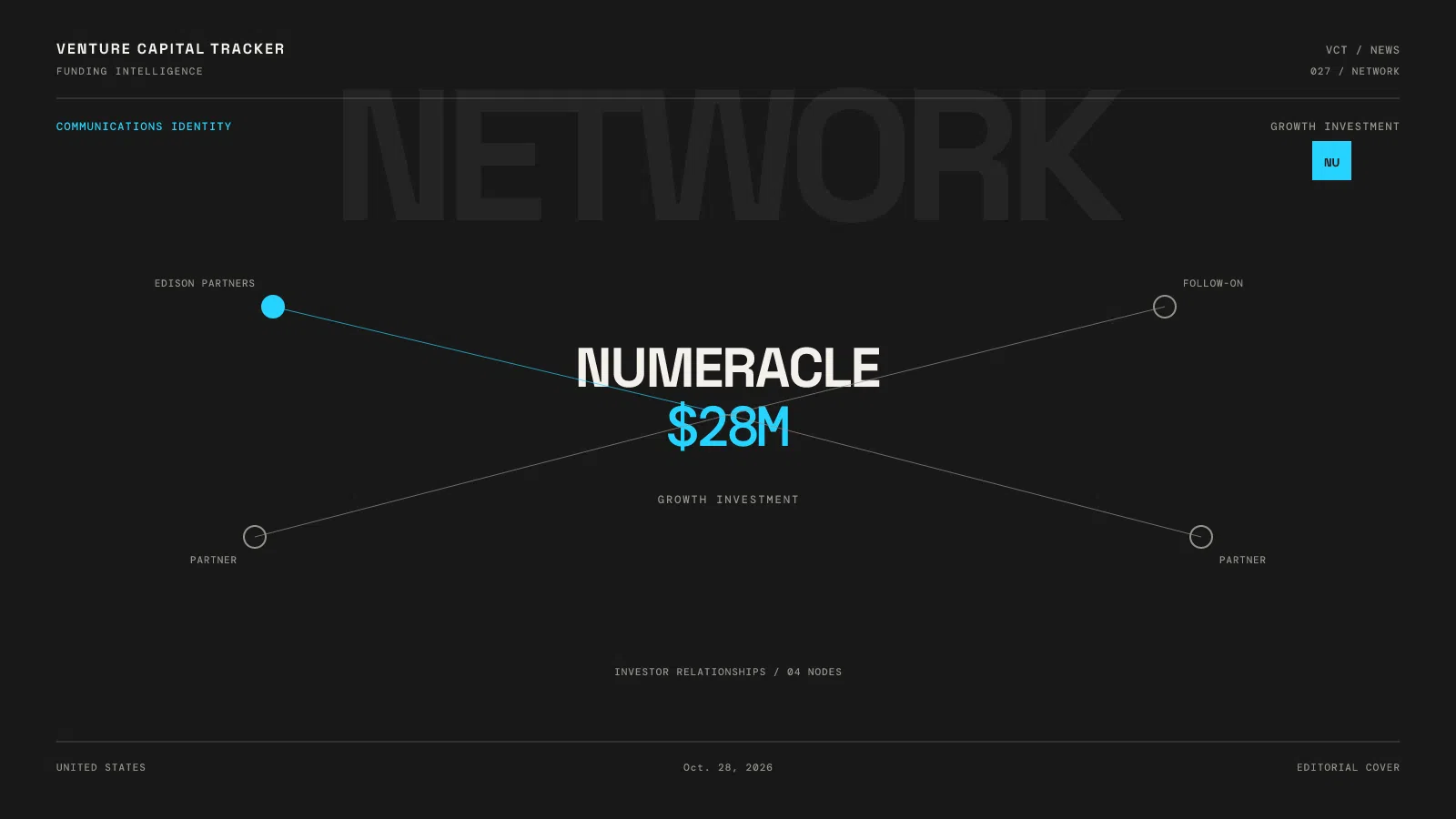
Numeracle has raised a $28 million growth investment led by Edison Partners to expand a business-identity platform that began with a frustrating telecom problem: legitimate calls are often blocked or labeled as spam. The financing matters because Numeracle is now trying to carry verified identity from phone calls into messaging, digital platforms and AI-mediated interactions.
The investor announcement was published October 28, 2026. Crunchbase News reported that Edison was the sole investor, bringing Numeracle’s total funding to $34.8 million after a $6.8 million Series A in December 2023. The company did not disclose a valuation.
What Numeracle sells
Numeracle’s customers include enterprises that need people to answer important outbound calls: healthcare providers, banks, retailers, home-services companies, universities, government organizations and charities. It also sells business-verification services to communications providers and platforms.
The workflow starts before a call reaches a phone. Numeracle verifies that a business is real, links that identity to the phone numbers it is authorized to use, shares the information with carrier screening systems, and monitors whether those numbers receive spam or fraud labels. When a legitimate number is mislabeled, the company helps pursue remediation. Customers can add branded calling so supported phones show a business name, logo or reason for the call.
This replaces a fragmented process in which a contact-center team monitors multiple reputation systems, submits corrections through free carrier or analytics-provider portals, and separately manages branded-calling programs. It does not remove the carriers from the process: display coverage still varies by network, device and service provider.
Founder and CEO Rebekah Johnson told Crunchbase News that Numeracle charges an annual subscription for reputation monitoring and an additional per-call fee for branded calling. Standard pricing, gross margin, retention and the revenue split between those products remain undisclosed.
A concrete before-and-after example
The College of Health Care Professions used Numeracle’s number-reputation product before adding branded calling to selected outbound numbers. In a company-produced case study, CHCP’s initial-attempt contact rate rose from 11.74% in March 2025 to 14.14% in April, a 20% relative increase.
The example is useful because it describes an actual workflow and names the customer. It is not an independent study: Numeracle published it, the test covered one month, and the page does not disclose a randomized control, call volume or all factors that may have affected answer rates.
Why Edison invested now
Edison cited three factors: Johnson’s telecom and compliance background, growing demand for trusted business communications, and the company’s position between enterprises and carriers. The firm said Numeracle’s annualized revenue run rate had increased 70% over 16 months and that the platform protected more than 4,000 enterprise brands.
Independent reporting adds context. Crunchbase News said Numeracle had roughly 85 employees and became profitable in 2026, earlier than Johnson expected. About 90% of sales inquiries were coming through unpaid inbound channels, according to the founder. Growth capital can therefore fund targeted marketing, hiring and international expansion without asking investors to underwrite an unproven core business.
A regulatory catalyst is also emerging. In April, the Federal Communications Commission proposed stronger know-your-customer requirements for voice providers, including more rigorous verification of businesses that originate high call volumes. That proceeding is a proposal, not a final rule, but it increases the strategic value of reusable business-identity infrastructure.
The competitive set is broader than caller ID
Numeracle competes directly with call-reputation and branded-calling vendors including Hiya, First Orion and Transaction Network Services. Those companies also verify callers, register numbers and deliver identity information through carrier networks. Free registration channels remain an alternative for businesses willing to manage the work themselves.
Recent financings around the category are informative but not exact matches. Equal AI raised a $30 million Series B in June 2026 for a consumer assistant that screens calls; it sits on the receiving side rather than managing enterprise call identity. Socure’s reported growth investment concerned digital identity and fraud prevention outside telecom. Pindrop’s closest recent financing was a $100 million debt facility in July 2024 for voice authentication and deepfake detection, a different product focus and capital structure.
The narrow market has no clean like-for-like disclosed round in VCT’s last 24 months. That scarcity makes Numeracle’s financing more useful as a signal: investors are treating verified business identity as infrastructure that may travel across communications channels, rather than as a single caller-ID feature.
The next evidence should be operational. Watch international carrier coverage, retention, adoption of the KYC service outside voice, and independently measured customer outcomes. Numeracle has shown that enterprises will pay to protect legitimate calls. The larger bet is whether the same verified entity can become a trusted identity across every place a business meets a customer.
Follow Venture Capital Tracker on Google
Add VCT as a preferred source to see more of our venture-capital reporting in Google Search.
Editorial note: AI tools assisted with research, structure, or drafting. Venture Capital Tracker retains human editorial responsibility for factual accuracy, relevance, and source quality before publication.