· Venture Capital · 9 sources · Verified
Nous Raises $17M to Take Household AI Beyond Bill Advice
Nous’s $17M funding backs household AI that acts on bills and admin. Its free and paid plans reveal different revenue models—and different tests of trust.

By Venture Capital Tracker Editorial
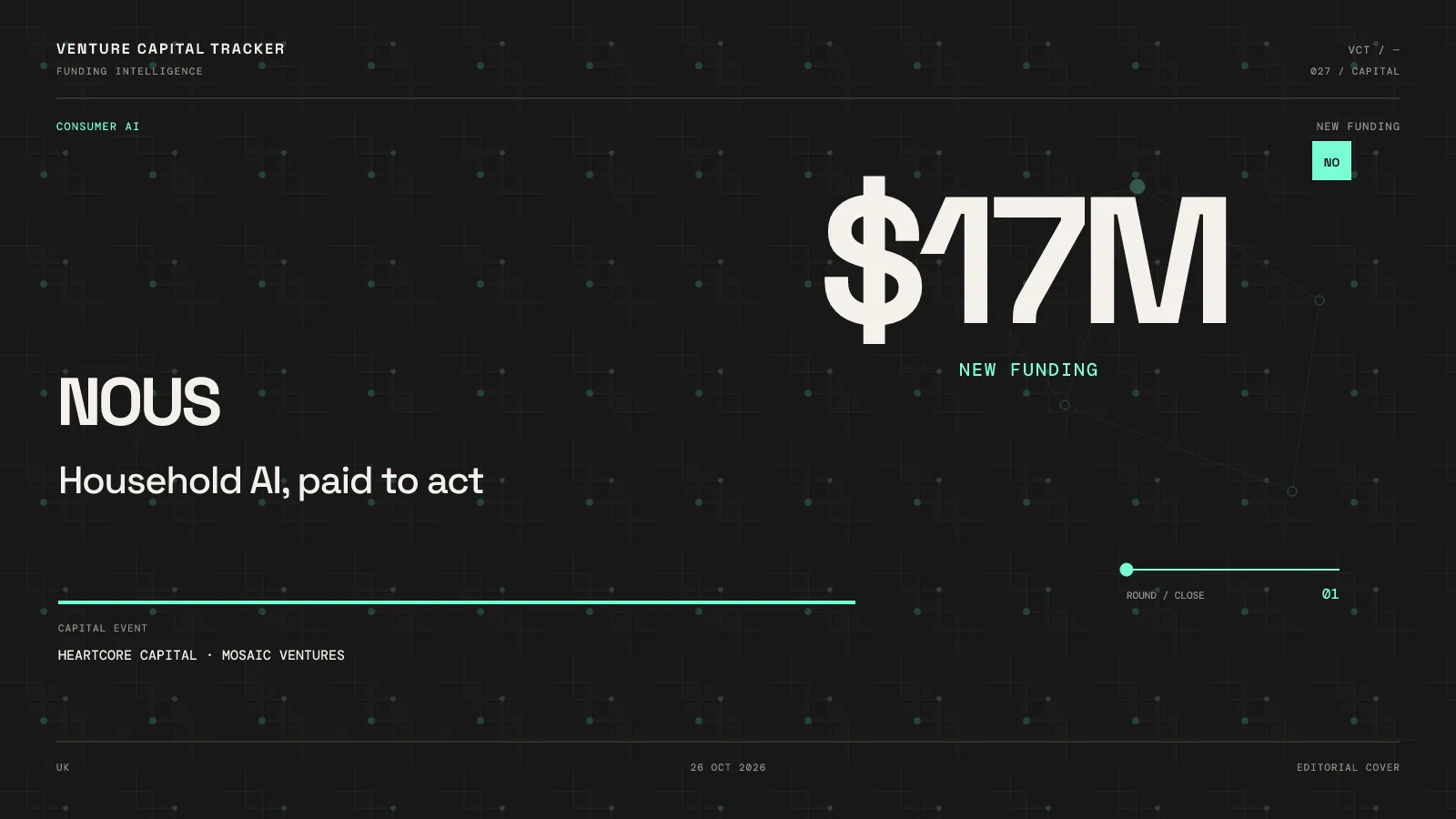
Nous has announced $17M in new funding to expand its household AI agent internationally and take on more administrative work. The October 26 announcement names Heartcore Capital and returning investor Mosaic Ventures, alongside Chalfen Ventures, Joyance Partners and Bain Future Back Ventures.
Its commercial proposition is more specific than a general-purpose assistant: handle the bill, rather than explain how to handle it. But the business has two different payers. Premium households subscribe; on the free tier, eligible supplier switches generate commissions.
Nous reports nearly 250,000 UK households and more than $900M of household spending under management. Neither figure establishes subscription revenue, paying customers or money held by Nous. The announcement does not disclose valuation, revenue, a lettered round stage or a debt/secondary breakdown. Its 2022 seed round was $9M; that older disclosure does not establish a complete funding history.
Who pays for the work?
The current pricing page lists Premium at about $9.30 per household per month (GBP6.99). Free members get up to two household services managed and limited subscription tracking. Premium adds unlimited services and household logins, wider administration support and cash rewards; support is subject to a fair-use cap.
The distinction is in the commissions. Nous says it retains commissions from eligible provider switches for Free members. For Premium members, it returns commissions as cash rewards. Those rewards generally accrue over time while the household remains with the provider and on Premium. The company says it does not earn advertising revenue or sell customer data.
That makes paid conversion more consequential than the household count. Subscription income is recurring, but comes with a broader service promise. Free-plan income depends on eligible switching activity. Nous has not disclosed the mix, commission rates, retention or service costs.
The price conversion uses October 26 ECB reference rates: USD1.1188 and GBP0.83820 per euro, equivalent to approximately $1.3348 per pound. The dollar figure is an editorial conversion, not a US price.
Delegation has to end in a completed job
Consider the energy-switching process described in Nous’s October 23 product-design post. A household normally checks its tariff, compares alternatives, considers exit fees and arranges the switch. Nous proposes doing that work within agreed permissions, explaining relevant trade-offs and distinguishing a requested switch from a completed one.
Those boundaries matter commercially. An assistant that needs constant supervision merely moves the administrative burden. One that acts outside the household’s instructions risks losing trust. Nous’s founder describes a hybrid system: language models for flexible interactions, rules-based processes for consequential financial actions. That is an architectural claim, not independently validated evidence of fewer errors.
In the funding announcement, Heartcore’s Max Niederhofer frames the opportunity as changing household purchasing decisions. Mosaic’s Toby Coppel emphasizes customers trusting agents to act, rather than merely advise. These are investor arguments quoted by Nous; a separate current investment memo was not located.
Two dated investments put that thesis in context. Household assistant Ohai announced strategic funding led by Muse Capital in August 2025, without disclosing the amount. Its emphasis is family coordination. Broader web-task agent Yutori announced a $15M seed in March 2025, led by Radical Ventures. Neither is an identical bill-switching service.
Ohai’s April 2026 redesign post also offers a useful caution: some users struggled to understand how to use it or feel its value quickly enough. Features alone do not remove household work.
The same distinction between workflow claims and service economics appears in Nevis’s adviser-automation financing, albeit with business buyers. For Nous, the decisive evidence will be completed tasks, retained paying households and gross margin after the cost of support and mistakes—not the value of bills passing through the system.
Follow Venture Capital Tracker on Google
Add VCT as a preferred source to see more of our venture-capital reporting in Google Search.
Editorial note: AI tools assisted with research, structure, or drafting. Venture Capital Tracker retains human editorial responsibility for factual accuracy, relevance, and source quality before publication.