· 6 sources · Verified
Norwest Raises $4B Fund 18: Founder Fit, Cheque Sizes and LP Questions
The new pool spans venture and growth equity, not AI alone. Norwest publicly describes different investment sizes and ownership routes, while its fund-level LP commitments, fees and first deployments remain undisclosed.

Editorial team
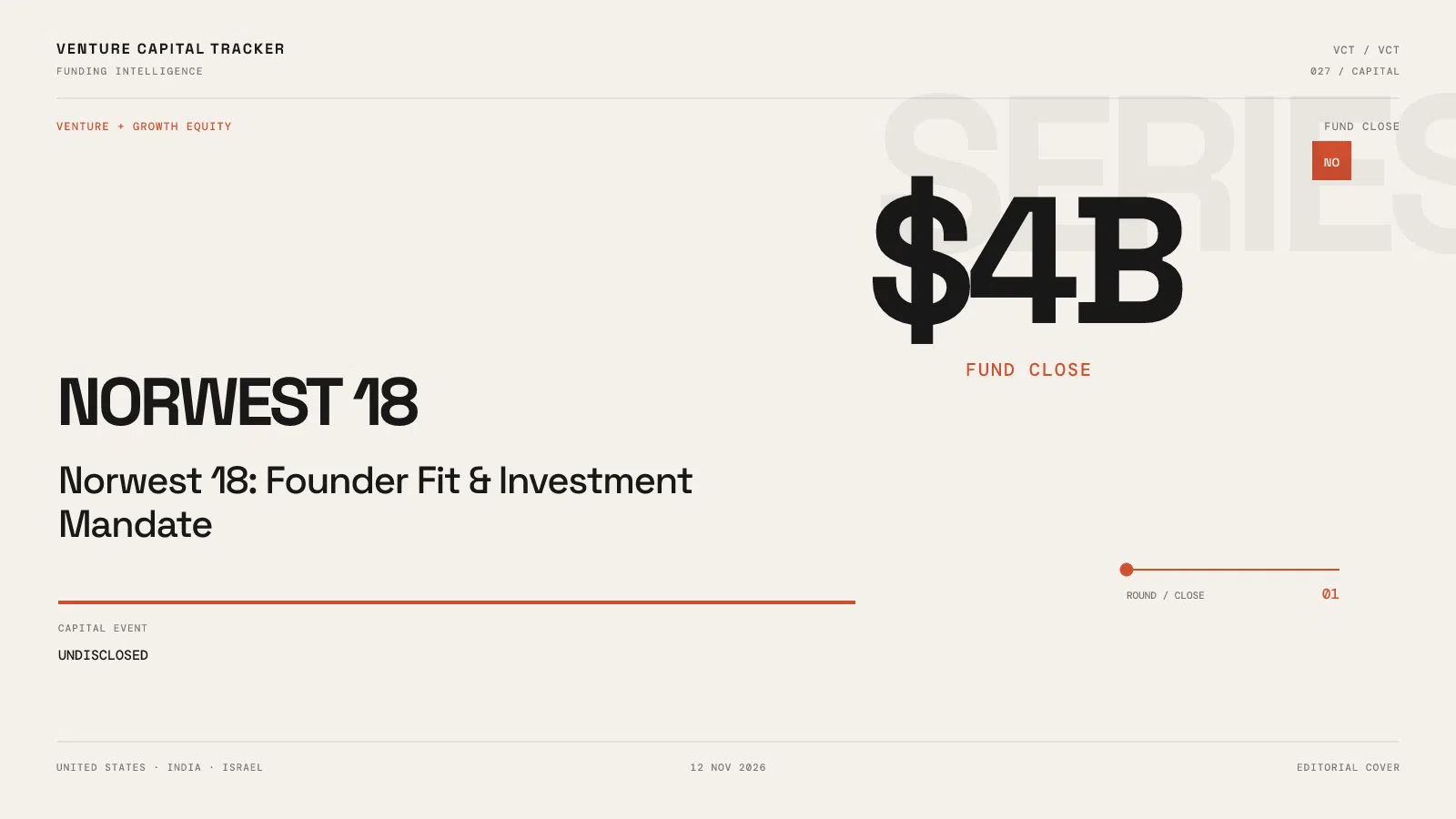
Norwest's newest vehicle is not a narrowly earmarked artificial-intelligence fund. It combines early venture investing with later-stage growth equity, across technology, healthcare and consumer businesses. That distinction is more important to a founder than its headline size: the firm's venture practice and growth-equity practice offer different ownership structures, cheque sizes and operating support.
Deal details & investors
Fund close
Norwest 18
For an early-stage company, Norwest says smaller initial venture investments begin around $1 million–$5 million, while typical early-stage investments total $10 million–$15 million over time. It also describes larger venture investments of $25 million–$100 million. Its growth-equity team advertises $20 million–$300 million equity investments in established businesses and can consider minority stakes, recapitalisations or buyouts. These are firm-level public guidelines, not a guarantee that the new fund will make any particular cheque. That is a more actionable starting point than treating a $4 billion fund as a single, uniform investor.
What Norwest 18 actually finances
In its November 12 announcement, Norwest said the vehicle backs companies in three broad sectors — technology, healthcare and consumer — across the United States, India and Israel. It specifically highlighted financial infrastructure, industrial and physical AI, drug discovery, healthcare delivery, agent-focused cybersecurity and autonomous systems.
A diversified mandate matters here. A laboratory therapeutics company, a profitable Indian components manufacturer and a US agent-security software business will not be judged on identical commercial milestones. The venture team can evaluate technical differentiation and a credible founding team before significant sales exist; the growth team emphasizes an operating business with customers, a path to scaled earnings and strategic options.
Norwest's named recent investments include Generalist AI (robotics), ORION Security, VAST Data, healthcare companies and industrial businesses. Those names demonstrate manager experience, not a verified list of assets bought by Norwest 18. The firm has not publicly itemized this new vehicle's deployments.
The fund history: three vintages, not three new raises
| Fund vintage | Announcement | Disclosed fund size | What the figure represents |
|---|---|---|---|
| NVP 16 | December 2021 | $3B | Historical fund capital |
| NVP 17 | April 25, 2024 | $3B | Separate venture and growth fund |
| Norwest 18 | November 12, 2026 | $4B | Newly announced eighteenth fund |
The new vehicle is about 33% larger than either of the preceding two, calculated from Norwest's original 2024 fund announcement and its current release. That is meaningful capacity for follow-on investments or larger growth transactions, but it is not proof of future returns.
Norwest reports having backed more than 85 additional companies and supported over 30 liquidity events since announcing Fund 17 in April 2024. These are manager-wide activity counts during the interval. They are not the number of Fund 18 investments or independently calculated distributions to Fund 17's limited partners.
The manager also reports $18 billion in total capital under management after the new close. This is different from the $4 billion raised by this specific vehicle: it is a firm-wide measure covering its investment platform. It should not be described as fresh capital available from Fund 18, nor treated as an audited fund net-asset value.
A founder's practical route to the right Norwest team
The following is an illustrative diligence journey, not a claim that we applied or tested a confidential investment process.
- Identify your actual stage. A venture-stage founder with little revenue should use the firm's venture criteria, not assume the growth team's $20 million–$300 million remit applies. An established business contemplating recapitalization should evaluate the growth route instead.
- Match the geography and sector. The firm has US, India and Israel teams. A US AI infrastructure pitch, an Indian precision-manufacturing expansion and an Israeli cybersecurity spinout may reach different sector specialists. Its website describes these practices but does not promise a decision or response time.
- Prepare evidence appropriate to the stage. An early founder should explain product differentiation, technical readiness, customer adoption and why the team can execute. A later-stage company should also be ready to discuss revenue quality, margins, capital needs, governance and possible liquidity routes.
- Clarify cheque, ownership and reserves. Ask whether the initial investment and prospective follow-on capital come from this vehicle; what ownership, board rights or preference terms are sought; and how investment decisions and co-investments are handled. The public close announcement does not provide those deal terms.
- Evaluate post-investment help. Norwest advertises an operating and portfolio-success group supporting hiring, go-to-market, product and M&A. Named case studies indicate the type of involvement available, not a guarantee of equal support to every portfolio company.
This is why Norwest's existing investor profile and the new Norwest 18 fund record should remain distinct: the first describes the manager's broader history; the second tracks this vintage's capital and mandate.
India has more specific public numbers — with limits
Norwest India head Niren Shah told Moneycontrol on November 12 that the firm's India operations typically deploy $250 million–$350 million annually, and expect to maintain a similar pace. The same interview reported venture cheques generally around $10 million–$25 million and growth or buyout investments around $30 million–$150 million. India has roughly $2.5 billion of the manager's capital under management, according to that interview.
Those are India-team patterns, not a separate $250 million–$350 million allocation promised from Norwest 18 each year. Shah specifically said there was no preset geographic allocation for the new fund. This distinction helps explain a seemingly contradictory story: the global firm is talking more about AI, while its India business expects considerable spending on value-added manufacturing, industrial services, health systems and mature companies.
At the smaller end, a founder developing specialised software may have a credible venture fit. A precision-manufacturing platform looking to buy and modernise suppliers may be better suited to a growth-equity conversation. Those are illustrative applications of the disclosed strategy, not announced future investments.
What LPs and competing investors still need to know
TechCrunch describes Norwest as backed solely by Wells Fargo. That is a useful ownership and funding-context signal, not an itemised LP commitment schedule for Norwest 18. The November 12 manager release does not identify each limited partner, how much each committed, the fee and carried-interest terms, or the legally finalised close date separate from the public announcement.
An LP diligence reader should ask whether the vehicle has recycling provisions, how follow-on reserves are funded, the strategy mix between venture and control-oriented growth deals, and how the manager reports realised versus unrealised performance. None of these economics is established by the firm's statement that it supported more than 30 recent liquidity events.
For a founder comparing firms, Norwest is one option among multi-stage investors such as Accel, Sequoia and Bessemer, but broad sector labels alone do not establish comparable terms. A practical choice turns on a named partner's experience, check and ownership expectations, portfolio overlap, the geographic team's operating relationships and the ability to support subsequent rounds. Norwest's Zenity financing coverage illustrates a manager-level sector relationship, not confirmation of a Norwest 18 deployment.
The important risk behind a larger pool
A one-third larger fund creates more capacity but can also increase the pressure to put money to work, especially if late-stage valuations stay elevated. The firm's mix of consumer, biotech, software and industrial investments can diversify exposure, yet each requires different specialist diligence and may have different holding periods and exit conditions.
The next disclosures that would materially change the assessment are actual Fund 18 portfolio investments, documented deployment pace and commitments, clearer manager-versus-vehicle performance figures, and any published fee or LP information. Until then, the defensible conclusion is narrower than an AI-funding-boom headline: Norwest has enlarged its established global multi-stage strategy, while the fund's realised economics are still unknown.
Follow Venture Capital Tracker on Google
Add VCT as a preferred source to see more of our venture-capital reporting in Google Search.
Editorial note: AI tools assisted with research, structure, or drafting. Venture Capital Tracker retains human editorial responsibility for factual accuracy, relevance, and source quality before publication.