· 11 sources · Verified
Northwood Space's $375M Series C: Portal, Prism and Ground-Network Economics
Northwood Space closed $375M Series C co-led by a16z and DFJ Growth. How Portal, Prism, satellite-pass booking and its $2B reported valuation actually work.

Editorial team
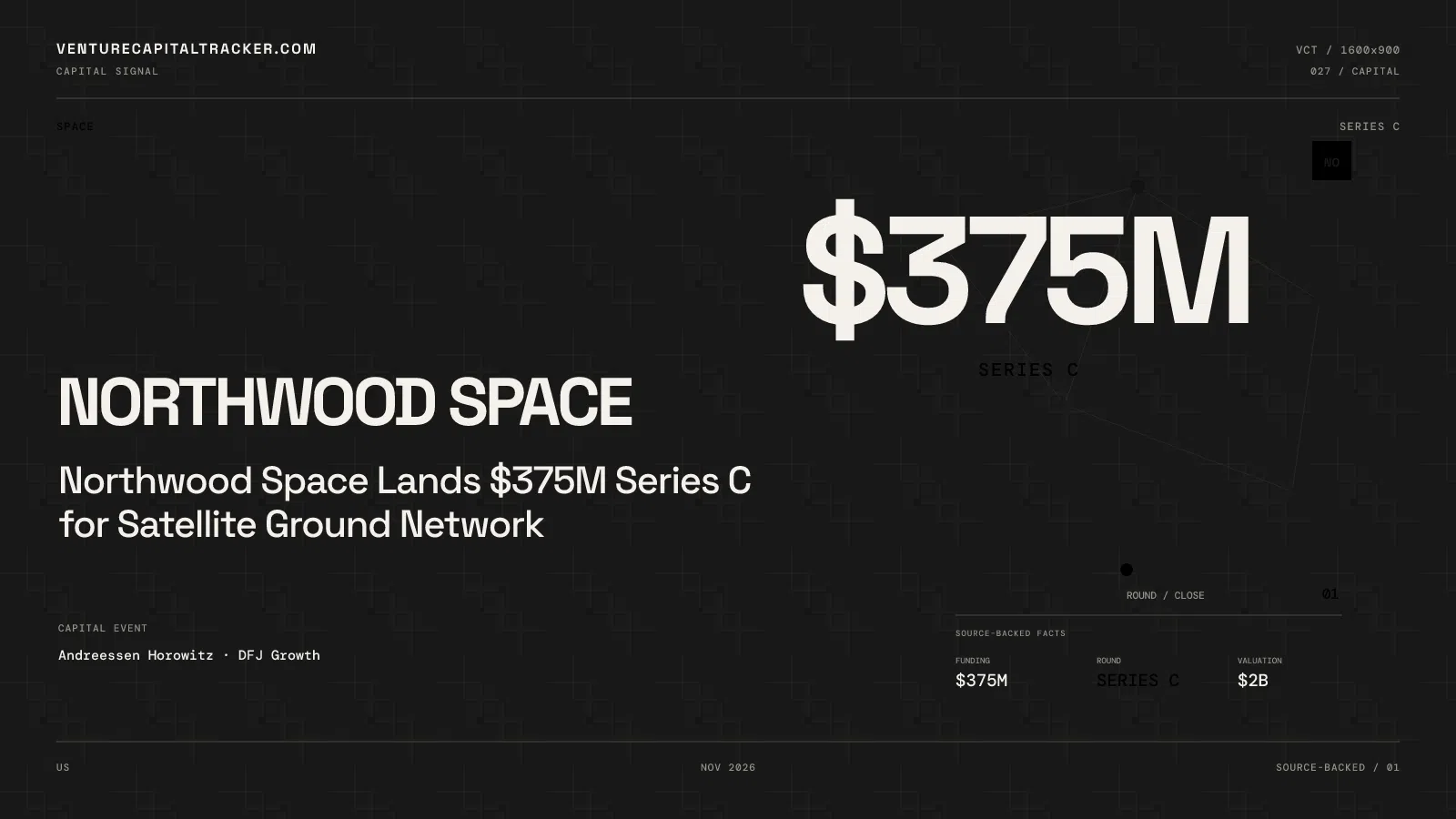
Northwood Space closed a $375 million Series C financing on November 2, 2026, co-led by Andreessen Horowitz (a16z) and DFJ Growth, as it expands a shared network of satellite ground stations. Independent reporting by Bloomberg, TechCrunch and specialist space media puts its valuation at approximately $2 billion; the company's own announcement does not give that valuation or say whether it is pre- or post-money. Northwood also arranged a separate multi-year HSBC Innovation Banking credit facility of undisclosed size. That is debt capacity, not part of the $375 million equity round. Northwood's original round announcement names the investors and says the financing closed.
The useful business question is what Northwood sells. The company is not manufacturing launch vehicles or operating a satellite constellation. It builds Portal phased arrays for spacecraft command and control, Prism dishes for high-throughput data, and software that lets operators reserve satellite communications capacity across a shared ground network. This is the ground equivalent of renting computing capacity instead of building your own data center, though the physical, spectrum and orbital constraints are very different.
Funding facts: equity, valuation, credit and government contracts
| Question | Sourced answer |
|---|---|
| Company | Northwood Space, headquartered in Torrance, California; co-founded by Bridgit Mendler, Griffin Cleverly and Shaurya Luthra |
| New financing | $375M Series C equity, announced Nov. 2, 2026 as closed |
| Co-leads | a16z and DFJ Growth |
| Other reported round participants | Washington Harbour Partners, Alpine Space Ventures, StepStone and In-Q-Tel, among others |
| Valuation | About $2B reported by Bloomberg, TechCrunch and trade reporting; not stated in the company's release |
| Separate credit | HSBC multi-year facility, amount undisclosed; cannot be added to $375M |
| Prior company financing | $100M Series B, announced Feb. 18, 2026; earlier $30M Series A, described by the company |
| Government award | $49.8M U.S. Space Force contract previously announced; commercial contracting not venture equity |
| Existing deployment | Company reports six multi-orbit-capable sites on two continents as of Nov. 2 |
| Manufacturing | 185,000-square-foot Torrance factory, opened in 2026; target of hundreds of antennas per year |
| Undisclosed | Revenue, ARR, gross margins, network utilization, antenna cost, average price per pass and precise HSBC facility size |
The figures come from the Series C company release, its Series B account, Bloomberg's financing report and Via Satellite's CEO interview. $375M + $100M = $475M in these two announced equity rounds alone; it is not necessarily lifetime funding. Nor is the $49.8M Space Force contract a financing round, realized revenue or guaranteed annual recurring revenue.
A practical product tour: what a satellite operator actually books
Imagine an illustrative Earth-observation startup with several satellites collecting high-resolution imagery. Its customer wants timely disaster or agricultural imagery, but spacecraft can transmit to a given location only during suitable orbital passes. A dedicated worldwide network requires land, licences, antennas, integration, 24/7 operations and local connectivity.
- Define the mission. The operator specifies orbit, compatible frequency bands, command/telemetry needs, required downlink throughput, mission-critical timing, allowed territories and security rules. A spacecraft in low Earth orbit has different contact windows from a geostationary satellite.
- Select a suitable antenna service. For command, control and tracking, Northwood offers Portal. For high-volume imagery or payload data, it offers Prism. Some missions require both; their roles are not interchangeable.
- Reserve a contact. The company's announced network API lets customers search for passes, reserve capacity, revise reservations and cancel them. Northwood also offers human Mission Architects for onboarding. The API's public endpoints, request schema and exact authentication model were not published in the material reviewed.
- Make the satellite contact. At the scheduled time, the antenna tracks or electronically steers toward the spacecraft. Command or telemetry traffic, or payload data, is transferred according to the mission and allocated spectrum. A booked pass is not proof that every bit was delivered: antenna availability, weather at higher frequencies, interference and spacecraft health all matter.
- Receive, process and repeat. The operator brings data into its existing cloud/processing stack, reviews pass completion and schedules the next contact. Northwood sells shared ground-network capacity; for selected customers it also sells antenna hardware directly.
That is an illustrative customer journey, not a live VCT account test or a claim about Northwood's undisclosed service-level agreements. The economic substitution is clear: recurring ground-station capacity and operations instead of owning every site. The exact unit price, minimum contract, data-egress charge and support SLA are not public.
Portal versus Prism: different jobs, different engineering constraints
| Portal | Prism | |
|---|---|---|
| Technology | Electronically steered, multi-beam phased array | Modular 2.4 m parabolic dish |
| Primary job | Spacecraft telemetry, tracking and command (TT&C), including multi-satellite links | High-throughput payload data and communications |
| Parallel contacts | Up to six satellites cited in specialist reporting | One directed link at a time under the described configuration |
| Demonstrated milestone | Northwood reports full-duplex GEO command link to a government satellite in a test and arraying 10 Portals to match a 20-foot dish's receive performance | Introduced June 2026 as part of the expanded data network; company describes multi-gigabit links |
| Future claim | Standardized, rapid replacement and fleet scaling | 100+ Gbps-capable sites in high-demand regions by end-2027, not present-day measured aggregate speed |
Northwood's product descriptions and June Prism announcement explain the technical distinction. Six simultaneous Portal contacts is not six times the throughput of a competing station, and matching a conventional dish's receive performance in one test is not a blanket comparison across every band, weather condition or transmit configuration. Similarly, 100+ Gbps describes a future site-capacity ambition, not an independently audited production throughput today.
The operational figures are more valuable than launch-day imagery: Northwood says new ground sites can come online in roughly three months and a newly delivered antenna can move from truck to live link in three to four hours. Those are company-reported deployment examples—not a guarantee for every country, frequency licence, customer security requirement or remote installation.
Where the money is spent: a ground-network capacity business
Ground infrastructure has a recognizable investment profile: upfront antenna manufacturing and deployment, site leases or property rights, fibre connectivity, frequency/spectrum permissions, ongoing site maintenance, network software, operations and redundancy. Revenue comes from sold hardware and/or repeated customer access to shared capacity. Northwood has not disclosed its split between these revenue streams.
Three variables should determine whether this funding creates an attractive business:
- Utilization: how many available pass minutes or beams are actually sold, by geography, orbit, band and hour. An antenna on an empty site earns nothing; a fully scheduled one can reject new customers.
- Contribution margin per contact: customer price less incremental electricity, networking, software, support, spectrum/licensing costs and other site operations. Company data for this measure is not public.
- Capital productivity: antennas and sites built and commissioned per dollar and month, net of quality failures and rework. A large factory is capacity for future production, not proof of hundreds of revenue-generating units.
Via Satellite reports Northwood built 29 units across Portal and Prism during the preceding year. An illustrative straight-line average is about 2.4 systems per month, but it is not a current monthly production rate and says nothing about shipment yield or deployed capacity. The firm's announced hundreds-per-year manufacturing ability is a scale-up objective. The difference between prototype output, manufacturing capability and customer-accepted installations is central to the financing thesis.
Avoid this false calculation: $375M divided by six deployed sites is not the cost of one site. The round finances many things beyond the six existing sites: factory expansion, future equipment, teams, operations and delivery on contracts. Equally, a $2B private valuation is not customer revenue.
What has Northwood actually proved?
The strongest practical indicators are its deployed network, early government contracts and flight links:
- Six operational-capable multi-orbit sites on two continents, reported by the company on November 2.
- A full-duplex geostationary command demonstration for a government satellite, following earlier low-Earth-orbit contacts. A demonstration does not establish continuous worldwide commercial coverage.
- A $49.8M U.S. Space Force contract, described in the February Series B press release, to support the Satellite Control Network. A contracted ceiling and multi-year period are not the same as cash already earned or net profit.
- A new 185,000-square-foot Torrance factory and headquarters, plus roughly 140 staff, with a 400-person hiring plan for the following three years. Announced jobs are not present headcount.
These are more concrete than a typical deep-tech funding press release. Yet the company has not published independently verified customer satisfaction, uptime, average deployment cost, booked capacity, annual recurring sales or its proportion of contracted capacity converted into recognized revenue.
Competitor analysis: who else can connect a spacecraft?
A real procurement decision compares ground-station services, spectrum/coverage, integration, contractual resilience and actual mission support—not whether a founder's technology looks most modern.
| Alternative | What buyers get | Important trade-off |
|---|---|---|
| Northwood Portal / Prism | Shared ground capacity, phased-array multi-contact technology, network API and optional hardware sales | Six sites currently reported; commercial pass pricing and operating SLAs not published |
| **KSATlite** | Extensive established polar/global network, automated API scheduling, mission operations and data services | A large established footprint; compare frequency bands and exact ground-contact availability for the mission |
| **AWS Ground Station** | Cloud-connected satellite-pass reservations, on-demand or reserved antenna time | AWS publishes billing modes rather than a universally applicable public price; integration and reserved-commitment terms matter |
| Leaf Space | Multi-site smallsat ground connectivity and automation | Mission-specific coverage, data pipelines, features and terms need side-by-side quotation |
| Owned ground station | Direct control and tailored hardware at chosen sites | Higher fixed costs, licences, staffing, maintenance and geographic coverage burden |
KSAT's own network page reports 150+ antennas across 26 stations in its KSATlite service as described there, substantially more deployed hardware than Northwood reports today. This is important counterevidence to any suggestion that Northwood has already become the largest ground provider. AWS's official pricing documentation confirms on-demand and reserved antenna-time models, demonstrating that Ground-Station-as-a-Service itself is not a newly invented category.
A procurement team should ask all suppliers for coverage by orbit and frequency, guaranteed contact windows, contact failure remediation, latency from downlink to customer cloud, security boundary, availability guarantees, egress charges and price per usable minute/GB. Northwood's potential advantage is modular site buildout and multi-beam control; incumbent rivals have established footprints, customers and mission operations.
Why a16z and DFJ Growth committed another $375M
In an April 2025 investment thesis, a16z partner Katherine Boyle argued that growing satellite constellations would make terrestrial communications capacity a bottleneck and that Northwood was commercializing phased arrays in a mass-manufacturable form. Its November 2026 follow-on is consistent with that publicly documented thesis, not proof that Northwood has an exclusive licence or guaranteed government future revenue.
DFJ Growth's Randy Glein, quoted in the November company announcement, emphasizes the combined value of phased-array hardware, vertically integrated production and software. That contrasts with pure SaaS: the investment also underwrites manufacturing execution, field deployment and infrastructure balance-sheet intensity.
There is a relevant but not directly interchangeable recent space venture comparison: Hubble Network's $200M Series C involves a different satellite connectivity technology and customer model. Comparing round sizes is possible; benchmarking unit economics or treating the two as identical ground-station operators is not.
Valuation, dilution and the risks the headline omits
The $2B valuation comes from Bloomberg and multiple independent specialist accounts, while Northwood's own statement names the equity capital without giving a valuation. Without verified pre- versus post-money status or primary/secondary allocation, dividing $375M by $2B and claiming an exact investor ownership percentage would be misleading.
The main uncertainties are manufacturing yields as the firm scales beyond prototypes, site and spectrum approval timelines, ground-network reliability, price competition with established providers, government procurement concentration, capital calls on the undrawn HSBC facility and the difficulty of matching geographically distributed supply with orbital demand. A six-site network can prove product readiness without yet proving nationwide or global network economics.
Bottom line: Northwood's Series C is financing the industrialization of shared satellite ground connectivity, not a new spacecraft. The highest-quality evidence so far is its combination of working ground links, a government contract, production infrastructure and an operator booking API. The unanswered investment question is whether it can add sites quickly enough—and fill them profitably enough—to justify its independently reported $2B private valuation. See the Northwood startup profile for its financing chronology and the linked Series C investment event, which keeps equity and credit financing distinct.
Follow Venture Capital Tracker on Google
Add VCT as a preferred source to see more of our venture-capital reporting in Google Search.
Editorial note: AI tools assisted with research, structure, or drafting. Venture Capital Tracker retains human editorial responsibility for factual accuracy, relevance, and source quality before publication.