· Venture Capital · 12 sources · Updated · Verified
Mercor Raises $750M Series D at $20B: Tender, AI Evals and Funding Economics
Mercor confirmed a $750M Series D and $20B valuation Nov 10, 2026. The round includes an undisclosed employee tender. Funding history, investors, AI eval workflow and margin risks.

Editorial team
Funding event
Mercor
Backed by Benchmark , Felicis +6 more
Reported valuation $20B
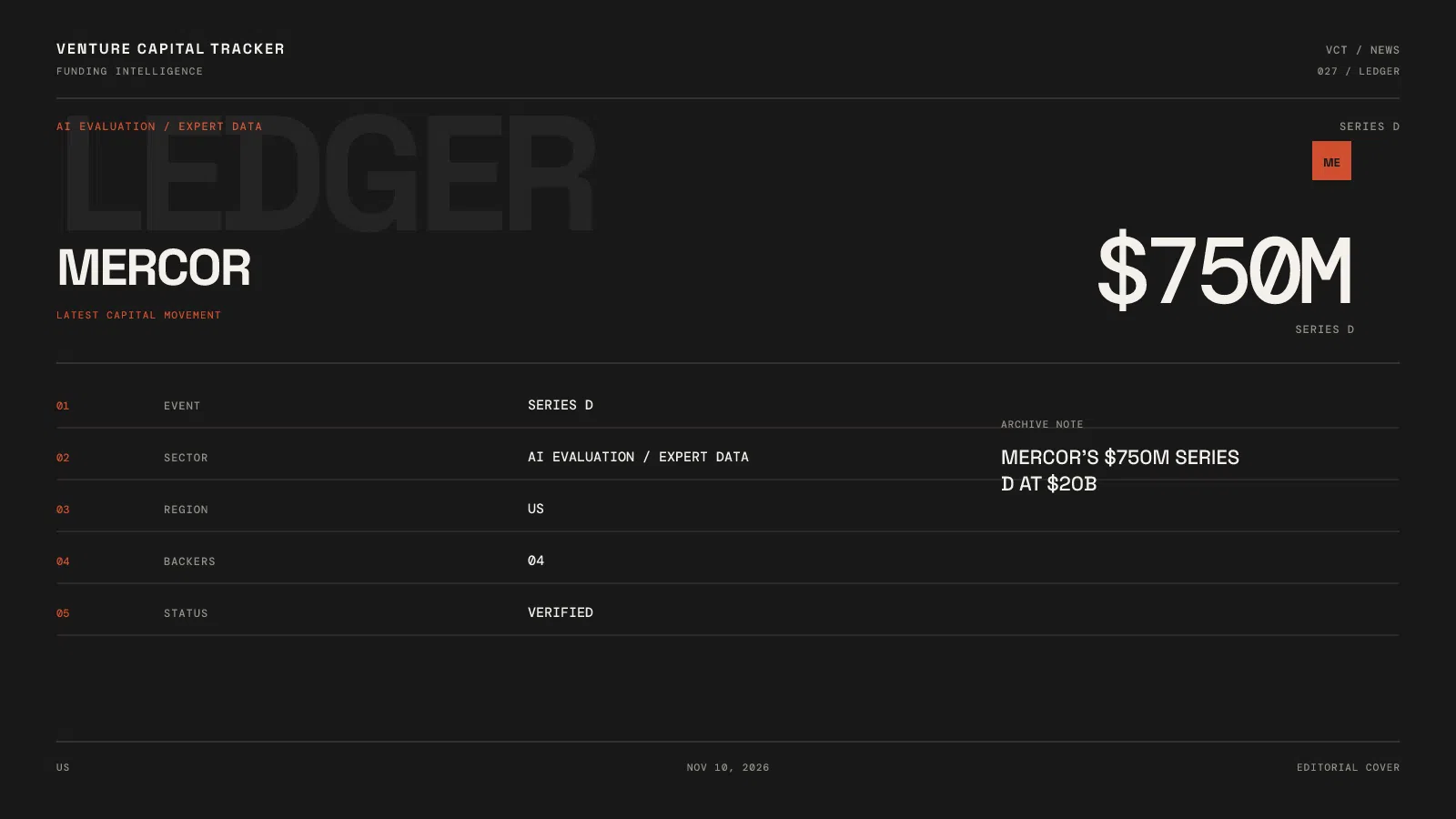
Mercor announced a $750 million Series D at a $20 billion valuation on November 10, 2026. The deal, disclosed by co-founder and CEO Brendan Foody, includes an employee share tender. That distinction matters: the announcement does not disclose how much of the $750 million represents newly issued company shares versus existing shares sold by employees. The same release confirms the $20 billion private valuation that VCT previously classified only as a reported 2026 financing possibility.
Mercor connects specialists with AI labs and is expanding into enterprise AI evaluation and post-training infrastructure. Its announced five-million-plus expert network is a network figure, not five million full-time staff or customers. The company did not identify a lead investor for the Series D or publish audited revenue, a Series D primary/secondary split, or a profitability figure.
Mercor's Series D: the answers at a glance
| Question | Verified answer |
|---|---|
| Announcement | November 10, 2026 |
| Round | $750M Series D, including employee tender |
| Valuation | $20B, company-announced; issuer did not specify pre- vs post-money |
| Named investors | Benchmark, Felicis, Fundomo, Apollo-affiliated funds, G Squared, General Catalyst, Glade Brook Capital, NVIDIA, Salesforce, Sapphire Ventures, StepStone Group, XTX Ventures and Zoom |
| Lead investor | Not identified in the issuer's announcement |
| New money into Mercor | Undisclosed: employee secondary amount not separated |
| Business | Domain experts, AI evaluation datasets, enterprise agent assessments and post-training environments |
| Public pricing and audited profit | Undisclosed |
The November statement is not a report of a signed financing term sheet: it is a direct announcement from Mercor. However, an announced financing amount does not independently establish the transaction's legal closing date, cash already received or individual ownership percentages.
Mercor's funding history, corrected
| Announced | Round | Announced amount | Private valuation | Evidence quality |
|---|---|---|---|---|
| September 2024 | Series A | $30M | Reportedly $250M | Secondary transaction data |
| February 20, 2025 | Series B | $100M, reported | Approximately $2B | Issuer confirms investment and investor lead; amount reported separately |
| October 27, 2025 | Series C | $350M | $10B | Mercor announcement |
| November 10, 2026 | Series D including employee tender | $750M | $20B | Mercor announcement; tender split unknown |
The four amounts add arithmetically to $1.23 billion, but that is a total of headline round amounts, not a verified cumulative $1.23 billion of primary cash raised. The final $750 million includes secondary liquidity, and earlier financing disclosures may not constitute a complete lifetime ledger.
The confirmed valuation doubled from $10 billion in October 2025 to $20 billion in November 2026. Using the reported September 2024 $250 million Series A mark produces an 80× change in stated private valuation, not an 80× shareholder return. Different financings can have different liquidation preferences and capital structures; neither a realized exit price nor an investor-level multiple is disclosed.
What does Mercor actually sell, and who pays?
Mercor began by matching specialized human workers—physicians, engineers, lawyers, accountants and other professionals—to companies developing foundation models. Those workers help create training examples, critique AI responses and measure whether complex professional outputs are correct. AI developers pay for vetted expert work and the operational infrastructure that turns it into repeatable datasets and evaluations.
The new strategy goes further: Mercor is selling company-specific AI-agent evaluations and post-training workflows. An enterprise testing a finance agent needs more than a benchmark showing that the agent can solve abstract accounting questions. It needs to know whether the agent can reconcile a real ledger, respect that enterprise's chart of accounts and authorization rules, flag exceptions and finish the task without making costly errors.
Illustrative five-step buyer journey, based on Mercor's published product descriptions—not independent hands-on testing:
- A buyer selects a concrete workflow, such as resolving supplier invoices, and specifies its applications, permitted tools and quality standard.
- Mercor matches knowledgeable finance and operations specialists to define representative cases, edge conditions and expected outcomes.
- Specialists create and validate task data, rubrics and tests that can expose failures invisible in generic benchmarks.
- A model or AI agent runs through those cases. Simulation environments, including software derived from the acquired Deeptune team, recreate business applications and give the agent opportunities to practice.
- The buyer examines task-level success, errors, intervention rates and cost, then revises prompts, tools or post-training and repeats the evaluation.
What is demonstrated by Mercor's disclosures is the existence of an expert network, its evaluation product direction and the acquisition of a simulation team. They do not establish universal agent productivity gains, model reliability, independently verified enterprise ROI or publicly disclosed pricing.
Why the Deeptune acquisition matters
On July 9, 2026, Mercor announced an agreement to acquire Deeptune. By November, its Series D post described Deeptune as acquired. The team had developed simulated enterprise software environments designed for reinforcement learning—places where agents complete tasks and receive machine-checkable feedback.
A useful evaluation has three layers: a credible representation of the software environment; a professional task with the necessary context; and a verifier that decides whether the agent actually succeeded. Mercor supplies expert-generated tasks and evaluation rubrics, while Deeptune contributes simulated applications.
This is a strategic expansion from selling expert labor to supplying the measurement-and-practice infrastructure enterprise agents need. It also exposes Mercor to engineering costs, software fidelity requirements and competition from customers building their own test environments. Deeptune's purchase price was undisclosed; its earlier financing must not be presented as Mercor's acquisition consideration.
Investors: why NVIDIA, Salesforce and others matter
Mercor named a broad syndicate including existing venture investors Benchmark, Felicis and General Catalyst, alongside NVIDIA, Salesforce, Zoom, multiple investment managers and other funds. The release did not identify a lead. Treating NVIDIA or Salesforce as the lead would be an unsupported inference.
Their presence makes strategic sense without proving an exclusive commercial arrangement. NVIDIA has exposure to model infrastructure and compute demand; Salesforce operates business applications and AI-agent workflows. Mercor's enterprise focus addresses the missing layer between generic model capability and reliable work in company systems. That interpretation is VCT analysis, not a disclosed board mandate, guaranteed partnership or special distribution right.
Revenue and the unit-economics trap
An earlier 2026 media report put Mercor's annualized gross revenue run rate around $2 billion. This is not a statement that Mercor collected $2 billion in audited annual revenue in the last financial year. Nor does it establish retained revenue after payments to domain experts, the margin on evaluation work, free cash flow or operating profit.
Historic media reporting described large contractor payouts as a share of gross billings. Those estimates cannot be used as definitive November 2026 consolidated margins. Similarly, the CEO's statement that Mercor spends three times as much on inference as employee salaries is a business-operating claim; it does not identify total inference spend, payroll or the gross profit generated by this usage.
The key questions for a serious investor or enterprise buyer are whether projects renew, how much is paid to experts, how much evaluation tooling is reusable across customers, and how concentrated demand remains among a small number of frontier-model laboratories.
Mercor versus Scale AI, Turing and Surge AI
| Provider | Core buyer overlap | Important purchasing distinction |
|---|---|---|
| Mercor | Specialist human data, evaluation and agent post-training | Combining expert sourcing with custom business evals and simulated environments |
| Scale AI | Training data, evaluation and enterprise/government AI work | Broad data operations and complex procurement footprint; confirm which specific services are available |
| Turing | Technical talent and expert-driven AI training | Different sourcing, management and workforce-delivery model |
| Surge AI | Reinforcement learning, human preference data and evaluation | Different operating and dataset focus; compare reproducibility and independent quality |
These are overlapping suppliers, not interchangeable products. An evaluation buyer should trial the same realistic workflows and compare task accuracy, verification rigor, expert-review turnaround, sensitive-data handling, cost per accepted output and provider accountability—rather than compare fundraising valuations.
The important unanswered questions
Mercor has not disclosed the primary proceeds of its Series D, the employee tender amount, the Series D lead, the exact valuation basis, profitability, precise public service pricing or a customer-level breakdown of contract renewals. Its 5M+ expert-network claim is not a count of active revenue-generating experts. The company has not established that every enterprise task can be reliably automated.
There are also hard problems beyond a model's benchmark score: private customer data may enter expert workflows; verifiers can reward shallow shortcuts; simulated applications can miss production complexity; and concentrated model-lab customers can renegotiate budgets. Human oversight remains material for decisions involving medical, financial and legal liability.
A concrete security risk, not just a theoretical one: Mercor confirmed that compromised LiteLLM software affected its systems in March 2026. In a June 25 company update, it said an investigation with outside specialists found sensitive information affected for a limited subset of its expert network, and it described customer-data exposure as limited. Wired reported in April that Meta temporarily halted work with Mercor while investigating the incident. Mercor's June post said frontier labs had increased work but did not independently verify Meta's specific resumption status. Claims that attackers stole a particular multi-terabyte volume were not publicly confirmed as forensic findings. Buyers processing sensitive datasets should request concrete security evidence, subprocessor disclosures, incident notifications and isolation guarantees, rather than infer safety from investor backing.
Bottom line: The $20 billion mark is no longer speculation—it is company-announced. The strongest new business thesis is Mercor's shift from expert staffing toward a repeatable enterprise evaluation and training infrastructure. But the $750 million includes secondary sales, and neither the primary financing proceeds nor the recurring software economics are publicly established. See the canonical Mercor company profile for the separate round ledger and investor relationships, or Alumni Ventures' profile for a separately disclosed historical portfolio association.
Last updated:
Editorial note: AI tools assisted with research, structure, or drafting. Venture Capital Tracker retains human editorial responsibility for factual accuracy, relevance, and source quality before publication.