· Venture Capital Tracker · venture-capital
LearnUpon Secures $50M Claret Debt Facility for Agentic Learning
LearnUpon accesses a $50M growth debt facility from Claret Fund IV for product development, expansion and possible acquisitions. Drawdown is undisclosed.
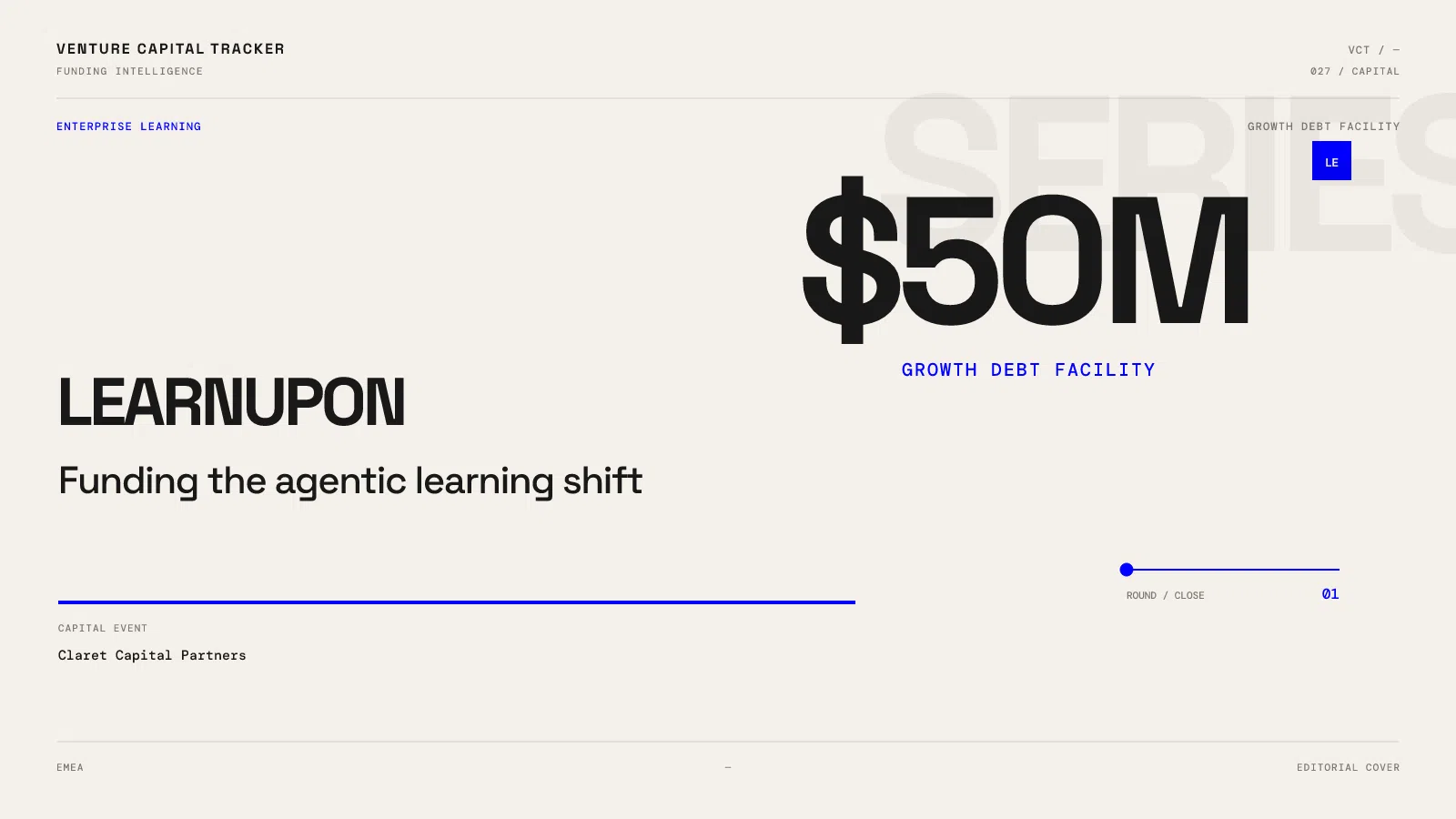
LearnUpon announced access to a $50 million growth financing facility from Claret Capital Partners on October 13, 2026, to support product development, international expansion and potential acquisitions.
This belongs in the debt category. The company announcement calls the capital non-dilutive, and Claret identifies its Fund IV as the funding vehicle. Neither source presents the transaction as a new numbered equity round or discloses a company valuation.
What LearnUpon’s $50M facility provides
A financing facility establishes access to capital under agreed terms. Its announced size does not show how much has already been drawn, when additional borrowing is available or which conditions apply.
The releases do not disclose the interest rate, maturity, repayment schedule, covenants or drawn balance. Those details are necessary to evaluate the cost and practical flexibility of this particular arrangement.
The financing also includes possible acquisitions among its intended uses. That is a capital-allocation option, not evidence that LearnUpon has signed or completed a new acquisition.
The investment backs a shift in enterprise learning
LearnUpon’s Agentic Learning Platform is intended to automate administrative workflows, content curation, skills-related learning and localized delivery. Human teams set goals and guardrails while software agents execute operational tasks.
The investment thesis is that reducing administration can free customers to focus on learning outcomes. However, automating more tasks does not by itself demonstrate that employees learn more, customers adopt products faster or association members renew at higher rates.
A useful commercial assessment would connect the software’s activity to measurable outcomes: time saved after implementation, content-review requirements, learner engagement and the customer’s cost of operating the program.
Debt changes the sequencing of growth
In our analysis, the facility offers a way to fund expansion while preserving ownership compared with issuing new shares. The tradeoff is an obligation to support financing costs and repayment under the actual contract.
That makes the order of investment important. Product development and entering new markets can require spending before returns arrive. An acquisition adds another challenge: integration must preserve customers and cash generation while delivering the expected benefit.
The announcement does not provide enough financial information to independently establish how comfortably LearnUpon can meet those obligations. Claret’s assessment of the business is a lender’s view, rather than a substitute for public financial statements.
Where an enduring product advantage could develop
Learning software is embedded in operating processes, permissions, content and reporting. An agentic platform becomes more valuable if it can work reliably within those constraints and reduce the effort of running training across different audiences.
The practical questions concern governance as much as generation: who approves new material, how errors are corrected, what data agents can access and whether customers can inspect the actions taken on their behalf. These are evaluation criteria, not reports of a failure at LearnUpon.
For growth investors and lenders, customer retention, expansion revenue, implementation effort and cash conversion would help distinguish a durable platform improvement from a short-lived AI feature cycle.
The milestones after the facility
Watch for evidence that faster product delivery and international expansion improve customer economics, along with disclosure of any acquisition actually agreed. Until borrowing details are published, the amount should remain labeled $50 million of facility capacity, with drawdown undisclosed.
See the LearnUpon profile. Compare North.cloud’s equity financing for enterprise software and ID Finance’s mixed equity-and-debt package.
Follow Venture Capital Tracker in Google
Add VCT as a preferred source to make our venture-capital coverage easier to find in Google Search.
Editorial note: AI tools assisted with research, structure, or drafting. Venture Capital Tracker retains human editorial responsibility for factual accuracy, relevance, and source quality before publication.