· Venture Capital Tracker · venture-capital
Intuit Agrees to Acquire Sequence in Reported $200M Deal
Intuit signed an agreement to acquire AI-native revenue platform Sequence. The price is officially undisclosed; media reports put the deal near $200M.
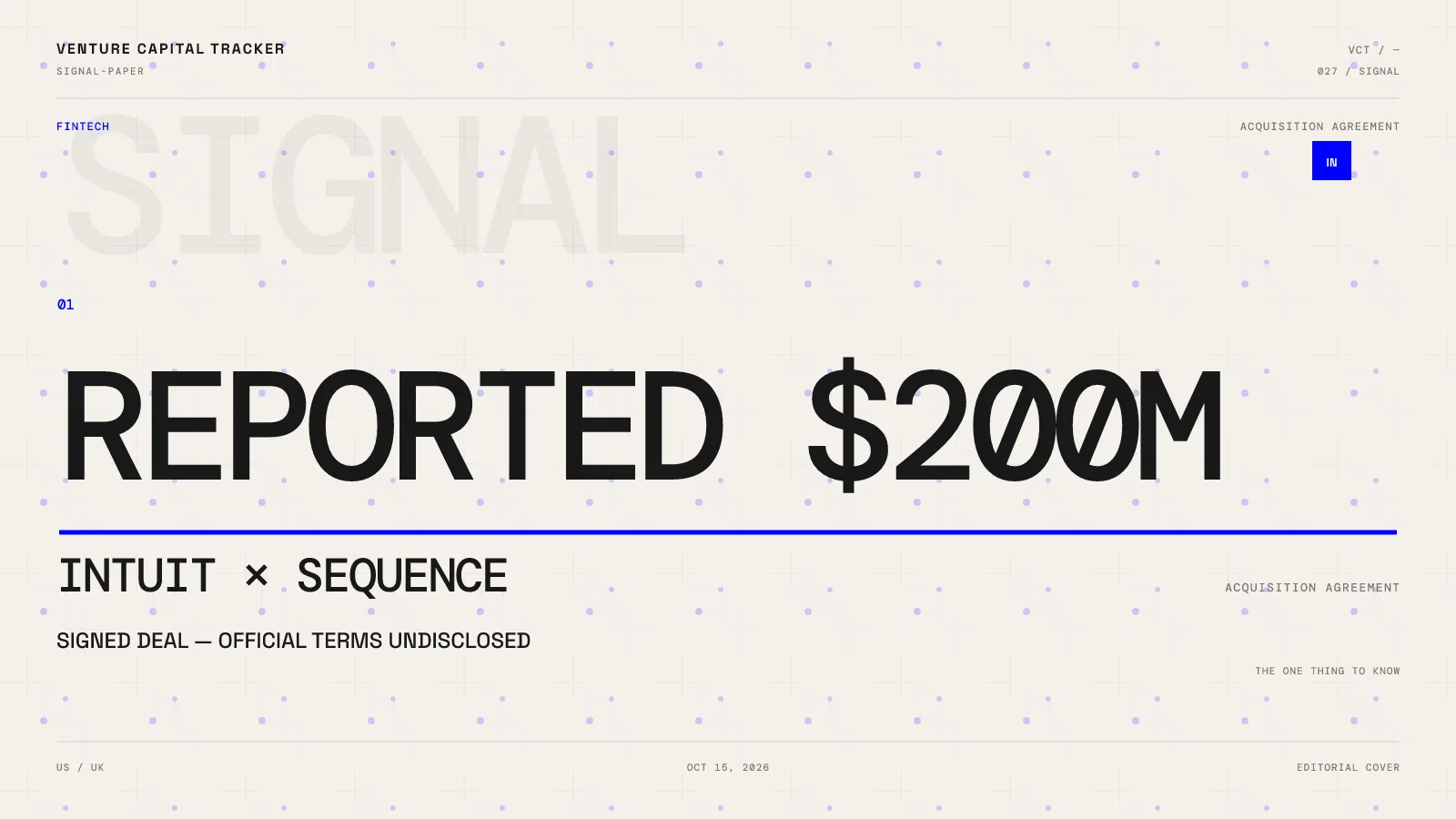
On October 15, Intuit announced a purchase agreement for Sequence, the London- and New York-based revenue-management startup. The purchase price is officially undisclosed. The Times reports that the transaction is worth about $200 million; Tech.eu separately relays that estimate.
This is an acquisition agreement, not a completed acquisition. Intuit says Sequence's team and technology will join after closing, but it has not published a closing date, payment mix or other transaction conditions.
Intuit–Sequence deal at a glance
| Item | Detail |
|---|---|
| Status | Signed acquisition agreement; closing not yet confirmed |
| Reported value | Approximately $200M |
| Official consideration | Undisclosed |
| Target | Sequence, an AI-native quote-to-revenue platform |
| Acquirer | Intuit |
| Sequence funding | $19M seed plus $20M Series A |
| Historical investors | Andreessen Horowitz, 645 Ventures, Passion Capital, firstminute capital and others |
The reported value comes from media sourcing rather than Intuit's announcement. It should not be treated as a confirmed cash price, and no stock component, earnout or retention package has been disclosed.
Why Intuit wants Sequence
Sequence automates the path from a commercial agreement to recorded revenue: deal configuration, pricing, billing, invoicing, collections and revenue recognition. That workflow becomes difficult when a company charges by usage, seats, consumption or project milestones instead of a simple fixed subscription.
Intuit plans to use those capabilities in Intuit Enterprise Suite and QuickBooks Online Advanced. The strategic logic is broader than adding another billing feature. Intuit is trying to move further upmarket, where finance teams often stitch together a CRM, contract tools, metering, invoicing and an ERP. Sequence offers a more unified revenue layer for business-software companies and professional-services firms.
The transaction also gives Intuit an AI-native engineering team. Sequence says its agents automate routine finance work while keeping staff in control. The harder test will be whether that automation remains dependable across contracts with amendments, credits, multiple entities and accounting rules.
What the reported $200M does—and does not—show
Sequence previously disclosed a $19 million seed round led by Andreessen Horowitz and a $20 million Series A led by 645 Ventures. A reported $200 million sale price is a little over five times the startup's disclosed capital raised.
That comparison is not a revenue multiple or an investor return. Sequence has not disclosed current revenue, profitability, dilution, liquidation preferences or the transaction's payment structure. Those missing inputs prevent a reliable calculation of founder or investor proceeds.
The price would nevertheless be material for a Series A company. It suggests Intuit values the combined product, customer relationships and engineering team more than the cost of rebuilding a quote-to-revenue system internally. It may also reflect urgency: usage-based and hybrid pricing are creating accounting complexity faster than legacy ERP workflows can absorb it.
Integration is the real execution risk
Intuit says it will continue supporting Sequence customers and make the startup's capabilities available after closing. It also intends to combine the products over the following months.
That creates three execution questions. First, existing Sequence customers will need product continuity during integration. Second, Intuit must decide how much of Sequence remains a standalone platform versus becoming embedded in QuickBooks and Enterprise Suite. Third, the combined product has to preserve flexibility for complex B2B contracts without importing enterprise-software implementation costs.
Competitor coverage has focused on the reported price and founder outcome. The more durable story is Intuit's product bet: owning the revenue-management layer could help it connect pricing, billing, collections and accounting inside one mid-market system.
Bottom line
Intuit has agreed to acquire Sequence, but the deal is not yet confirmed closed and the approximately $200 million value remains a media report. The strategic case is clear—Sequence fills a revenue-management gap in Intuit's mid-market stack. Whether the acquisition creates lasting value will depend on product integration, customer retention and reliable handling of increasingly complex pricing models.
Editorial note: AI tools assisted with research, structure, or drafting. Venture Capital Tracker retains human editorial responsibility for factual accuracy, relevance, and source quality before publication.