· Venture Capital · 8 sources · Verified
Infisical Raises $40M to Give AI Agents Access Without the Keys
Elad Gil leads Infisical’s $40M Series B at a $600M valuation. We examine credential brokering, preview status and the limits of agent permissions.

By VCT Editorial

Infisical announced a $40M Series B at a $600M valuation on October 27, 2026, led by Elad Gil. Its next expansion centres on a practical AI problem: giving agents access to business systems without putting the real passwords and API keys into the agent’s environment.
The company announcement names Y Combinator, Gradient Ventures, Gallery Ventures, Pace Capital and Dynamic Capital among the participants. It does not specify whether the valuation is pre- or post-money or disclose a primary/secondary split.
What the buyer is paying for
Infisical already sells secrets management, certificate management and privileged access. The buyer is an engineering or security organization responsible for controlling access to infrastructure; an AI agent is a new user of those controls.
Its pricing page offers free and paid plans, with secrets-management subscriptions priced per human or machine identity and enterprise terms negotiated separately. That pricing should not be mistaken for a confirmed Agent Vault tariff: the Agent Vault product page labels the service a preview whose features and pricing may change.
The product uses a forward proxy—a service through which requests travel before reaching an outside system. According to Infisical, the proxy attaches the real credential to an authorized request. The agent can work with a placeholder rather than read the underlying key. Administrators define allowed services, narrow access and expire sessions; actions are logged.
An illustrative use case is a coding agent investigating a production incident. Instead of copying a database password into its files, an operator could grant a limited session for the necessary services. After the investigation, that session expires. The intended benefit is fewer credentials scattered across files, logs and model conversations, alongside a clearer record of access.
This does not make every permitted action safe. An agent with excessive permission could still misuse an allowed service without ever learning its password. The proxy and its configuration also become important security dependencies. These are VCT’s analytical limits on the product proposition, not findings from an independent penetration test.
Why the investors are returning
In Forbes’ original reporting, Gil argues that agents need sufficient permission to work without receiving excessive access. The investor case is therefore broader than hiding keys: enterprises need to control what software acting on their behalf may do.
Infisical says it serves more than 1,300 organizations and has been cash-flow positive. Those are management claims, not audited financial results; customer count does not reveal contract value, retention or profitability.
The financing follows a $16M Series A announced June 7, 2025, also led by Gil, and a $2.8M seed announced July 4, 2023, led by Gradient. Those three disclosures total $58.8M. The new round funds product development and hiring; planned positions are not completed hires.
Related investments, different controls
Token Security’s $20M Series A in January 2025 offers a close identity-security comparison. Its issuer release names Notable Capital as lead and emphasizes discovering and managing non-human identities. Infisical’s Agent Vault instead focuses on brokering access to services. The products address overlapping risks through different control points.
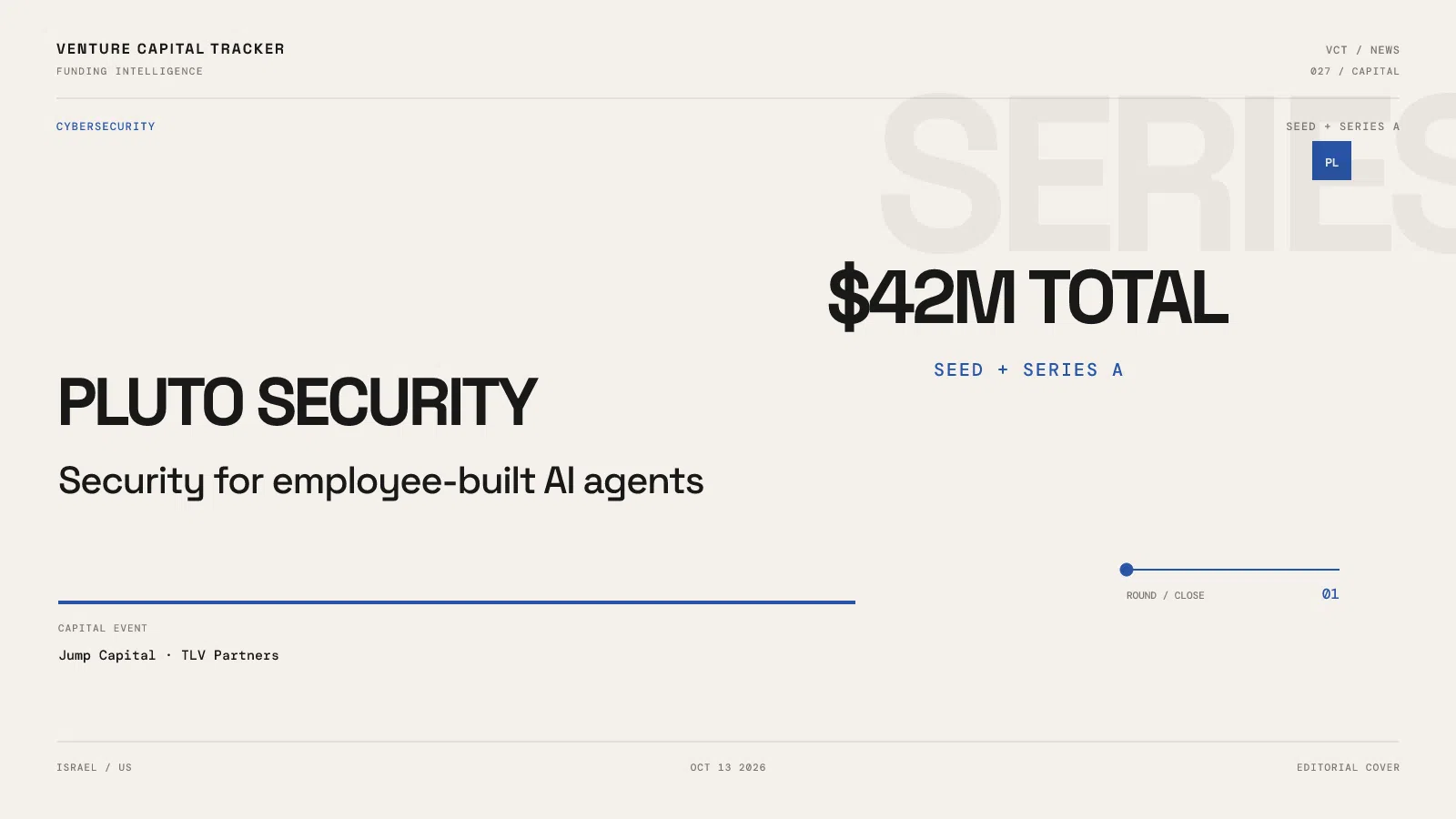
Pluto Security’s financing is adjacent: its investor Jump Capital confirms leading a $33M Series A for security across employee-used AI tools and their components. That is not the same product as a credential proxy.
The commercial test is whether organizations expand paid adoption after deployment, with manageable support costs and effective restrictions. Keeping a password out of an agent’s context is useful; controlling the actions that password authorizes is what makes the system worth trusting.
Follow Venture Capital Tracker on Google
Add VCT as a preferred source to see more of our venture-capital reporting in Google Search.
Editorial note: AI tools assisted with research, structure, or drafting. Venture Capital Tracker retains human editorial responsibility for factual accuracy, relevance, and source quality before publication.