HyLight Raises €13M Series A to Scale Autonomous Inspection Airships
HyLight raised €13 million to grow a fleet of hydrogen-powered autonomous airships that inspect power lines, pipelines and railways.
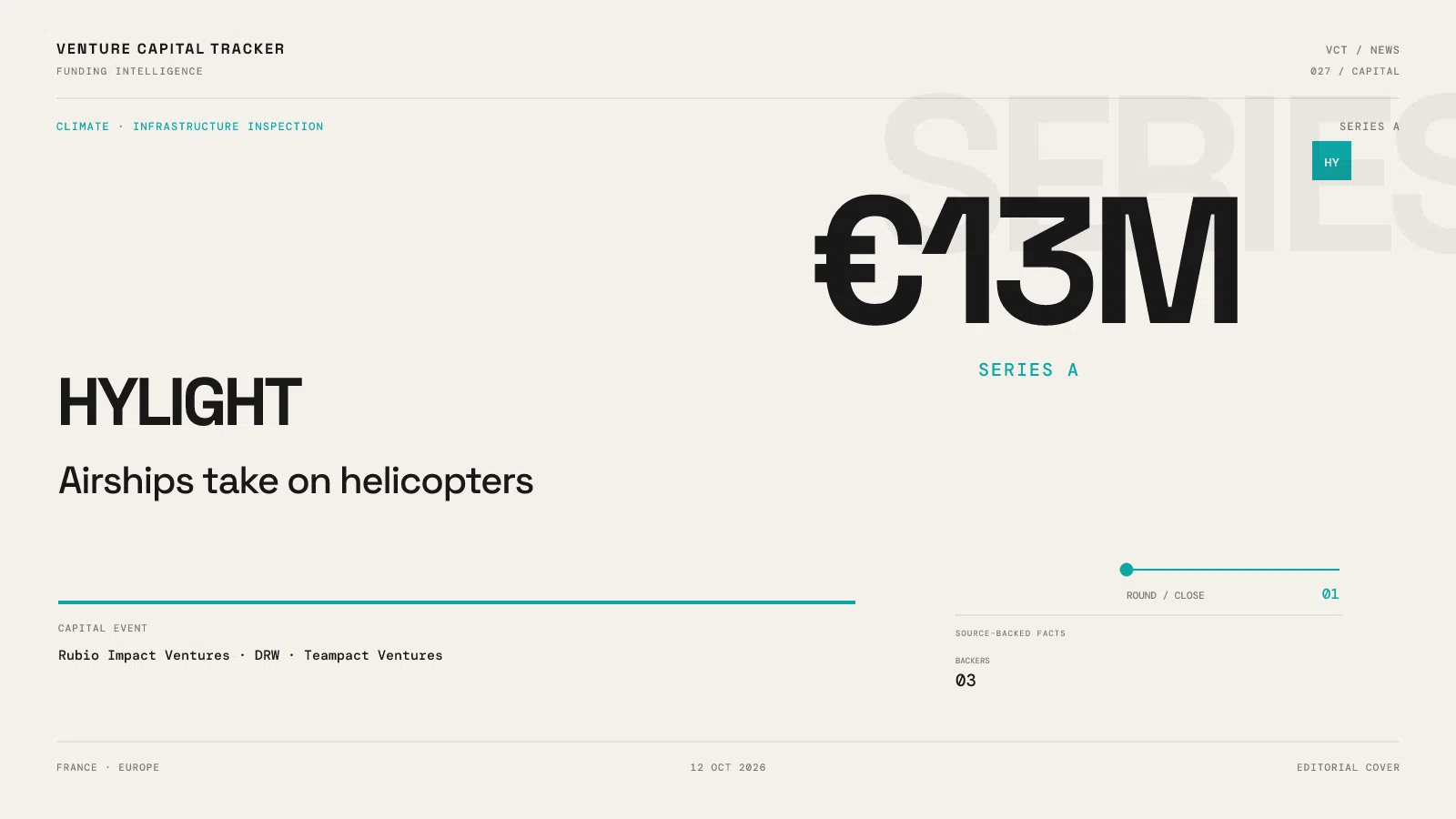
French aviation startup HyLight has raised €13 million in Series A funding to industrialise its hydrogen-powered autonomous airships and expand infrastructure-inspection operations across Europe.
Rubio Impact Ventures led the financing, with DRW and Teampact Ventures participating alongside existing investors Y Combinator and Ring Capital. The valuation was not disclosed.
The deal at a glance
| Item | Detail |
|---|---|
| Financing | Series A equity |
| Amount | €13 million |
| Lead investor | Rubio Impact Ventures |
| Other investors | DRW, Teampact Ventures, Y Combinator, Ring Capital |
| Product | Autonomous airships and inspection-data software |
| Target fleet | 15 HyLighters by 2027, up from four |
A different answer to long-range inspection
HyLight's 12-metre HyLighter aircraft uses helium for lift and a hydrogen fuel cell to power electric motors. It can carry cameras, LiDAR and methane sensors over power lines, railways and pipelines, while software converts the captured data into geolocated maintenance findings.
The company is not trying to replace every inspection technology. Its target is the gap between helicopters, which offer range and payload but carry high cost and emissions, and conventional drones, which often face endurance and regulatory limits. Satellites cover large areas but cannot always deliver the precision or timing required for asset-level inspection; fixed sensors only monitor selected points.
HyLight says its aircraft have completed more than 750 flight hours and inspected thousands of kilometres for customers including Enedis, NaTran, Téréga, SNCF Réseau and VINCI. Those are company-provided metrics, but the named deployments give the round a more commercial footing than an aircraft-development story alone.
The capital will test fleet economics
The Series A will fund aircraft industrialisation, automated data analysis and a European data infrastructure. HyLight plans to expand from four aircraft to 15 by 2027.
That target turns manufacturing and fleet utilisation into the central investment case. An inspection aircraft produces value only when it is flying paid missions, and HyLight manufactures and operates its own fleet. The company therefore has to manage aviation certification, hydrogen logistics, maintenance, trained operators, weather constraints and customer scheduling while continuing to improve its software.
A larger fleet can create operational leverage if aircraft and crews are deployed consistently across recurring inspection routes. It can also consume cash quickly if procurement cycles are slow or aircraft sit idle.
Regulation is an asset and a constraint
HyLight says the HyLighter is authorised by French aviation regulator DGAC and the European Union Aviation Safety Agency for beyond-visual-line-of-sight operations over critical infrastructure. Such permissions can become a barrier to entry, particularly around sensitive assets and populated areas.
But aviation approval is not a one-time moat. Scaling across countries can require new operating permissions, documentation and local coordination. Customers in energy and transport also demand reliability, cybersecurity and auditability from the data platform layered on top of the aircraft.
Where the competitive advantage could form
The hardware is visually distinctive, but the longer-term advantage may sit in the inspection dataset. Repeated flights over the same assets can help HyLight automate defect detection, change monitoring and maintenance prioritisation.
That creates a two-part model: aircraft provide proprietary data collection, while software turns the observations into recurring operational value. If customers begin to depend on longitudinal asset histories, the relationship can become harder to displace than an individual inspection contract.
The risk is that better long-range drones or lower-cost helicopter services narrow the operational gap before HyLight achieves sufficient scale. The company must prove that its airships are not merely cleaner, but more economical and dependable across a full inspection season.
What to watch next
The most useful milestones will be the number of aircraft in commercial service, paid kilometres inspected, utilisation per aircraft, renewal rates and the proportion of revenue generated by recurring data products. Reaching 15 aircraft matters; demonstrating that those aircraft produce repeatable gross margins matters more.
Follow Venture Capital Tracker in Google
Add VCT as a preferred source to make our venture-capital coverage easier to find in Google Search.
Editorial note: AI tools assisted with research, structure, or drafting. Venture Capital Tracker retains human editorial responsibility for factual accuracy, relevance, and source quality before publication.