· Venture Capital Tracker · venture-capital
Hone AI Raises $60M Seed at a $285M Valuation
Benchmark and Index Ventures led Hone’s $60 million seed round. The five-month-old enterprise-agent startup is valued at a reported $285 million.
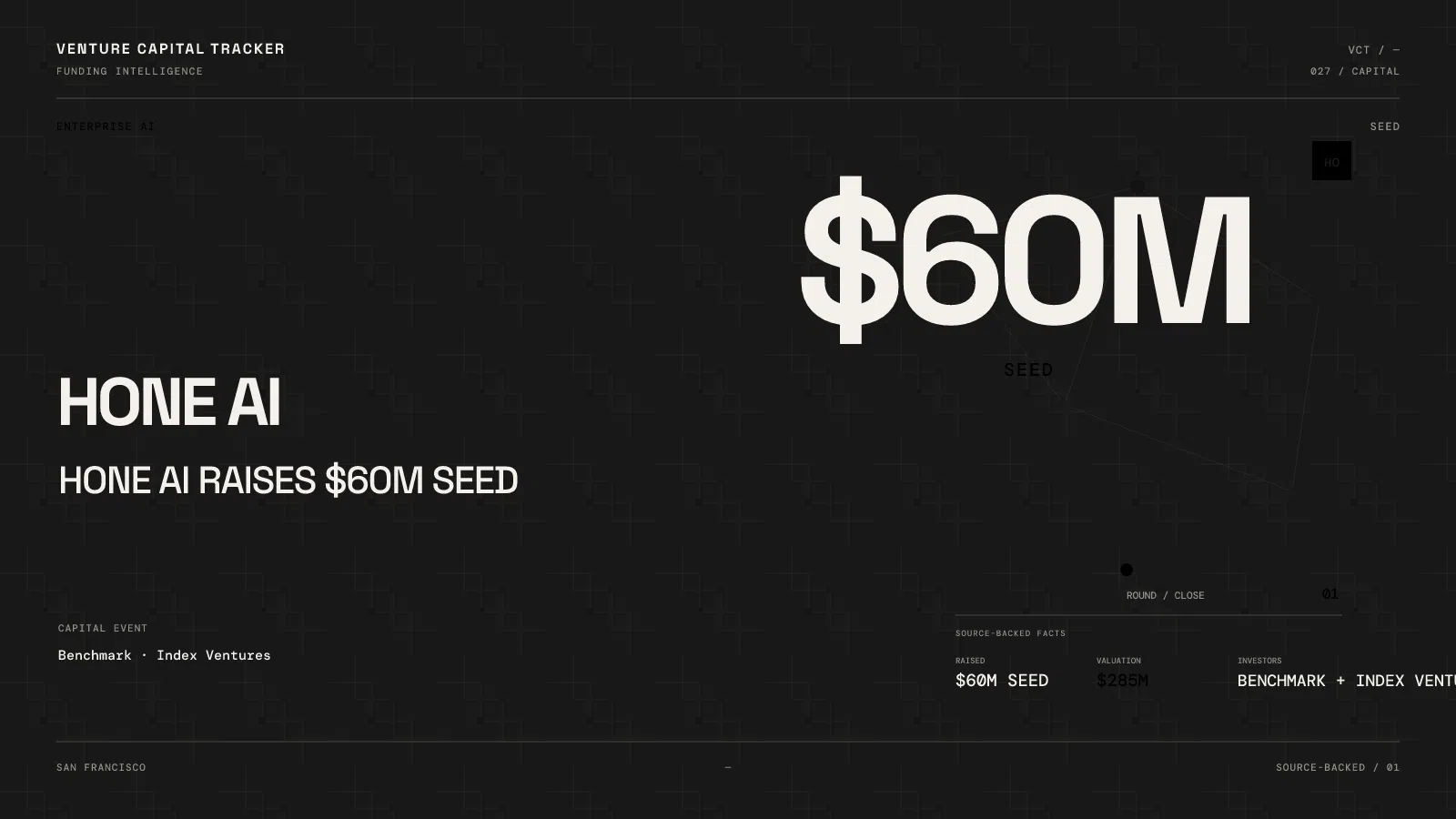
Hone has raised a $60 million seed round led by Benchmark and Index Ventures to develop persistent enterprise AI agents that it calls “Engines.” The five-month-old San Francisco company says the software is designed to own a business outcome over weeks or months, rather than wait for prompts or complete isolated tasks.
Hone’s launch announcement confirms the round and the two lead investors. Bloomberg reports that the financing values Hone at $285 million. That valuation is not stated in Hone’s own announcement, so it should be treated as reported rather than company-filed transaction data.
The financing at a glance
| Item | Detail |
|---|---|
| Financing type | Seed equity |
| Amount | $60 million |
| Valuation | $285 million, reported by Bloomberg |
| Lead investors | Benchmark and Index Ventures |
| Other reported participants | Elad Gil, Hanabi, Definition, Diffusion, Lux Capital, SV Angel and Align |
| Headquarters | San Francisco |
| Product | Persistent enterprise AI agents called Engines |
| Announced | October 8, 2026 |
A $60 million seed round is unusual even in the current AI market. It gives Hone enough capital to build enterprise infrastructure, recruit expensive technical talent and support long deployments. It also prices in a substantial amount of execution before the company has disclosed revenue, annual recurring revenue, customer retention or gross-margin data.
At the reported valuation, the new capital equals roughly 21% of post-money value. That is not a cap-table calculation—round structures and secondary components were not disclosed—but it illustrates how aggressively the deal has been priced for a company at the start of commercial development.
What Hone means by an AI “Engine”
Hone is deliberately drawing a line between chatbots, task-oriented agents and its Engines. A chatbot answers a question. An agent performs a job. An Engine is assigned a goal—improve customer retention, reduce procurement cost or increase qualified sales pipeline—and is expected to keep working after an individual interaction ends.
The product is designed to onboard into a company by learning its systems, people, history and constraints. It then builds routines and specialist agents, works with employees through tools such as Slack, Teams and email, and evaluates whether its actions are moving the target metric.
That positioning matters because enterprise AI is shifting from seat-based copilots toward software that attempts to replace or coordinate workflows. The economic promise is larger: vendors can argue that they should be paid for business value rather than user access. The operating risk is larger too, because persistent agents touch more systems, retain more context and make more decisions than a conventional assistant.
Hone says its controls include versioned routines, simulation against historical cases, fine-grained permissions, action logs and human approval for sensitive decisions. The company also says customer data is not used to train models and that deployments can run in Hone’s cloud or inside a customer-controlled environment.
Those safeguards are part of the product, not merely a compliance layer. A system that continues acting for weeks must show how it reached a decision, where its authority ends and what happens when the organization changes faster than its memory.
Why Benchmark and Index are funding the outcome layer
Hone’s founders have experience across Cognition, Mercor, Ramp and Stanford AI research. Chief executive Moritz Stephan previously worked at Cognition, where the Devin coding agent helped establish a market for software that performs multi-step work rather than generating suggestions.
The investment thesis appears to extend that model beyond software engineering. If coding agents can own a backlog item, Hone argues that persistent agents can own commercial or operational metrics. Its website cites early deployments with AI companies including Cognition and Modal, alongside use cases in revenue, procurement, risk, product and operations.
This is also a bet on where durable value sits in the AI stack. Frontier models are improving quickly and are available to many application companies. Hone is not trying to win by training a general-purpose model. Its prospective moat is the organizational memory, evaluation data, workflow integration and trust accumulated as an Engine operates inside a customer.
That can compound if deployments deepen. It can also become expensive professional-services work if every customer requires a bespoke implementation. The key question is whether Hone can turn company-specific learning into a repeatable software product without erasing the customization that makes an Engine useful.
The $285 million valuation raises the proof threshold
The reported valuation is nearly five times the new capital. For investors, that price suggests confidence in the founders, the market and the possibility that a persistent agent becomes a system of record for how work is performed.
For Hone, it creates three near-term proof points:
- Measurable outcomes. The company will need controlled evidence that an Engine changes revenue, cost, risk or cycle time—not only that it completes tasks.
- Deployment economics. Long integrations and human oversight can make gross margins look more like consulting than software. Repeatable onboarding is essential.
- Safe autonomy. Simulation and approvals must work under real permissions, changing data and adversarial inputs. An audit trail is useful only if customers can interpret and act on it.
There is a fourth issue: attribution. Business results rarely have a single cause. If pipeline improves after an Engine changes lead routing, sales staffing and pricing may have changed too. Outcome-based AI will need credible baselines and counterfactual evaluation, especially when pricing is linked to claimed value.
Hone’s own research emphasizes simulation as a mechanism for testing self-improving agents before they act. That is directionally important, but historical replay is not a perfect proxy for a live organization. Policies, customers and competitors change. The strongest deployments will combine simulation with limited scopes, human escalation and continuous measurement after release.
A crowded enterprise-agent market
Hone is entering a market that already includes horizontal agent platforms, workflow-automation incumbents and vertical AI applications. Sierra is building customer-service agents. Glean is extending enterprise search into agents. Microsoft and UiPath can distribute agent-building and orchestration through existing enterprise relationships. Specialists are targeting sales, legal, finance, procurement and security.
The company therefore cannot win on the generic promise of “AI agents for work.” Its differentiation is the claim that a persistent system can take responsibility for a metric across functions while remaining governable.
That claim also explains why the product name matters. “Hone AI” is easily confused in search with Hone, the older corporate-learning platform. The new company’s official domain is hone.com, and its product is called Engines. Customers, researchers and investors should verify the domain when comparing funding records or product claims.
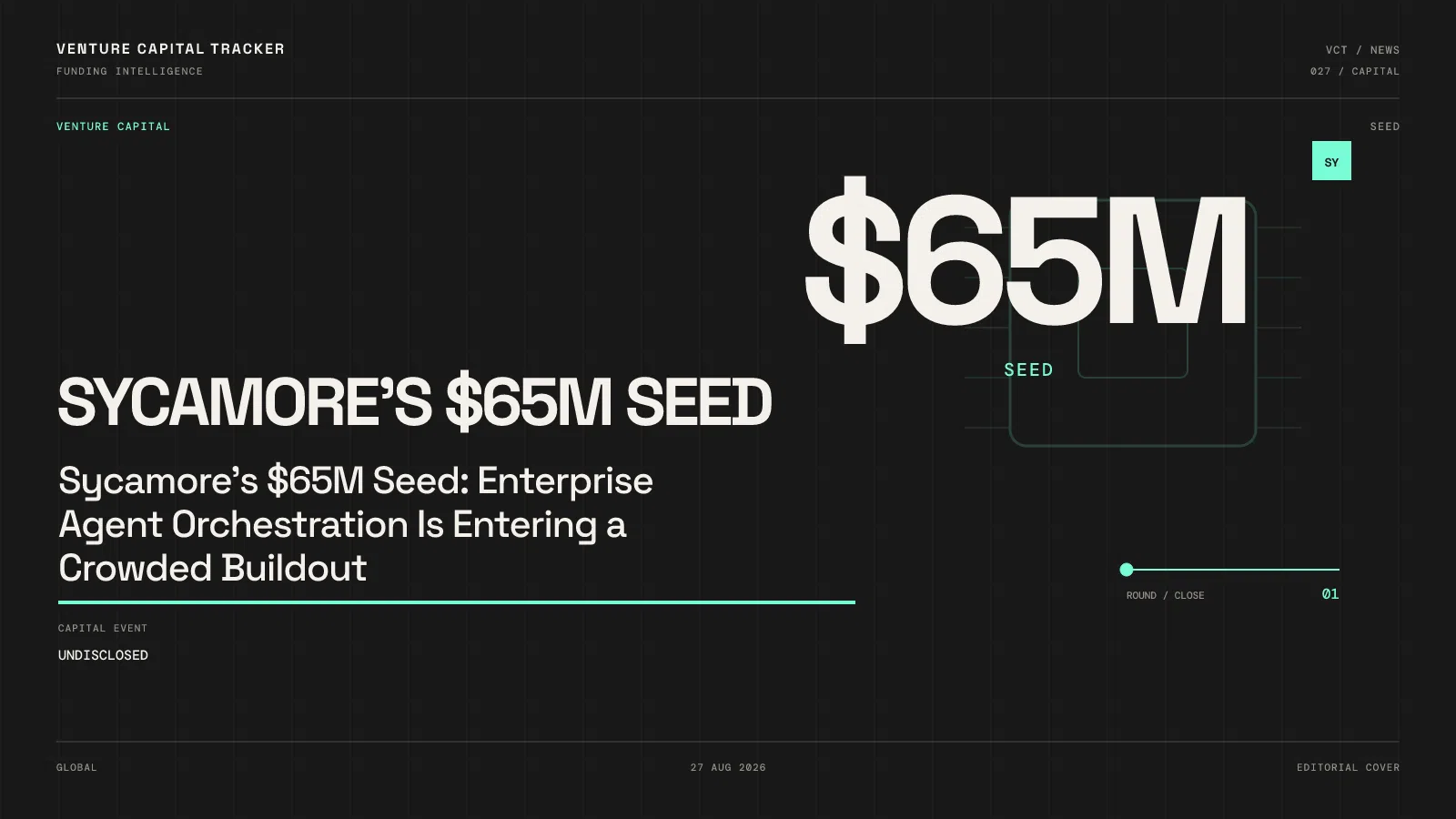
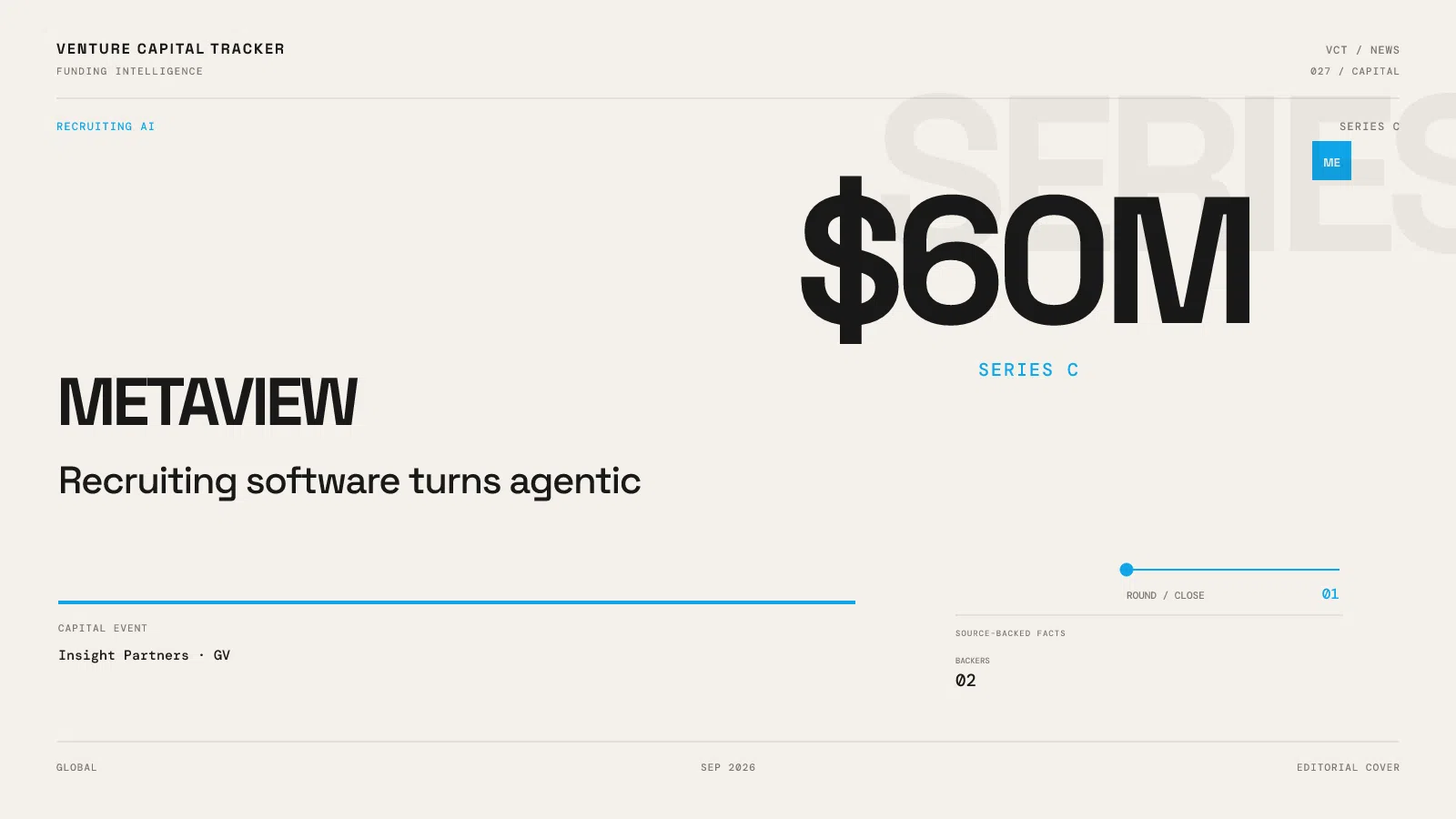
For context, VCT has also covered Sycamore’s $65 million seed for enterprise-agent orchestration and Metaview’s $60 million Series C in agentic recruiting software. Hone is earlier than both but is asking investors to underwrite a broader, cross-functional platform from the start.
What to watch next
The financing is a confirmed seed close, not a debt facility, grant or acquisition. Benchmark and Index are the company-confirmed lead investors. Additional participants have been reported by deal-data sources, but Hone’s public launch post does not enumerate them.
The next material disclosure should be commercial rather than promotional. Useful evidence would include the number of production deployments, time to go live, customer expansion, retention, gross margin and a documented outcome measured against a baseline.
Hone has enough capital to attempt an ambitious product. The investment case now depends on whether “owning outcomes” becomes a repeatable software category—or remains a compelling label for heavily supervised automation.
- ai-agents
- agentic-ai
- enterprise-ai
- +2 more
Editorial note: AI tools assisted with research, structure, or drafting. Venture Capital Tracker retains human editorial responsibility for factual accuracy, relevance, and source quality before publication.