· Venture Capital · 6 sources · Verified
Foundry Robotics Raises $100M for Flexible Autonomous Factories
Foundry Robotics raised a $100M Series A to own and operate flexible assembly factories. The model, tradeoffs and closest funded comparisons explained.

By VCT Editorial
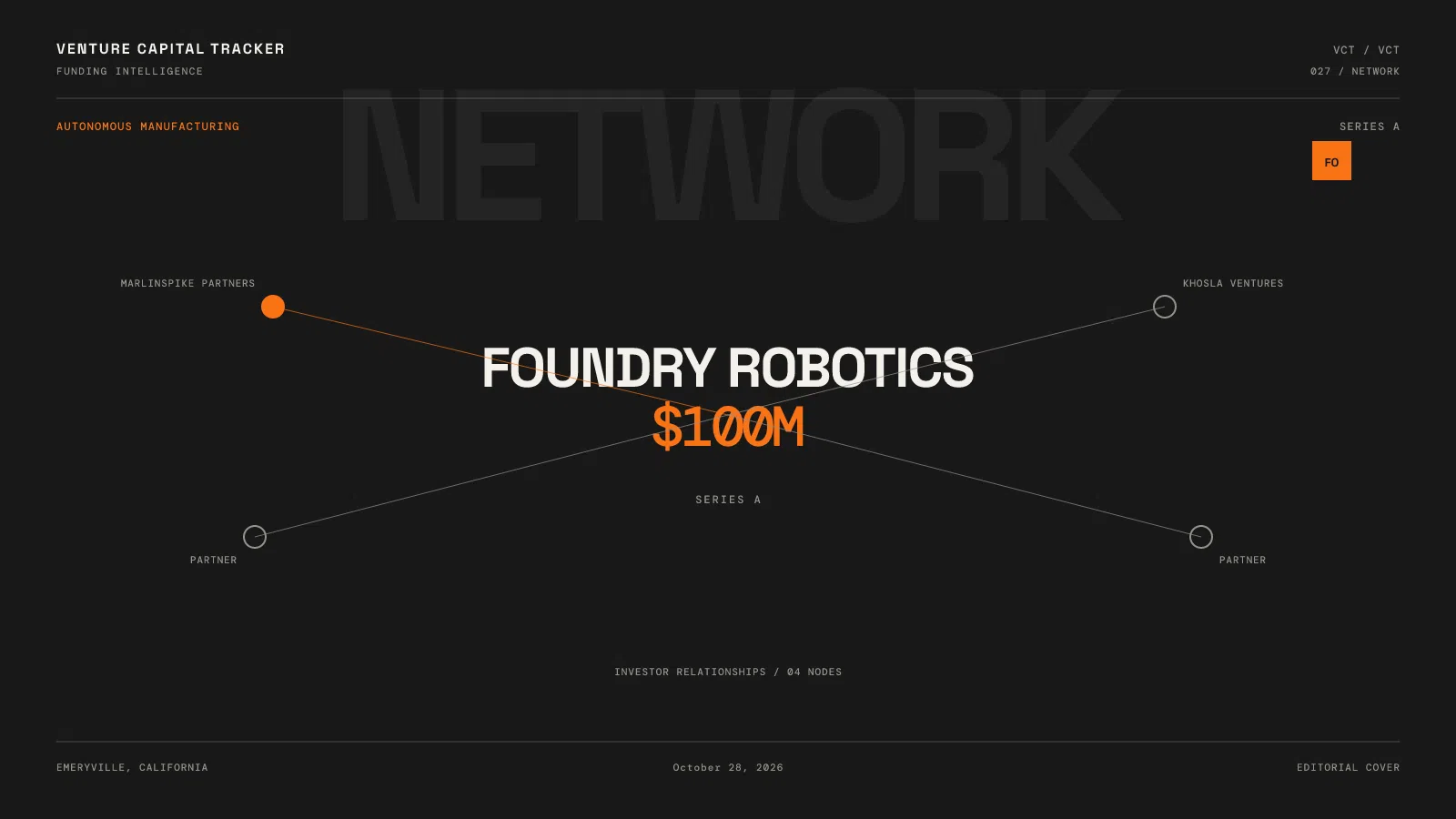
Foundry Robotics raised a $100 million Series A less than a year after its founding, an unusually large early round for a company that owns physical factories rather than selling software alone. Marlinspike Partners led the financing, with Khosla Ventures, Red Glass Ventures, SE Ventures, Wing VC, Axiom Ventures, Hanabi and Zero Shot Fund participating. The bet is that flexible robotic assembly can relieve a real constraint in defense and industrial hardware: production capacity that cannot change as quickly as product designs do.
The October 28 company announcement describes the round as oversubscribed but does not disclose a valuation, revenue, pricing, round composition or total capital raised. Foundry says it will use the money to build out a 130,000-square-foot Emeryville, California, facility and hire across robotics, engineering and factory operations.
What Foundry sells
Foundry is a contract manufacturer with a technology layer. It owns and operates the factory, while customers pay it to assemble complex products. The target markets include defense, aerospace, energy, autonomous vehicles and telecommunications.
The practical difference appears before production starts. A hardware company would ordinarily design a dedicated line, buy equipment, hire an integrator and then retool when the product changes. Foundry offers manufacturing as a service: the customer sends a design, and Foundry assigns work to modular robotic cells supported by human technicians. The company says this can move a product from design to production in weeks without the customer funding a new line.
FoundryOS connects the robots, factory floor and cloud. Its cells are trained around assembly skills such as fastening, cabling and precise placement, rather than one finished product. Production data then feeds back into the models. In an interview with The Information, CEO Adarsh Kulkarni gave the deliberately broad example of building drones, batteries and satellites on different days.
That flexibility has limits. Kulkarni acknowledged that a specialized line remains more efficient for mass production, and that AI-powered robots still struggle with some micron-level work. Foundry uses human technicians for tasks the robots cannot yet perform. The model is therefore best understood as flexible capacity for complex, changing products—not a universal replacement for high-volume plants.
Why investors are backing capacity now
Marlinspike says Foundry addresses an urgent shortage of domestic assembly capacity. That fits the firm's published focus on technologies that serve national-security needs and large commercial markets. Khosla Ventures founder Vinod Khosla told The Information that factories closer to demand must become more responsive and capital-efficient if the United States is to compete with lower-cost production abroad.
The strongest customer signal in the announcement comes from HII Unmanned Systems. President Duane Fotheringham called production capacity a national constraint on getting unmanned systems to the fleet. The statement supports the existence of a bottleneck, though the release does not identify a contract value, production volume or delivery schedule. The Information reports that Foundry is already shipping products to a handful of paying customers; the company has not named most of them.
The economics are more demanding than the software language suggests. Foundry must finance facilities, equipment, technicians and working capital before a flexible factory reaches steady utilization. It also carries quality and delivery risk. Owning the environment may let Foundry retain more production data than a robot vendor deployed inside a customer's plant, but the advantage matters only if learning lowers labor, changeover and defect costs across programs.
The closest financed comparisons
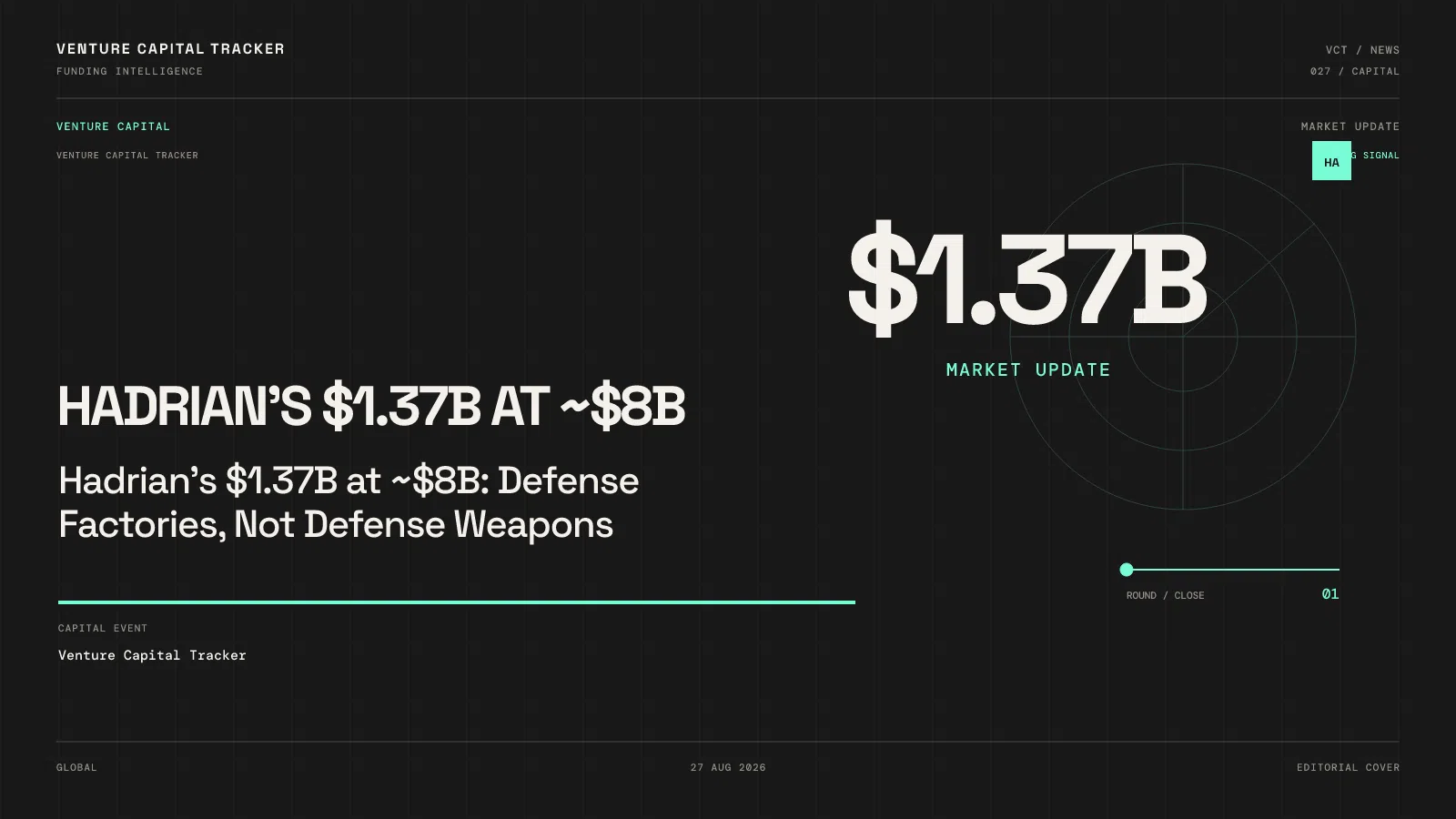
Hadrian's July 2025 financing put $260 million of Series C capital plus a factory-expansion loan behind automated U.S. manufacturing. Hadrian spans precision parts, assemblies and full products for aerospace and defense; its factories-as-a-service model is the closest broad comparison. VCT later covered Hadrian's much larger 2026 growth financing, showing how heavily investors are funding owned industrial capacity once it reaches scale.
Machina Labs raised $124 million in February 2026 to build a large intelligent factory for metal structures. It overlaps in software-defined production, but focuses more narrowly on forming advanced metal components.
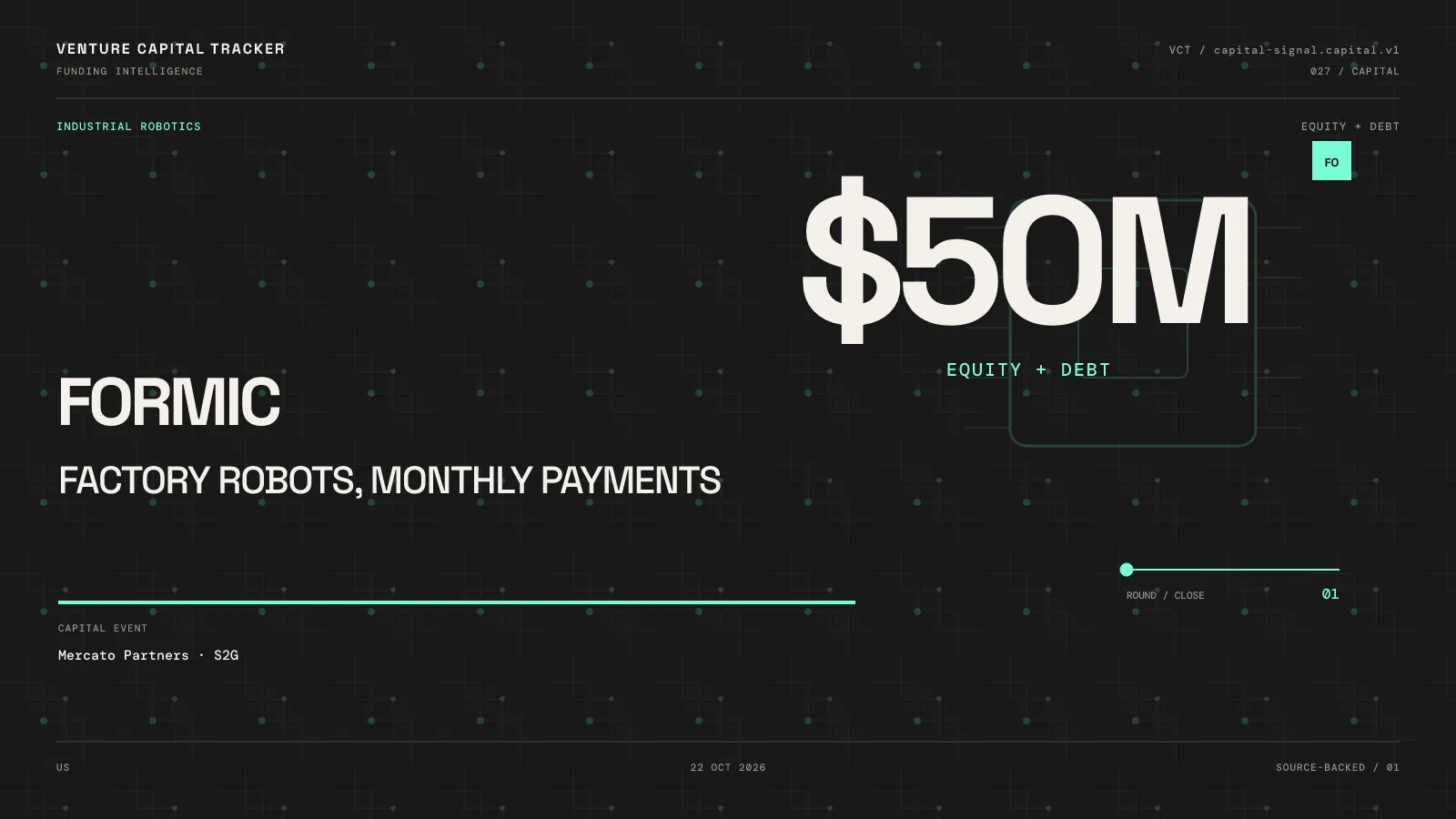
Formic's recent $50 million equity-and-debt package is an adjacent service-model comparison. Formic installs and services robot systems at customer facilities through subscriptions; Foundry owns the factory and sells output capacity. The distinction changes the capital burden, data rights and operational risk.
Foundry's round says more about the market than its maturity. Capital is moving toward companies that combine robotics software with real production assets because industrial customers need throughput, not demonstrations. The measures that will determine whether this Series A was early conviction or excess will be facility utilization, on-time yield, changeover time, repeat orders and gross margin after labor and equipment costs. Foundry has not disclosed those numbers yet.
Follow Venture Capital Tracker on Google
Add VCT as a preferred source to see more of our venture-capital reporting in Google Search.
Editorial note: AI tools assisted with research, structure, or drafting. Venture Capital Tracker retains human editorial responsibility for factual accuracy, relevance, and source quality before publication.