· Venture Capital · 4 sources · Updated · Verified
Different Raises $48M Seed for AI-Run B2B Marketing
Different emerged from stealth with a $48M seed led by General Catalyst. The real test for its AI-run B2B marketing system is attributable pipeline, governance, and retention.

By Venture Capital Tracker
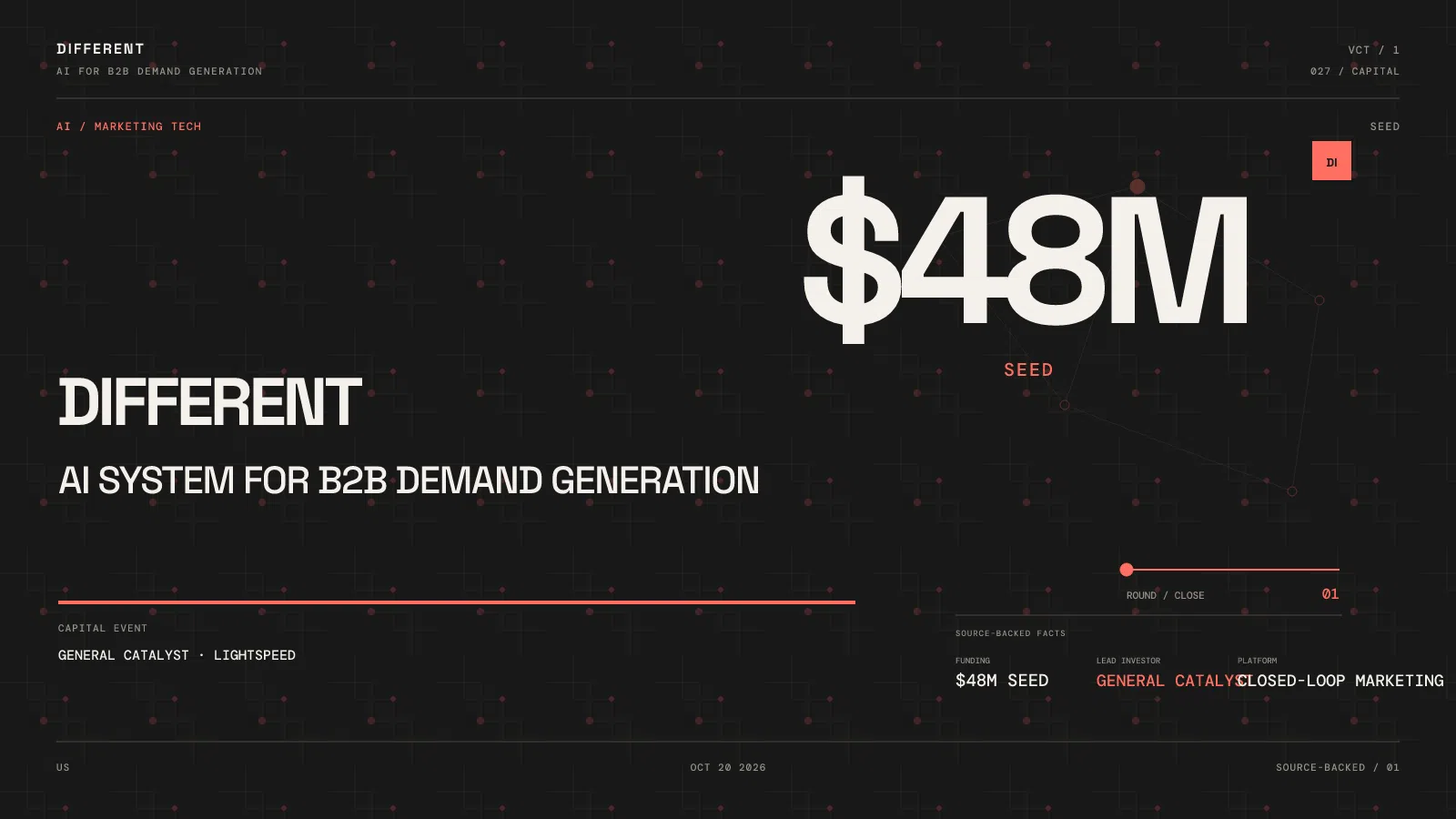
Different has emerged from stealth with $48 million in seed funding to build what it calls an AI system for B2B demand generation. General Catalyst led the equity round. Lightspeed Venture Partners, Together Fund, Haystack, MXV Capital, and Firebolt Ventures also participated.
The financing is confirmed by the company and its distribution release. Different did not disclose a valuation or the exact legal closing date. No debt facility, grant, acquisition, or secondary component was announced.
The round at a glance
| Item | Detail |
|---|---|
| Company | Different |
| Financing | Seed equity |
| Amount | $48 million |
| Lead investor | General Catalyst |
| Other investors | Lightspeed Venture Partners, Together Fund, Haystack, MXV Capital, Firebolt Ventures |
| Headquarters | San Francisco, California |
| Product | AI system for end-to-end B2B demand generation |
| Valuation | Undisclosed |
| Announced | October 20, 2026 |
The headline number matters because $48 million is unusually large for a seed round. It gives Different room to build integrations, control layers, and a go-to-market organization before the market has independently validated the product at scale. That makes the financing both a substantial vote of confidence and a demanding benchmark: the business will eventually need to prove that its software creates more attributable pipeline per dollar than a conventional marketing stack, agency, or enlarged internal team.
What Different is building
Different says its system is designed to take a B2B marketing program from strategy through execution and optimization. The product covers paid advertising, outbound email, landing pages, campaign monitoring, and budget allocation. Human users can approve material actions rather than handing every decision to the software.
That scope distinguishes the pitch from a narrowly defined copywriting assistant or workflow plug-in. Different is trying to own a closed loop:
- select accounts and define a campaign;
- create the assets and channel plan;
- launch across advertising, email, and landing pages;
- measure response and pipeline signals; and
- change messaging, targeting, or spend based on the results.
The company was founded by Ajeet Singh, Abhishek Pani, and Abhinav Yajurvedi. Their backgrounds span enterprise software, machine-learning applications in marketing, and large-scale consumer technology. That experience is relevant because the challenge is not merely generating content. The system must connect to business data, operate safely across multiple platforms, and make decisions that marketers can inspect and reverse.
Why investors may be underwriting a system, not a feature
Many marketing AI products accelerate one task: produce a draft, summarize a call, score an account, or generate an advertisement. Different is pursuing a broader operating layer. If it works, the economic value would come from coordination—fewer handoffs, faster experimentation, and a shared feedback loop—rather than from cheaper content alone.
That thesis helps explain the size of the seed financing. Building a system of action is more capital-intensive than releasing a single-purpose application. It requires integrations, permissioning, data quality controls, evaluation infrastructure, and support for the different ways companies define qualified pipeline.
The financing also reflects a category bet. General Catalyst and the other investors are backing the possibility that B2B marketing work becomes organized around AI agents that execute campaigns under human supervision. The round does not by itself prove that Different has product-market fit. It gives the company the resources to run that experiment at meaningful scale.
Early customer evidence is promising—but company-reported
Different cites early use cases from Descope and Motif. According to the company, its system helped Descope identify paid spending that could be redirected, and two marketers ran seven programs reaching 2,800 accounts. Different also says a three-person Motif team ran and optimized more than a dozen campaigns across four channels in a month.
These examples indicate the kind of operating leverage Different wants to sell. They should not be treated as independently audited performance data. The stronger test is whether the programs generated incremental qualified pipeline and revenue after accounting for media spend, software cost, sales capacity, and the campaigns that would have converted anyway.
Activity metrics can be misleading in marketing software. More campaigns, more accounts reached, and more assets created are useful only when they improve business outcomes. Buyers should look for controlled comparisons, consistent attribution rules, conversion quality, sales acceptance, and retention over several quarters.
The central question is attribution
A closed-loop marketing system can optimize only what it can observe. In B2B sales, the path from an advertisement or email to revenue may span months and involve multiple people, channels, and offline interactions. CRM data can be incomplete. Account identities may be difficult to resolve. A late-stage opportunity can be incorrectly credited to the campaign that touched it most recently.
Different’s long-term advantage will therefore depend less on how fluently it creates content and more on how rigorously it connects actions to outcomes. A credible product should disclose which signals it optimizes, how it handles sparse or delayed conversions, and when the system lacks enough evidence to change a budget.
For investors, the most important operating metrics are likely to include:
- incremental pipeline and revenue influenced per marketing dollar;
- time from campaign brief to launch;
- percentage of suggested actions accepted by human operators;
- customer retention and expansion;
- gross margin after model and integration costs; and
- performance across several industries and sales cycles.
A crowded competitive map
Different competes across several layers rather than against one obvious peer.
HubSpot and Salesforce have broad customer relationships, embedded data, and distribution. Both can add native AI features to existing marketing workflows. Their advantage is incumbency; their weakness can be fragmented products and slower redesign around an AI-first operating model.
6sense is adjacent through account-based marketing, intent data, and revenue orchestration. It already helps companies decide which accounts to pursue. Different’s claim is broader execution across the demand-generation loop.
AI-native workflow companies such as Gradial compete more directly for automated marketing operations. Point solutions in content, outbound, analytics, and media optimization may also assemble into an alternative stack.
Different’s defensibility will not come from access to foundation models alone. Durable advantages could emerge from integration depth, proprietary feedback data, reliable measurement, workflow adoption, and governance that gives larger companies confidence to let the system act.
Governance is part of the product
Automating demand generation creates operational risks. The system may have access to ad accounts, customer data, CRM records, email domains, budgets, and brand assets. A mistaken change can waste spend, damage sender reputation, publish an inaccurate claim, or create compliance exposure.
The product will need granular permissions, approval thresholds, audit logs, rollback controls, and clear responsibility for generated material. Enterprise buyers will also want to know how their data is isolated, whether it is used to train shared models, and how the software handles regulated or sensitive information.
Human approval is therefore not simply a temporary concession while the technology improves. For many customers, it will remain an important control surface. The commercial question is whether Different can reduce the amount of human coordination without obscuring accountability.
What the $48 million needs to prove
The funding gives Different a long runway to turn a strong product thesis into repeatable economics. Three milestones matter most.
First, the company must show that the system delivers measurable pipeline gains across customers, not only faster execution. Second, it must demonstrate durable retention after the novelty of AI-generated campaigns fades. Third, it must establish that integration and support costs do not consume the efficiency created by automation.
If those conditions hold, Different could become a control layer above the existing marketing stack. If they do not, buyers may prefer narrower AI tools that improve individual workflows while leaving strategy and orchestration with human teams.
Bottom line
Different’s $48 million seed is a confirmed, unusually large early-stage equity round for an ambitious category: AI-run B2B demand generation. The company is not just selling content generation; it is asking buyers to let software coordinate budget, channels, assets, and optimization under human supervision.
The round provides enough capital to build that system and test it with serious customers. It does not settle the central question. Different will be judged on attributable revenue, governance, retention, and unit economics—not on the volume of marketing activity its agents can produce.
Follow Venture Capital Tracker in Google
Add VCT as a preferred source to make our venture-capital coverage easier to find in Google Search.
Last updated:
Editorial note: AI tools assisted with research, structure, or drafting. Venture Capital Tracker retains human editorial responsibility for factual accuracy, relevance, and source quality before publication.