· Venture Capital · 7 sources · Verified
CREW Carbon Funding: $19M Equity and the Wastewater Business Model
CREW’s $25M package includes $19M equity. Public utility contracts reveal who pays, how carbon revenue flows and why customer savings need qualification.

By VCT Editorial
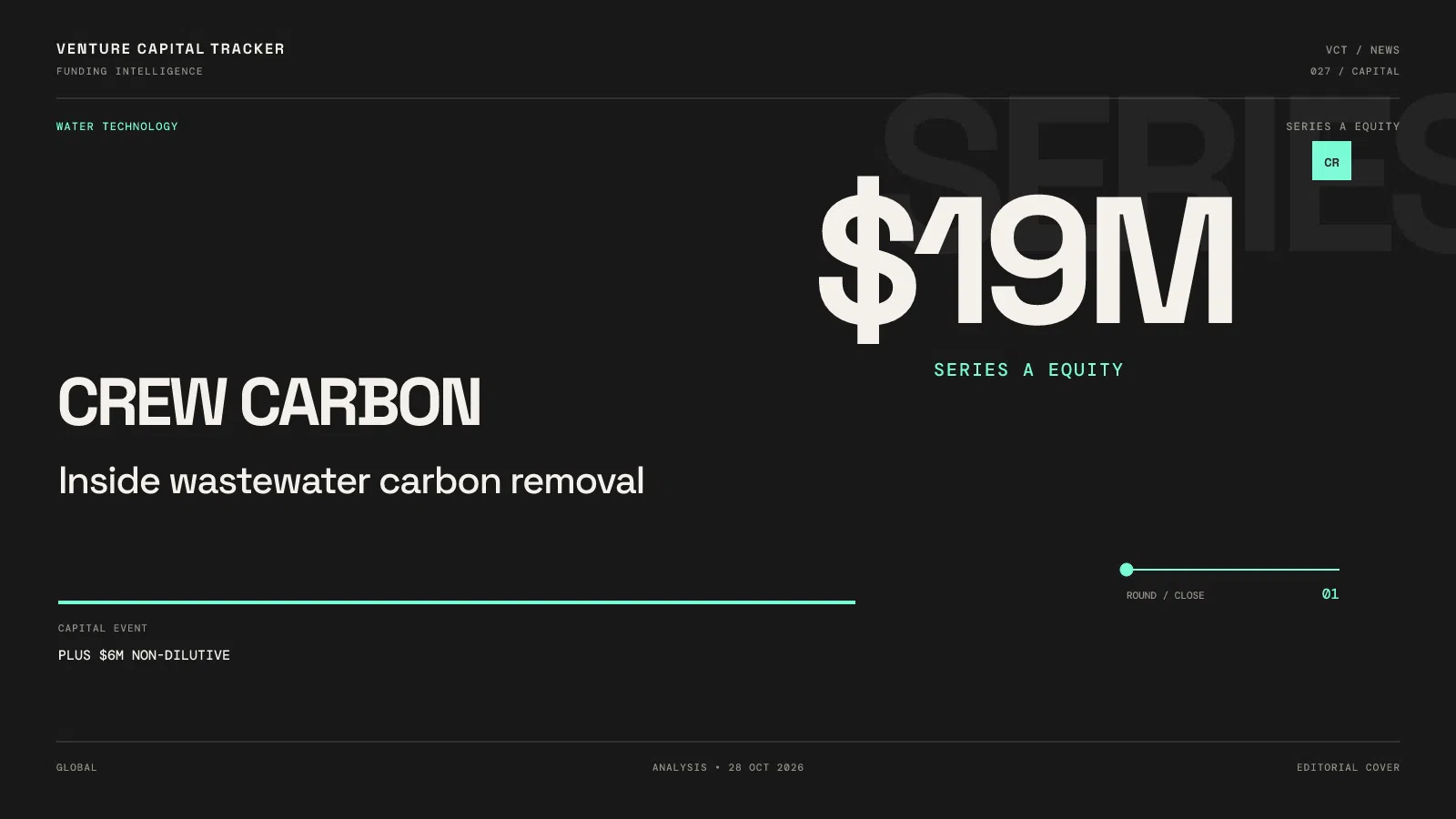
CREW Carbon announced a $25M funding package on May 14, 2026: $19M equity and $6M grants or other non-dilutive capital. Burnt Island Ventures led the Series A, with AP Ventures among the participants. The distinction matters because the full $25M is not venture equity.
The business is equally easy to oversimplify. CREW works inside wastewater plants, improving treatment through mineral dosing while generating carbon-removal credits. Its utility contracts show why operating performance and carbon revenue need to be assessed separately.
What the financing actually funds
The company’s dated release names Sony Innovation Fund, Builders Vision, Kibo Invest, Idemitsu Ventures and New York Ventures among the participants, alongside existing investors. It does not disclose valuation, individual allocations or a primary/secondary split.
The non-dilutive component includes grants and other sources whose complete breakdown is undisclosed. It should not be entered as a second equity round or described entirely as grants. CREW said it would expand utility deployments and its team; announced plans are not completed installations.
The product: change the treatment process
CREW describes dosing calcium-based minerals into a plant’s biological treatment process. Alkalinity helps manage pH and supports the microbes that remove pollutants. The proposed benefits include better nutrient removal, faster settling and reduced use of conventional chemicals. Those are company claims whose results depend on the facility.
For an operator, the workflow begins with existing treatment conditions and permit requirements. A dosing system, mineral deliveries and monitoring are added to that process. The operator then evaluates effluent quality, chemical consumption and operating demands. Carbon removal requires a separate measurement and verification process.
The customer is a utility or industrial treatment operator. Carbon-credit buyers form another market. The two revenue streams can reinforce each other, but neither should be assumed to subsidise every project successfully.
A real customer contract shows the trade-offs
HRSD’s January 27, 2026 commission minutes approve five-year agreements for its Virginia Initiative and Army Base treatment plants. They cover chemicals, equipment and data licensing.
At Virginia Initiative, HRSD owns and operates the feed system; CREW supplies material and advisory support. At Army Base, CREW leases the existing system while HRSD operates and maintains it. Carbon-data rights allow CREW to generate and sell credits, with licensing payments to HRSD.
The minutes estimate $2.614M paid to CREW and $2.224M received from CREW over the initial term. These are projected contract flows, not realised revenue or CREW’s margin. The accompanying recommendations slide projects a combined HRSD net cost of roughly $49,000 a year. Potential capital-project deferral is a separate consideration.
That evidence supports a more specific proposition than “the system always saves money”: treatment improvements and avoided infrastructure expenditure may matter even where ongoing operating economics remain challenging.
Why the lead investor backed it
In Burnt Island Ventures’ investment memo, Tom Ferguson argues that CREW connects utility operating needs with demand for durable carbon removal. He highlights simple site integration and reduced chemical dependence, and says the firm departed from its usual round-size pattern to lead the financing.
That is the investor’s underwriting argument. It does not independently establish attractive unit economics, uniform savings or returns. AP Ventures’ participation also places CREW within a broader industrial portfolio, whose companies face different adoption and financing constraints.
What is independently visible—and what remains unknown
Isometric’s Hampton Roads project record identifies HRSD facilities, a December 2025 approval, the Wastewater Alkalinity Enhancement protocol and third-party verifier 350Solutions. It provides evidence of a specific registered project and certificate issuance. It is not an audit of CREW’s finances or proof that all claimed removal is certified.
Nearby water-sector financings show the range of business models. Oxyle’s January 2025 $16M seed targets PFAS destruction. Watercycle’s November 2024 $5.6M Series A funds mineral recovery from waste streams. They are adjacent treatment businesses, not direct substitutes for CREW’s carbon-removal process.
VCT’s assessment is that the important next measures are repeat installations, reliable mineral supply, treatment performance through seasonal changes, and margin after equipment, verification and customer payments. A signed carbon offtake, a grant award and cash collected for delivered credits are three different things. CREW’s commercial progress will be clearer when those flows can be reconciled.
Editorial note: AI tools assisted with research, structure, or drafting. Venture Capital Tracker retains human editorial responsibility for factual accuracy, relevance, and source quality before publication.