· Investment Strategies · 9 sources · Verified
Cohere Series E Targets C$7B; Initial Close Amount Is Undisclosed
Cohere completed an initial Series E close toward a C$7 billion target, but it did not disclose the amount committed. Canada may invest up to C$1.6 billion in stages.

By Venture Capital Tracker
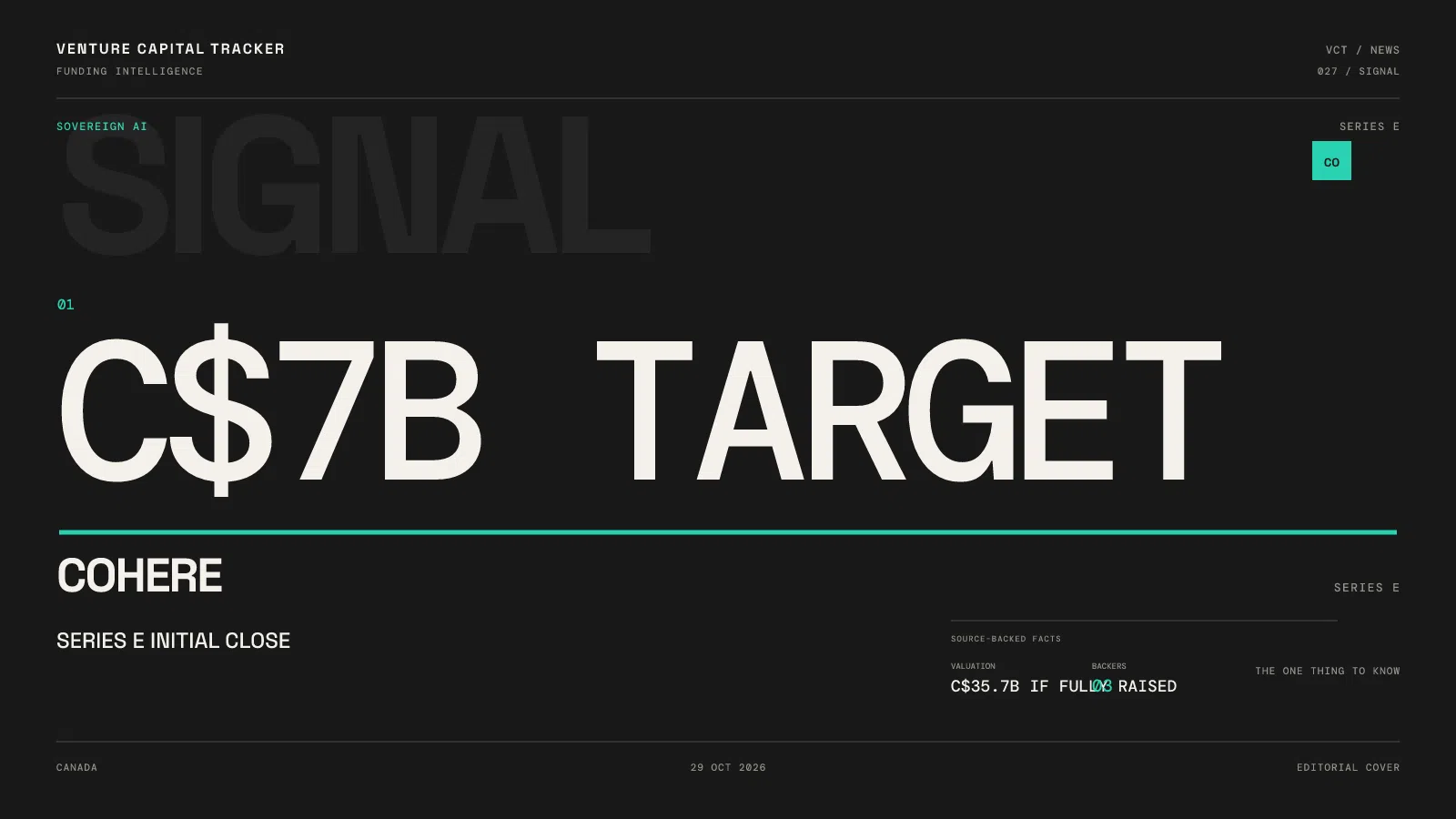
Cohere has completed an initial close of a Series E round that is targeting up to C$7 billion (about US$5.00 billion), the Toronto enterprise-AI company said on October 29. The crucial qualification is that Cohere did not disclose how much investors have committed so far. The advertised C$35.7 billion valuation (about US$25.51 billion) is also framed as what the round would represent if the target is reached—not as proof that C$7 billion has already closed.
The distinction resolves the central uncertainty in September's report on Cohere's fundraising talks. Those discussions have now produced a company-confirmed initial close, but the completed amount and final closing date remain undisclosed.
Who is investing—and what Canada receives
Companies of Germany's Schwarz Group lead the Series E. New investors include Bell Ventures, Bullhound Capital and the Government of Canada; Inovia Capital, NVIDIA and Prosperity7 Ventures returned, according to Cohere's announcement.
Ottawa separately disclosed an equity commitment of up to C$1.6 billion, to be invested in stages. In exchange, Cohere committed to create at least 1,000 Canadian technical jobs by 2030, spend at least C$1.7 billion on additional Canadian compute infrastructure, and keep its incorporation and headquarters in Canada. These are commitments attached to a staged government investment, not evidence that the full C$1.6 billion has already been wired.
Schwarz's participation was foreshadowed in April, when its digital unit announced a €500 million structured-financing commitment tied to the planned Cohere–Aleph Alpha combination. Schwarz now says it wants to run Cohere models on its STACKIT cloud. Its investment case is therefore more specific than broad AI enthusiasm: European customers and governments want capable models that can run under local laws and on infrastructure they control.
What Cohere sells
Cohere sells models and enterprise software to businesses and governments, especially organizations with strict security, privacy or data-residency requirements. Its North platform bundles workplace search and AI agents; private deployments can run in a customer's cloud, data center or isolated environment. North and private deployments use custom enterprise pricing. Cohere's publicly listed Model Vault rates give a partial view of the economics: dedicated instances currently start at US$3 an hour or US$2,000 a month, with higher-performance configurations costing more.
A Cohere case study shows the practical change. CoreWeave support engineers previously assembled ticket context manually, moved requests through FreshDesk and returned to Slack for troubleshooting. With North, a Slack bot collects customer and cluster data, a human reviews it, an automation creates the Jira issue, and a second agent retrieves internal documentation and past reviews. Cohere says the system reached broad production in 90 days and reduced average resolution time from four-to-eight days to two-to-five days. Those results come from a vendor-authored case study and have not been independently audited.
Cohere says annual recurring revenue grew 165% year over year in the third quarter and its customer base expanded twentyfold to 300. ARR is a run-rate measure, not audited annual revenue, and the company did not disclose the dollar value behind that growth.
Why sovereign AI is drawing capital now
The immediate catalyst is procurement risk. Banks, governments and industrial companies increasingly treat AI as operating infrastructure, which makes vendor jurisdiction, model access, deployment location and data governance purchasing criteria. Cohere's founders argue that institutions need a frontier supplier outside the United States and China; Schwarz frames the same demand as digital sovereignty and interoperability.
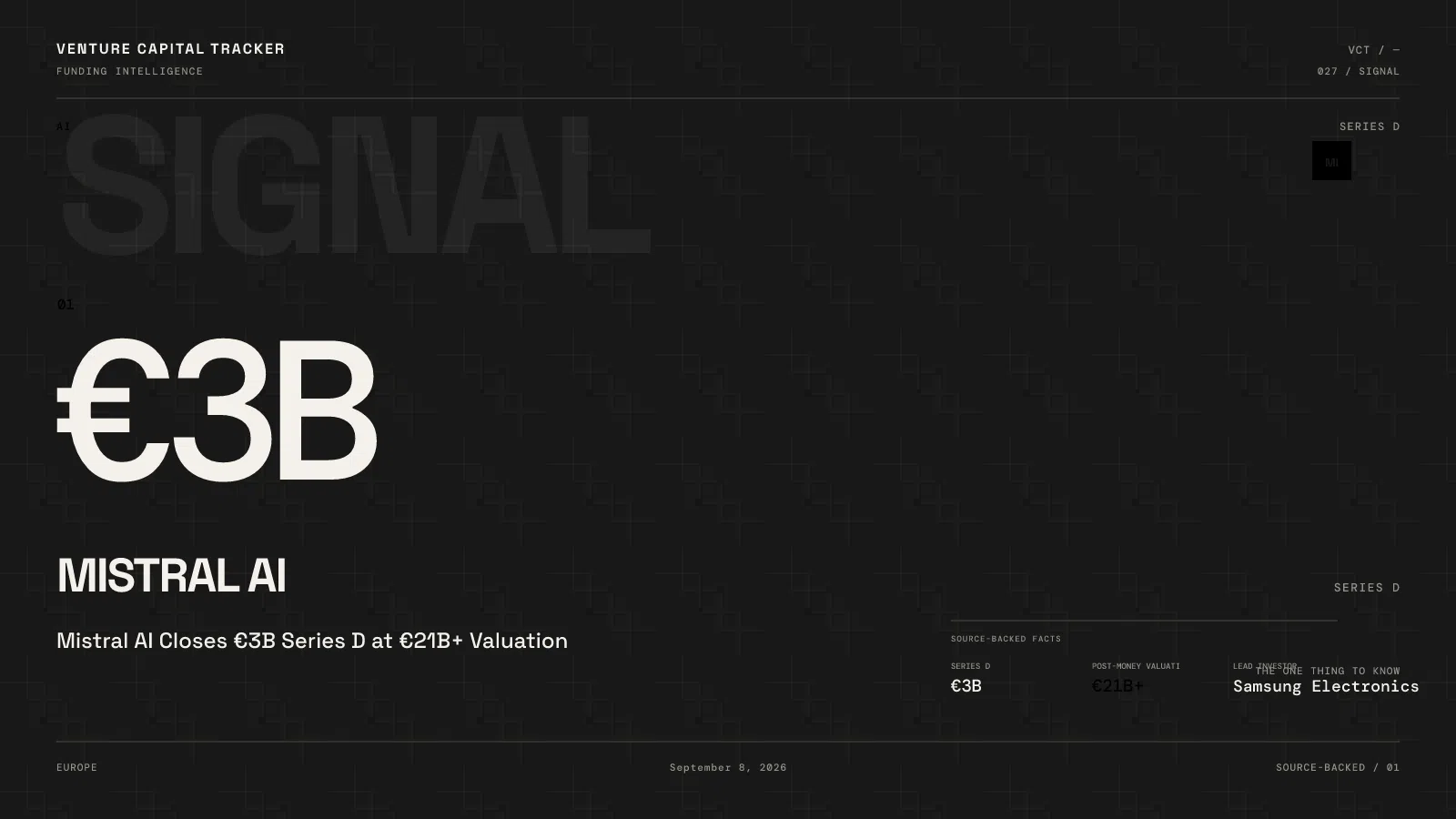
The closest funded comparison is France's Mistral AI, which closed a €3 billion Series D at a valuation above €21 billion in September. Samsung led that completed round, with EQT's Scaleup Europe Fund and PSG Equity as co-leads. Mistral emphasizes open-weight models and a broader AI stack; Cohere is more explicitly centered on private enterprise deployment and regulated buyers. Japan's Sakana AI offers another sovereign-AI comparison: it announced a ¥32 billion Series B in November 2025 to build frontier systems in Japan. Both deals show that national and regional alternatives have become a fundable category, but Cohere's proposed scale is far larger.
The competition remains unforgiving. Cohere must finance frontier-model training while competing with larger U.S. labs, prove that sovereignty translates into recurring software demand, and integrate Aleph Alpha without slowing product delivery. Government backing also adds execution tests: job creation and Canadian compute spending are now measurable obligations.
The next numbers matter more than the headline target: the amount actually closed, the mix of equity and structured financing, any final valuation terms, the closing date, and ARR in dollars. Until Cohere discloses them, the defensible description is an initial Series E close toward C$7 billion—not a C$7 billion raise.
Follow Venture Capital Tracker on Google
Add VCT as a preferred source to see more of our venture-capital reporting in Google Search.
Editorial note: AI tools assisted with research, structure, or drafting. Venture Capital Tracker retains human editorial responsibility for factual accuracy, relevance, and source quality before publication.