· Venture Capital Tracker · venture-capital
Aventra Raises $17.5M to Scale Piranha Defense System
Aventra Defense Systems secured a $17.5M package led by Konvoy to move Piranha into production. The total includes a bank facility, so it is not all equity.
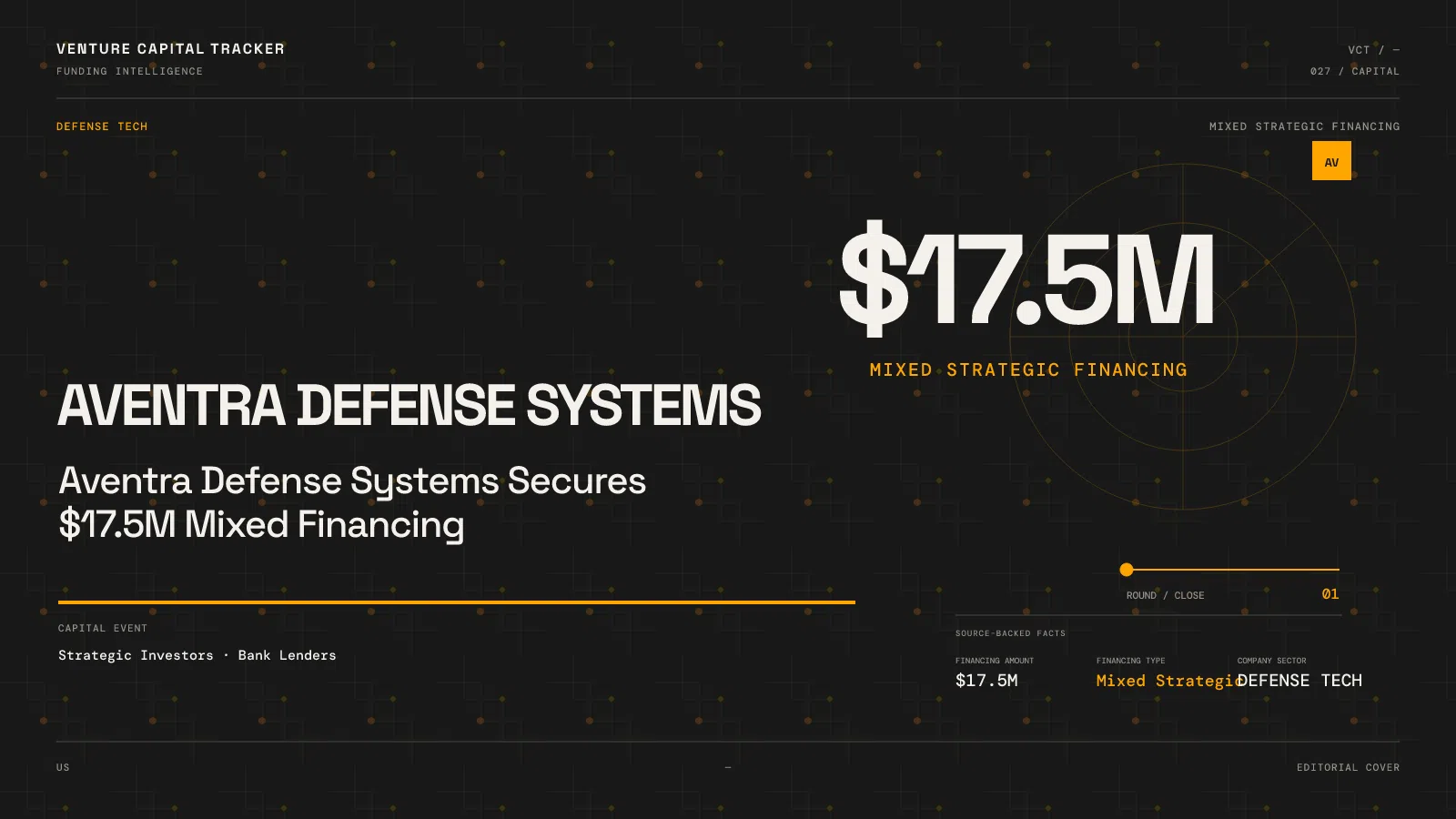
Aventra Defense Systems has announced $17.5 million in strategic financing to move its Piranha autonomous precision-payload system into low-rate production.
Konvoy led the financing. Existing investor Lavrock Ventures participated alongside Booz Allen Ventures, Sands Capital and Langford Industries. The package also includes a funding facility from Western Alliance Bank.
That last detail is important: Aventra did not disclose how much of the $17.5 million is equity and how much is debt. The entire amount should not be described as a venture-equity round.
What the financing funds
Aventra plans to use the capital to expand production at its Herndon, Virginia facility, increase flight testing and develop additional long-range strike, one-way attack and intelligence, surveillance and reconnaissance systems.
The company's first product, Piranha, is a modular glider carried to high altitude by a balloon and released for an autonomous long-range mission. The architecture is designed to combine inexpensive lift with guidance, control software and configurable payloads.
Aventra's pitch is economic as much as technical. Modern militaries need more precision effects than their inventories of expensive cruise missiles can sustain. A system built from lower-cost components could add capacity, provided it performs reliably in contested environments.
Financing structure: equity plus a bank facility
The company calls the transaction a strategic fundraise, but the disclosed investor list contains two different capital types.
Konvoy, Lavrock Ventures, Booz Allen Ventures, Sands Capital and Langford Industries are the equity or strategic participants named in the announcement. Western Alliance Bank supplied a funding facility, introducing a debt component whose size and terms were not disclosed.
That structure can be useful for a hardware company entering production. Equity can fund engineering, hiring and technical risk, while a facility can support equipment, working capital and manufacturing needs. It can also reduce dilution—but only if production and customer payments arrive on schedule.
Because Aventra gave no split, the defensible description is a $17.5 million mixed financing package, not a $17.5 million equity round.
From a $3M seed to production financing
Aventra emerged from stealth in October 2025 with a $3 million seed round led by Lavrock Ventures. The company was founded by former Army officers and repeat founders Michael Weigand, Brian Retherford and Jessup Meng.
The new financing follows roughly a year later and shifts the stated use of proceeds from product development and testing toward low-rate production.
That transition is consequential in defense technology. Demonstrating a prototype and operating a production line require different capabilities: supplier qualification, repeatable manufacturing, quality assurance and a contracting pipeline that can absorb inventory.
The investor signal
Konvoy is best known for its technology and interactive-entertainment thesis, making its lead role notable. Aventra says the firm is backing the platform and autonomy layer rather than treating Piranha as a single-purpose airframe.
Lavrock and Booz Allen Ventures bring national-security networks and experience translating commercial technology into government missions. Sands Capital adds a broader growth-investing perspective. Western Alliance's participation suggests the company has reached a point where lenders can underwrite at least part of its expansion.
The syndicate improves access to expertise, but it does not remove procurement risk. Defense startups can face long qualification timelines, program-specific budgets and uneven transitions from demonstrations to contracts.
What could make Piranha defensible
Aventra's competitive claim rests on four points:
- Cost per mission: balloons and modular gliders may be cheaper to manufacture and deploy than traditional long-range missiles.
- Range and persistence: high-altitude launch can extend reach without requiring a large aircraft or ground launcher near the target.
- Modularity: a common platform could support ISR and different precision-effects payloads.
- Scalability: simpler components could support distributed production and larger inventories.
The unresolved questions are equally important. Balloon operations depend on weather and mission planning. A slow high-altitude launch architecture may be easier to detect than marketing implies. Navigation, communications and terminal accuracy must work under electronic attack. And “low cost” remains a company claim until unit economics and procurement contracts are disclosed.
What to watch next
The next milestones are production throughput, repeatable flight-test results and named customer programs. Investors should also watch whether Aventra discloses the equity/debt split or facility terms, since those details determine how much new risk capital the company actually received.
For now, the round is best read as a production-finance signal: Aventra has moved beyond a seed-stage concept, but commercial scale and battlefield performance remain to be demonstrated.
Frequently asked questions
Did Aventra raise $17.5 million of equity?
Not necessarily. The announced package includes a Western Alliance Bank funding facility, and Aventra did not disclose the equity/debt split.
Who invested in Aventra's financing?
Konvoy led. Lavrock Ventures, Booz Allen Ventures, Sands Capital and Langford Industries participated, while Western Alliance Bank provided the funding facility.
What is Piranha?
Piranha is a balloon-launched modular autonomous glider designed to carry ISR or precision-effects payloads over long distances.
- startup-funding
- defense-tech
- deep-tech
- +1 more
Editorial note: AI tools assisted with research, structure, or drafting. Venture Capital Tracker retains human editorial responsibility for factual accuracy, relevance, and source quality before publication.