· Venture Capital Tracker Editorial · venture-capital
Gallatin AI Raises $50M Series A for Military Logistics Software
Gallatin AI raised a $50 million Series A from 8VC, Silent Ventures and other investors to scale decision-support software for military readiness and contested logistics.
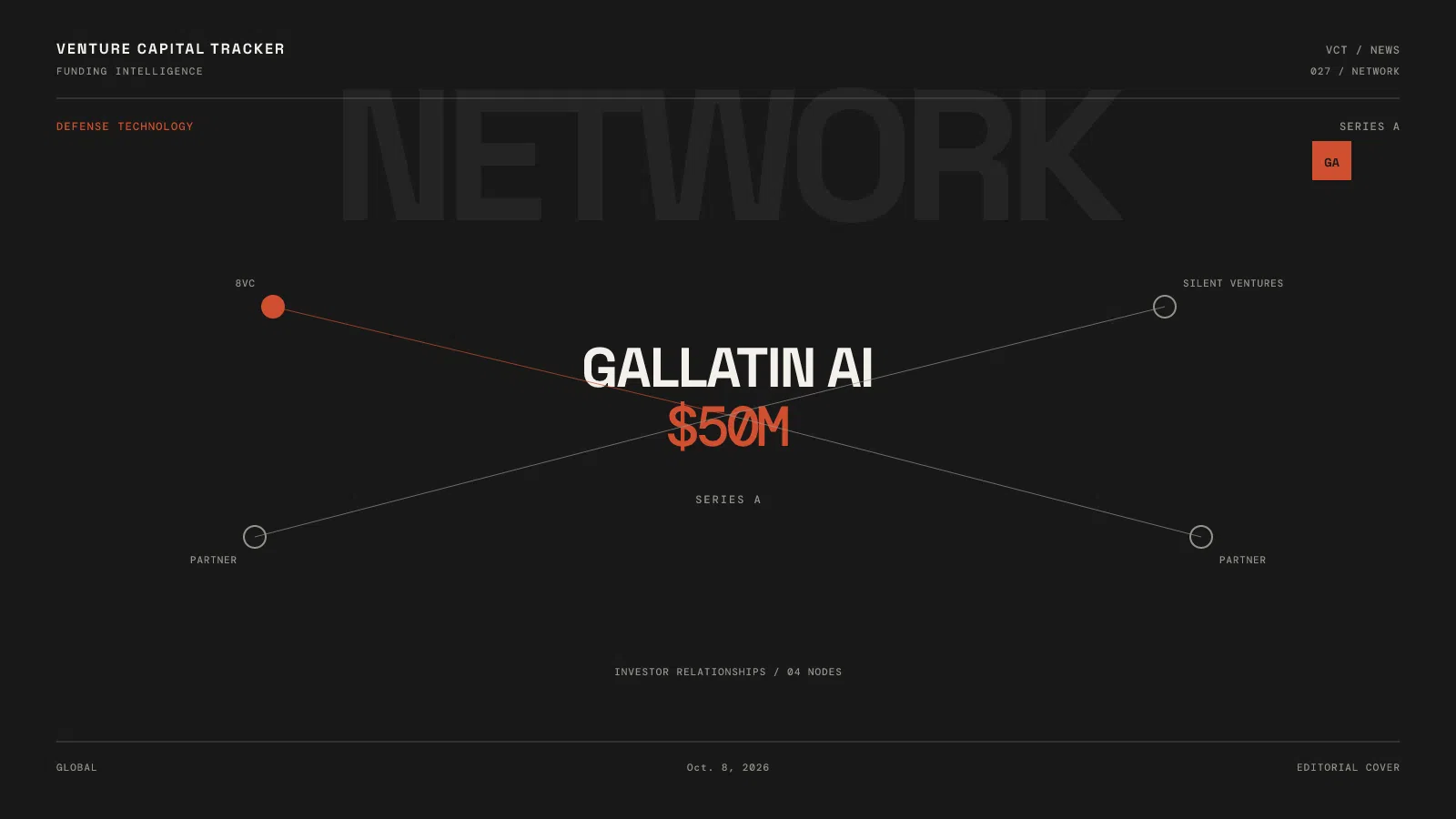
Gallatin AI has raised $50 million in Series A financing to expand its military logistics and sustainment software. The company named 8VC and Silent Ventures among new and existing investors but did not identify a lead.
The round brings total equity funding to $70 million and follows Gallatin's 2024 seed financing.
Financing at a glance
| Field | Detail |
|---|---|
| Company | Gallatin AI |
| Amount | $50 million |
| Stage | Series A |
| Investors named | 8VC, Silent Ventures and others |
| Total funding | $70 million, all equity |
| Valuation | Not disclosed |
| Announced | October 8, 2026 |
Logistics, not another weapons platform
Gallatin is building software for the operational layer that moves fuel, medical supplies, munitions, spare parts and maintenance capacity across military forces.
Its flagship Navigator platform connects readiness data and workflows across vehicle availability, supply, medical and other support functions. The company says Army and Air Force customers use the software at tactical, operational and strategic levels.
That focus matters because autonomous systems and advanced weapons do not remove logistics constraints. A larger fleet can make them harder: more platforms create more maintenance events, payload requirements, inventory decisions and transportation dependencies.
The Pentagon calls this challenge contested logistics—sustaining forces when communications, transport routes, warehouses and bases may be disrupted or attacked.
Why the market exists
Military logistics data remains fragmented across legacy software, spreadsheets and manual processes. Operational planners often need to reconcile systems built for accounting, maintenance or supply rather than real-time decisions.
Gallatin's opportunity is to create a decision layer across those systems rather than replace every database. Navigator aims to show readiness, identify supply constraints and coordinate actions from the battlefield to headquarters.
The company says the platform is already used by U.S. military units in exercises and operations across Japan, Alaska and Europe. Those deployment claims are significant, but Gallatin has not disclosed contract values, annual revenue, user counts or renewal rates.
The round's strategic logic
The capital will fund engineering hiring, product development and a permanent presence across four continents.
For investors, Gallatin offers exposure to defense software without the manufacturing intensity of drones, missiles or vehicles. Software can scale more efficiently, but government sales cycles, security accreditation and integration work can still slow deployment.
8VC has backed multiple defense-technology companies and incubated Gallatin through its Build program. Silent Ventures also focuses on national-security and aerospace technology. Their participation gives the company sector relationships but may also increase expectations for rapid contract growth.
Competitive landscape
Gallatin faces powerful incumbents and adjacent platforms.
- Palantir already provides data integration and operational decision systems across the U.S. government.
- Govini focuses on defense acquisition, supply chains and industrial-base intelligence.
- Raft builds government digital platforms and data systems.
- Scale AI supplies data infrastructure and AI capabilities to defense customers.
Gallatin's narrower specialization in sustainment can be an advantage if the product solves workflow details that broader platforms treat as implementation work. It can become a limitation if procurement agencies prefer one strategic vendor.
Risks behind the funding story
The strongest risk is evidence. Gallatin names deployments but provides few commercial metrics.
A useful diligence framework should ask:
- How much annual contract value is recurring rather than project-based?
- How long does deployment take across a new service or command?
- Which legacy systems can Navigator integrate without custom engineering?
- Has the software improved mission-capable rates, inventory availability or planning time?
- How does the company handle classified data, disconnected operations and adversarial electronic environments?
Defense demand is strong, but budget availability does not guarantee a scalable software business. Programs can remain stuck in pilots, require heavy services work or depend on a small number of champions.
Editorial view
Gallatin's Series A stands out because it finances the connective tissue behind modern military systems. The company is not betting that software can replace logistics; it is betting that better data can make a constrained physical network more resilient.
The next proof point is not another exercise announcement. It is evidence that Navigator moves from deployments into durable programs of record with measurable readiness outcomes.
Follow Venture Capital Tracker in Google
Add VCT as a preferred source to make our venture-capital coverage easier to find in Google Search.
Last updated:
Editorial note: AI tools assisted with research, structure, or drafting. Venture Capital Tracker retains human editorial responsibility for factual accuracy, relevance, and source quality before publication.