AvenCell's $47M Financing Is Mostly Royalty Capital, Not a $47M Series C
Ligand committed up to $47 million to AvenCell Therapeutics, but only up to $6 million is Series C equity; up to $41 million is milestone-based royalty financing.
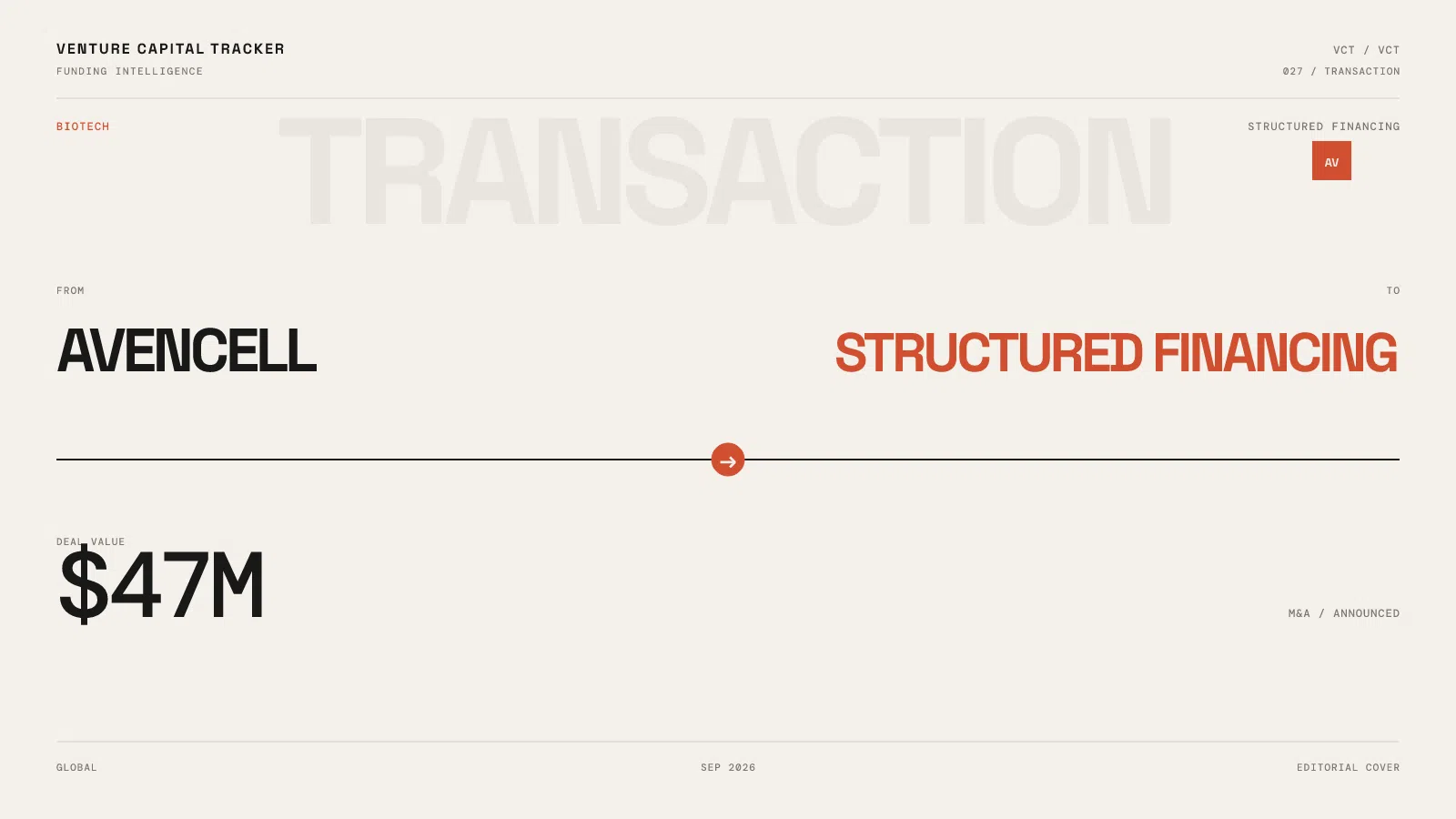
TL;DR: Ligand Pharmaceuticals committed up to $47 million to AvenCell Therapeutics on September 24, 2026. The structure is important: up to $41 million is royalty financing and up to $6 million is Series C equity.
Canonical company profile: AvenCell Therapeutics.
The financing structure
| Component | Maximum |
|---|---|
| Royalty financing | $41M |
| Series C equity | $6M |
| Total commitment | $47M |
The $41 million portion is funded in tranches and gives Ligand a royalty on worldwide annual net sales of AvenCell's current and future pipeline assets.
Why calling this a "$47M Series C" is wrong
Only the equity component is Series C financing.
The majority of the capital is effectively non-dilutive/structured financing exchanged for future royalty economics.
Combining both components into a venture-round database field would distort AvenCell's equity history and any analysis of biotech Series C sizes.
What AvenCell is developing
AvenCell develops controllable allogeneic CAR-T therapies, including AVC-201 for acute myeloid leukemia and AVC-203 for B-cell malignancies.
The financing is tied partly to clinical milestones, so not all committed capital is necessarily funded at signing.
Why VCT tracks structured biotech finance
Biotech increasingly uses royalties, milestone capital and asset-level financing alongside venture equity.
Those instruments can provide capital without the same dilution profile as an equity round, but they also exchange future economics for present funding.
VCT keeps them separate so funding histories remain analytically useful.
Editorial note: AI tools assisted with research, structure, or drafting. Venture Capital Tracker retains human editorial responsibility for factual accuracy, relevance, and source quality before publication.