Antares Ventures Passes $50M at Fund I’s Second Close
Antares Ventures I has secured more than $50M cumulatively at its second close. Its $100M remains a target, with about $27M already invested.
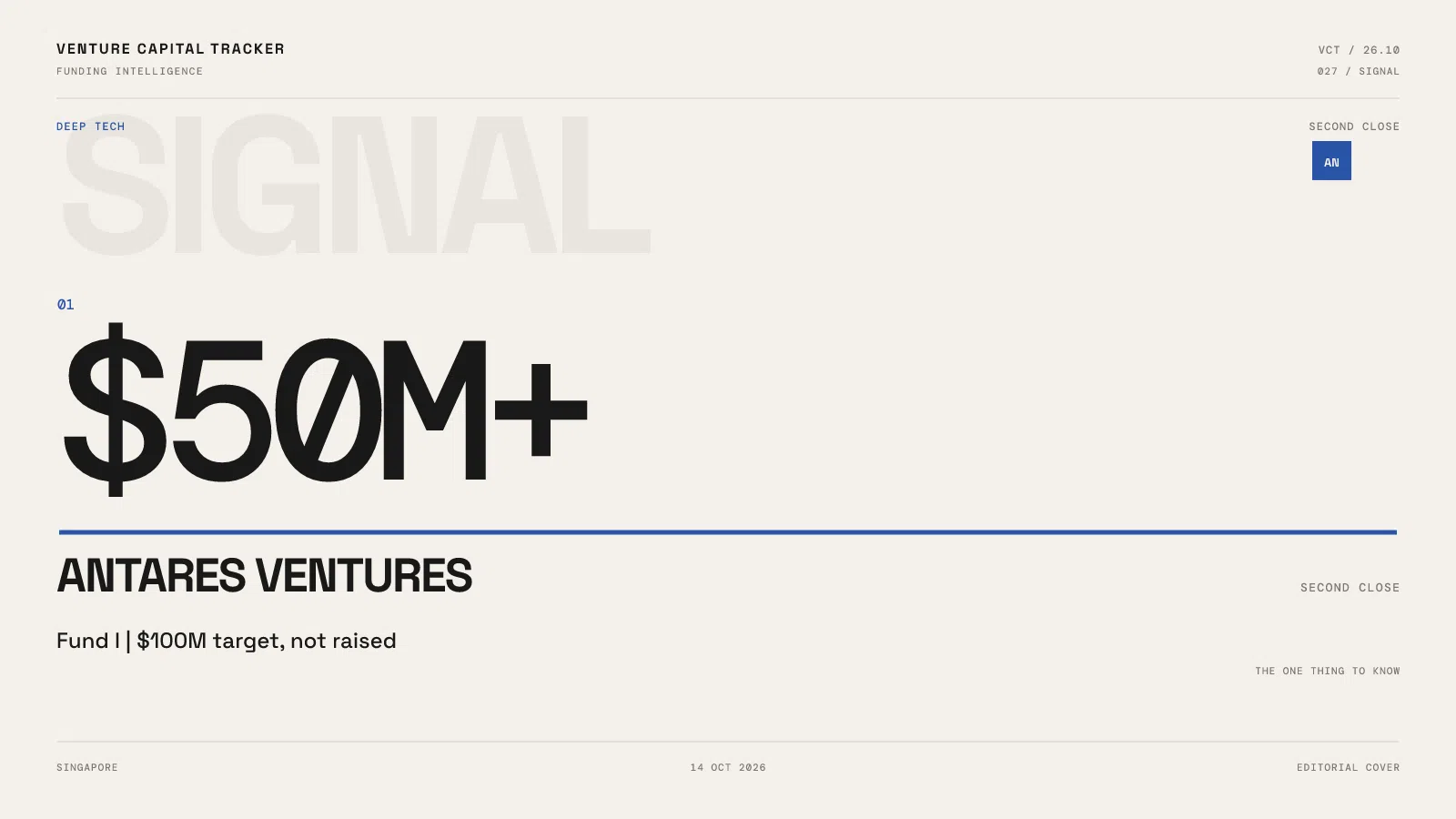
Antares Ventures has passed $50 million in commitments at the second close of its debut fund. The Singapore manager announced the milestone on October 14, 2026, while continuing to raise toward a $100 million final target.
The $50M-plus figure is cumulative at the second close—not a disclosed $50M incremental tranche. The $100M target has not been announced as raised.
What has Antares actually closed?
The firm’s announcement confirms more than $50M of commitments to Antares Ventures I. Investors include family offices and corporate and strategic investors from Southeast Asia, Japan and Korea. Individual LP names were not disclosed.
Antares says approximately $27M has already been invested across nine companies. That means the fundraising headline should not be described as entirely untouched dry powder. It also does not permit a precise calculation of available capital: the exact commitment total, fees, reserves and other obligations are not published.
TNGlobal’s coverage identifies the strategy as early-stage deep tech, from seed to Series B.
What is the investment thesis?
Antares invests globally in technologies it aims to commercialize across Asia. Its themes include energy, compute and digital infrastructure, industry, and urban and transport infrastructure.
The portfolio provides more concrete context than a broad “deep tech” label. Named investments include storage developer VFlowTech, transformer-technology company IONATE, industrial-plasma developer enaDyne and electric-aircraft developer The ePlane Company.
These are existing portfolio examples, not newly announced company financing rounds. The $27M deployment total should not be distributed among them through invented individual checks.
Why commercialization is the central test
Our analysis is that this strategy depends on converting technical performance into deployments inside established infrastructure. A better component or process is valuable only if customers can integrate it safely, reliably and economically.
That creates an execution task beyond finding promising science. Pilots need commercial objectives. Industrial partnerships need operating responsibility. Localization needs a reason rooted in customer requirements rather than a general promise of regional expansion.
A cross-border model can help a company reach customers that would otherwise be difficult to access. It can also introduce regulatory, procurement and support complexity. A global sourcing network is therefore an opportunity, not proof that every investment can scale in every Asian market.
What does the second close change?
An interim close increases committed resources while fundraising continues. It does not remove the need to match portfolio obligations with capital actually secured.
Existing companies may require further financing before reaching commercial scale. New investments compete with those follow-on needs. The relevant questions are reserve discipline, expected development timelines and whether commercial milestones can be reached without assuming the final target will be achieved.
Investors should also distinguish technical validation from recurring revenue. A successful pilot, a signed partnership and a paid repeat deployment are different pieces of evidence.
What should readers watch next?
The next informative updates are a final-close announcement, additional detail on portfolio support and evidence that industrial pilots convert into durable customer relationships. Published fund terms, concentration limits and realized outcomes would help evaluate the model more rigorously.
The Singapore venture manager should also be identified precisely in search and reporting. Broader “Antares fund” queries surface private-credit products, which are not the subject of this financing story.
Bottom line
Antares’s $50M-plus second close is a meaningful early-stage infrastructure-technology fund milestone. The strongest angle is not a hypothetical $100M pool: it is how the manager balances an already-deployed portfolio with continuing fundraising and the practical work of commercializing engineering-led businesses.
Editorial note: AI tools assisted with research, structure, or drafting. Venture Capital Tracker retains human editorial responsibility for factual accuracy, relevance, and source quality before publication.