Aldaron Launches AI Buyout Firm With Reported $885M Fund
Aldaron’s reported $885M debut fund backs control-oriented AI transformation. Its Oak Point majority investment closed in March, not October.
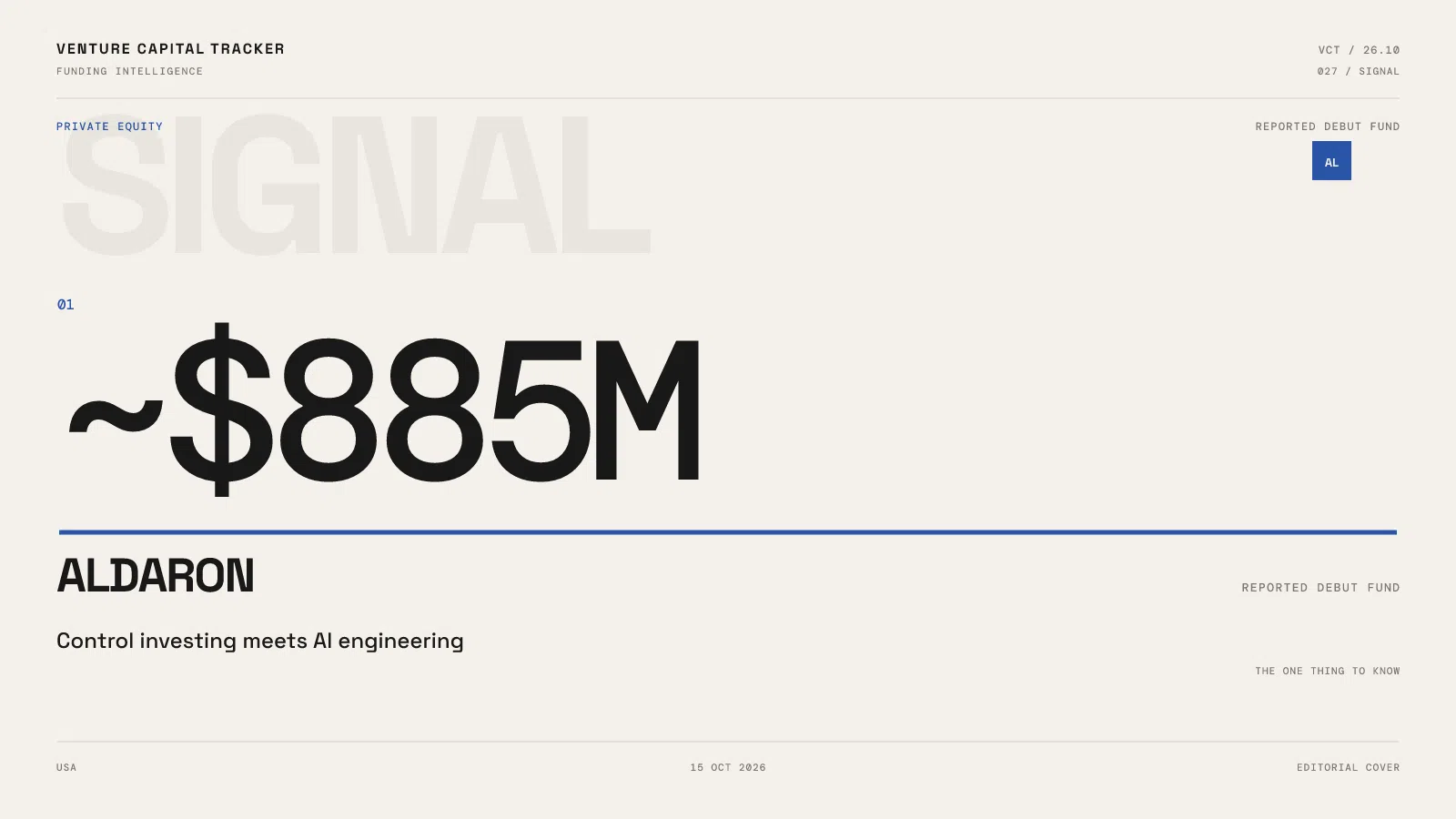
Aldaron publicly launched on October 15, 2026 with a strategy combining control-oriented investing and embedded AI engineering. Separately, The Wall Street Journal reports that the firm recently closed a debut fund with roughly $885 million in commitments.
The amount is a reported figure, not one stated in the launch release. The exact fund-closing date and named LPs were not established in the materials reviewed. This is private equity, not an $885M startup venture round.
What does Aldaron mean by “transformation equity”?
The official announcement describes a team of engineers and investors working inside established American businesses. Aldaron uses “transformation equity” as its label for that operating model; the label alone does not establish a new asset class or a proven return advantage.
Co-founders Will Oberndorf, Evan Mendez and Jay Grewal bring backgrounds in private investing and engineering. The proposition is to connect investment underwriting with the team responsible for applying technology after a deal.
Our analysis is that ownership is the important distinction. A control investor can help set budgets, operating priorities and governance. It is not simply selling an AI tool to a customer that remains free to ignore it.
Oak Point is an existing transaction, not an October acquisition
Aldaron’s first majority equity investment was in Oak Point Partners, a purchaser of remnant intangible assets and payment rights. The company announcement says the transaction completed in March 2026. Purchase consideration was not disclosed.
October’s news is the public launch and disclosure of the strategy—not a newly completed Oak Point deal. VCT does not count that historical transaction as fresh acquisition volume.
Aldaron says its engineers are working with Oak Point on asset discovery and operating capacity. Those statements describe the intended application and company-reported work, not independently verified investment returns.
Why the operating model could be compelling
Specialist businesses often contain valuable process knowledge that is difficult to capture in generic software. An embedded team can learn where information is lost, which decisions require judgment and which repetitive tasks constrain capacity.
In a business such as asset recovery, a useful system would need more than fluent text generation. It would need reliable records, traceability and a workflow that lets specialists check consequential decisions.
The potential advantage is tighter feedback between the software and its users. The potential cost is labor intensity: senior engineers and domain experts cannot be duplicated across an unlimited number of portfolio companies without changes to staffing or delivery quality.
What would demonstrate value beyond an AI narrative?
The investment test is whether operating improvement exceeds the cost of implementation and the risks introduced by new systems.
For asset discovery, more leads are not the same as more realized recoveries. Readers should look for conversion, recovery timing, legal and operating costs, and repeatability. Where reporting uses time savings or growth estimates, the baseline and measurement method matter.
Governance is equally important. Human review, data permissions and accountability need to survive the introduction of automated tools. Controlling ownership does not make poor data or model errors disappear.
The approach may also be replicable by incumbent owners. Defensibility would need to come from execution, reusable capabilities or proprietary operating knowledge—not the claim that AI can improve businesses.
Bottom line
Aldaron’s reported $885M debut fund makes its launch a substantive private-markets story. Its strategy should be judged against operating results and the economics of embedded engineering. The fund amount remains media-reported, LP names remain undisclosed, and the Oak Point investment must retain its March completion date.
Editorial note: AI tools assisted with research, structure, or drafting. Venture Capital Tracker retains human editorial responsibility for factual accuracy, relevance, and source quality before publication.