· Venture Capital Tracker Editorial · venture-capital
Universal Quantum Raises Over $100M Series A for Modular Quantum Computing
Universal Quantum raised more than $100 million in a record UK quantum Series A led by DCVC and Firgun Ventures to commercialize its modular trapped-ion architecture.
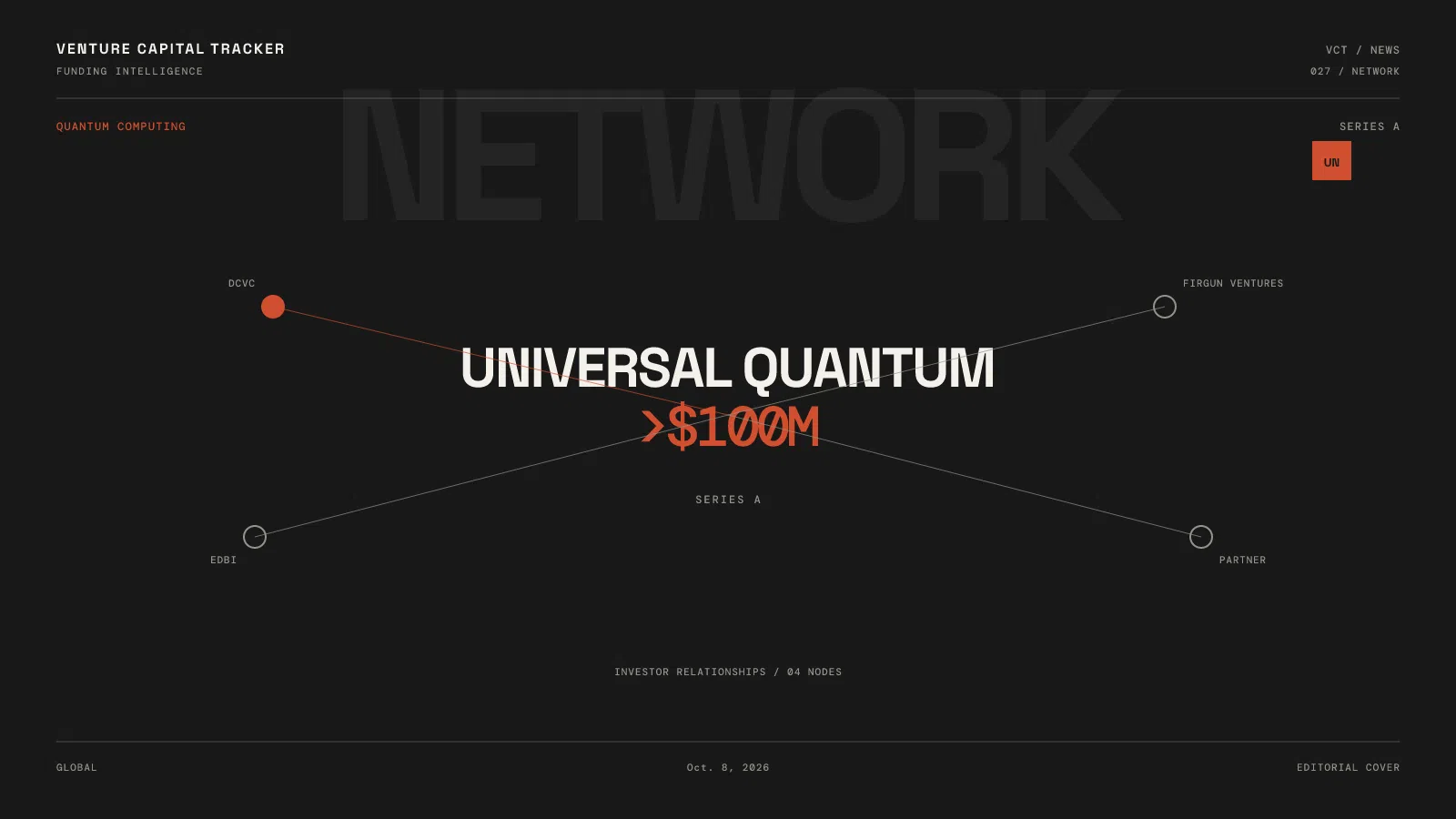
Universal Quantum has raised more than $100 million in Series A financing to develop and commercialize its modular trapped-ion quantum computers. DCVC and Firgun Ventures co-led the round.
The syndicate also includes EDBI, Artal advised by Invus, Integral GlobalTech, Main Sequence, Hostplus, NGS Super, IAG Capital, EdenBase, Eigenstate.holdings, Roblox founder David Baszucki, Nauta Capital and The Venture Collective.
The company described the financing as the largest Series A raised by a UK-headquartered quantum-computing company. It did not disclose the exact amount or valuation.
Financing at a glance
| Field | Detail |
|---|---|
| Company | Universal Quantum |
| Amount | More than $100 million |
| Stage | Series A |
| Leads | DCVC and Firgun Ventures |
| Valuation | Not disclosed |
| Announced | October 8, 2026 |
| Use of proceeds | Hardware commercialization, Singapore R&D centre and expansion in the US, Japan and Germany |
A modular trapped-ion thesis
Universal Quantum's system uses trapped ions—charged atoms held by electric fields—as qubits. Instead of trying to manufacture a single enormous quantum processor, the company plans to tile smaller quantum chips into a larger machine.
Its interconnect uses electric fields to move quantum information between modules. Universal Quantum argues this avoids the complexity of large photonic networks and the cost of extreme cooling infrastructure used by some competing architectures.
The central engineering question is whether the company can preserve gate fidelity and system reliability as the number of modules and control channels increases.
Commercial evidence matters
Universal Quantum has one advantage that is unusual for a quantum company at Series A: a $77 million contract with the German Aerospace Center.
The contract does not prove that the company has reached fault-tolerant utility. It does show that a sophisticated government buyer is willing to fund system development, creating non-equity capital and operational feedback alongside the venture round.
The company has more than 100 technical employees and is establishing an R&D centre in Singapore. The new capital will also support expansion in Hamburg, Japan and the United States.
Management declined to disclose revenue and has not committed to a precise delivery date for a useful commercial system, saying the goal is within the next decade.
Why the investor mix is strategic
The syndicate spans US deep-tech capital, a quantum-specialist lead, Singapore sovereign-linked investment and Australian pension capital.
That structure reflects how quantum computing is becoming a strategic national capability. Hardware programs need patient funding, access to specialist talent and relationships with government customers. Geographic diversity can reduce dependence on one public-funding regime, although it adds coordination and export-control complexity.
EDBI's participation aligns with the Singapore R&D centre. Main Sequence, Hostplus and NGS Super add long-duration Australian capital, while DCVC brings a portfolio built around technically complex commercialization.
Competitive landscape
Universal Quantum competes most directly with other trapped-ion developers:
- Quantinuum has advanced hardware, software and logical-qubit work.
- IonQ is public and sells cloud access while pursuing modular systems.
- Alpine Quantum Technologies is developing European trapped-ion machines.
- Oxford Ionics, now part of IonQ, developed chip-based ion-trap control.
Alternative architectures include neutral atoms, superconducting circuits and photonic systems. Each trades off gate fidelity, connectivity, cooling, manufacturing and control complexity.
Universal Quantum's differentiated claim is not simply that trapped ions work. It is that chip tiling and electric-field interconnects can create a manufacturable path to a large machine.
What the round does not prove
The financing confirms investor demand and gives the company a meaningful runway. It does not establish:
- logical-qubit performance at commercial scale;
- reliable inter-module operations;
- a delivery schedule for a useful machine;
- revenue independent of government development contracts; or
- the total capital required before commercialization.
The next material evidence should come from hardware benchmarks, completed contract milestones and named workloads run on progressively larger systems.
Editorial view
Universal Quantum is a strong financing story because it combines a differentiated architecture, a large Series A and real government contract revenue. The risk is that the commercial narrative can run far ahead of the machine.
Investors are backing a credible route to scale. They are not buying a finished quantum computer.
Follow Venture Capital Tracker in Google
Add VCT as a preferred source to make our venture-capital coverage easier to find in Google Search.
Last updated:
Editorial note: AI tools assisted with research, structure, or drafting. Venture Capital Tracker retains human editorial responsibility for factual accuracy, relevance, and source quality before publication.