· Venture Capital Tracker Editorial · venture-capital
Oratomic Raises $475M Series B at $5.4B Valuation
Oratomic raised $475 million in a Series B just three months after its Series A, lifting the neutral-atom quantum startup's reported valuation to $5.4 billion and total funding to $775 million.
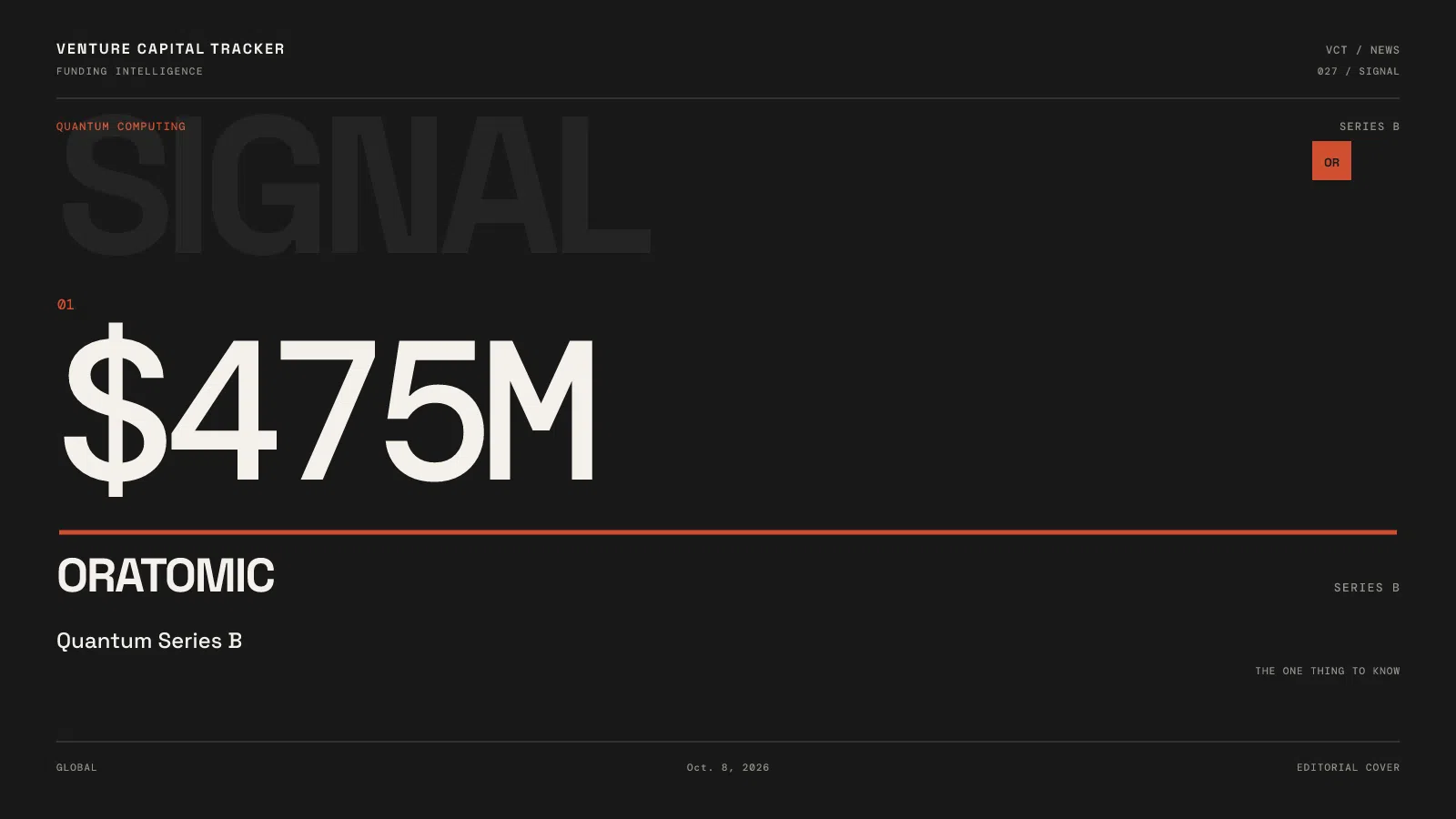
Oratomic has raised $475 million in Series B financing at a reported $5.4 billion valuation, only three months after its Series A. The round was co-led by ARCH Venture Partners, Spark Capital, Khosla Ventures, Index Ventures, General Catalyst and Bezos Expeditions, according to The Wall Street Journal.
The financing takes total disclosed funding to $775 million and more than triples the Pasadena company's valuation from the $1.5 billion mark attached to its earlier round.
Financing at a glance
| Field | Detail |
|---|---|
| Company | Oratomic |
| Amount | $475 million |
| Stage | Series B |
| Valuation | $5.4 billion, reported |
| Total funding | $775 million |
| Investors | ARCH, Spark, Khosla, Index, General Catalyst and Bezos Expeditions |
| Announced | October 8, 2026 |
| Status | Reported completed financing; no company release was available at publication |
What Oratomic is building
Oratomic is pursuing a utility-scale, fault-tolerant quantum computer based on neutral atoms. Its core claim is that a newer error-correction architecture could reduce the physical-qubit requirement for cryptographically relevant computation from roughly one million to about 10,000.
That difference matters because error correction—not simply raw qubit count—is the main barrier between laboratory demonstrations and machines that can perform long, useful calculations. Quantum bits are fragile; practical systems must detect and correct errors without destroying the calculation.
A lower-overhead architecture could reduce the amount of hardware, control electronics and calibration required. It does not remove the need to demonstrate high-fidelity operations at scale.
Why investors are paying a premium
The valuation step-up reflects two connected bets.
First, neutral atoms offer a credible path to dense arrays and flexible connectivity. QuEra, Atom Computing and Pasqal are pursuing related physics, creating a competitive ecosystem around the architecture.
Second, investors are underwriting the possibility that Oratomic's founders can translate research in fault tolerance into an integrated machine. The company is targeting a commercial-scale system by 2030, a deadline that leaves little room for delays in hardware, controls, software and fabrication.
The financing also shows how capital is concentrating around teams that claim a complete path to fault tolerance rather than incremental improvements in noisy intermediate-scale machines.
The valuation is ahead of the evidence
A $5.4 billion private valuation is unusually high for a company founded in 2025 and still working toward its first utility-scale system.
The round implies a 3.6-fold increase from the reported $1.5 billion valuation only three months earlier. That pace is not supported by public revenue disclosures, customer deployments or audited hardware milestones. It is primarily a price on technical credibility and strategic scarcity.
Investors are therefore accepting several risks:
- Architecture risk: lower theoretical overhead must survive real hardware noise and imperfect operations.
- Scale risk: neutral-atom arrays must maintain fidelity as control complexity grows.
- Integration risk: useful machines require compilers, networking, calibration, cryogenic or vacuum infrastructure and error correction to work together.
- Timeline risk: a 2030 target can slip even if the underlying science is sound.
- Capital risk: $775 million may not be the final private capital required before commercial revenue becomes material.
Competitive context
Oratomic enters a crowded race. QuEra and Atom Computing are advancing neutral-atom systems; Quantinuum and IonQ use trapped ions; Google, IBM and Rigetti focus on superconducting approaches; Universal Quantum is pursuing modular trapped-ion scale-up.
The correct comparison is not headline qubit count. The decisive measures are logical error rates, circuit depth, uptime, manufacturing yield and the cost of running a useful algorithm.
Oratomic has not yet published enough system-level evidence to establish leadership on those measures. Its Series B buys time to do so.
What to watch next
Four milestones would make the financing easier to underwrite:
- A repeatable logical-qubit benchmark with disclosed assumptions.
- Hardware demonstrations showing the architecture can scale without fidelity collapsing.
- Named research or commercial partners running workloads on the system.
- A capital and delivery roadmap connecting today's platform to the 2030 target.
Until those milestones arrive, the round should be read as a large, competitive wager on a research team—not proof that utility-scale quantum computing has been achieved.
Follow Venture Capital Tracker in Google
Add VCT as a preferred source to make our venture-capital coverage easier to find in Google Search.
Last updated:
Editorial note: AI tools assisted with research, structure, or drafting. Venture Capital Tracker retains human editorial responsibility for factual accuracy, relevance, and source quality before publication.