· Investment Strategies · 1 source
Ultrahuman’s $70M at $365M: Smart Rings Become On-Finger Computers
Qualcomm Ventures joined Ultrahuman’s $70M round ($65M equity + $5M debt) at a $365M valuation — betting rings can run software, AI, and games on-device, not only sleep metrics.

Editorial team
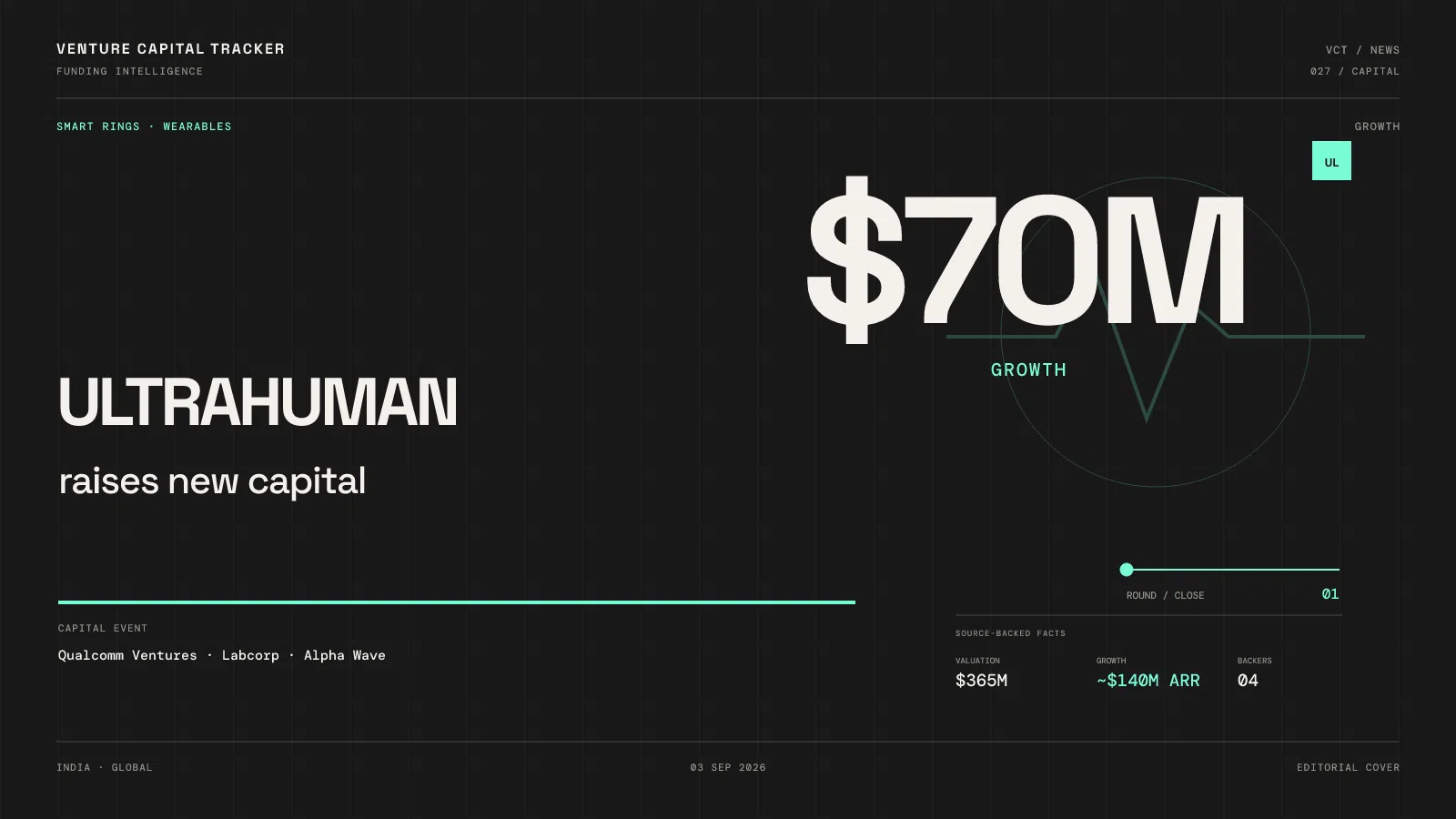
Ultrahuman raised $70 million on September 3, 2026 — $65 million equity plus $5 million debt — at a $365 million valuation, about 3× its $120 million 2023 mark (TechCrunch interview with CEO Mohit Kumar). Qualcomm Ventures and Labcorp joined Alpha Wave, Blume Ventures, Nexus Venture Partners, and Alteria Capital.
Spine: rings that only track sleep are commodities; rings that run software and AI on-finger are a platform bet — and Ultrahuman already claims ~$140M revenue run rate.
Key facts
- Company
- Ultrahuman (Bengaluru)
- Round
- $70M ($65M equity + $5M debt)
- Valuation
- $365M
- Notable
- Qualcomm Ventures, Labcorp
- ARR run rate
- ~$140M (company); targeting ~$200M by Jan 2027
- Units
- ~800k rings sold
- Founded
- 2019 (Mohit Kumar, Vatsal Singhal)
Who uses the product — and for what job
Users: consumers buying Ring Air / Ring Pro for metabolic, sleep, and recovery tracking — with a growing cohort paying for PowerPlugs software (~12% of users).
Job today: continuous personal health sensing without a watch form factor. Job next: on-device compute for AI interactions, game control, pointing, and car-key style ambient interfaces — using finger placement plus biometrics.
U.S. is ~45% of revenue this quarter; India ~11%. Demand for Ring Pro in the U.S. is running 18–20× supply after a patent-driven Ring Air pause (company via TechCrunch).
Why now
- Oura is IPO-pathing; Ultrahuman is choosing hardware + software platform expansion over an immediate listing.
- Qualcomm silicon partnership points to rings that are less phone/cloud dependent.
- Labcorp explores pairing ring blood-flow signals with lab diagnostics — a path from wellness gadget to clinical adjacency.
Why Qualcomm / Labcorp — portfolio fit
Qualcomm Ventures wants personal AI device surfaces beyond phones. Labcorp wants longitudinal wearable data married to diagnostics. Neither needs to lead a consumer hardware round to extract strategic optionality.
Likely founder rationale: raise enough to fix U.S. supply, fund retail in India/UAE, and finance silicon/clinical work — accepting near-term profitability tradeoffs — without racing Oura to a public ticker.
Qualcomm Ventures or Labcorp are not in our fund directory.
| Dimension | Fit |
|---|---|
| Stage | Growth hardware + subscription |
| Thesis | Ring as computer, not tracker |
| Risk | Patent/IP fights, supply, Oura brand gravity, margin pressure from retail |
Competitive map
| Player | Lane |
|---|---|
| Oura | Category leader; IPO-tracked |
| Smartwatches | Broader compute, worse continuous finger form factor |
| Other ring startups | Feature competition at lower scale |
Takeaway
The interesting ratio is ~$140M ARR run rate on a $365M mark — hardware multiples look disciplined if the software attach and clinical partnerships land. The unresolved issue: can Ultrahuman turn Qualcomm-era silicon into developer distribution before Oura’s public markets story freezes category mindshare?
Sources
- TechCrunch: https://techcrunch.com/2026/09/03/qualcomm-backs-ultrahuman-in-70m-round-on-bet-to-turn-smart-rings-into-computers/
Follow Venture Capital Tracker in Google
Add VCT as a preferred source to make our venture-capital coverage easier to find in Google Search.
Editorial note: AI tools assisted with research, structure, or drafting. Venture Capital Tracker retains human editorial responsibility for factual accuracy, relevance, and source quality before publication.