· Investment Strategies · 2 sources
Source Foundry’s $400M Check: Sequoia’s Lithography Bet Meets Hedge-Fund Capital
Situational Awareness put another $400M into Sequoia-backed Source Foundry (~$5B valuation) — a stealth ASML-challenger attack on the AI chip manufacturing wall.

Editorial team
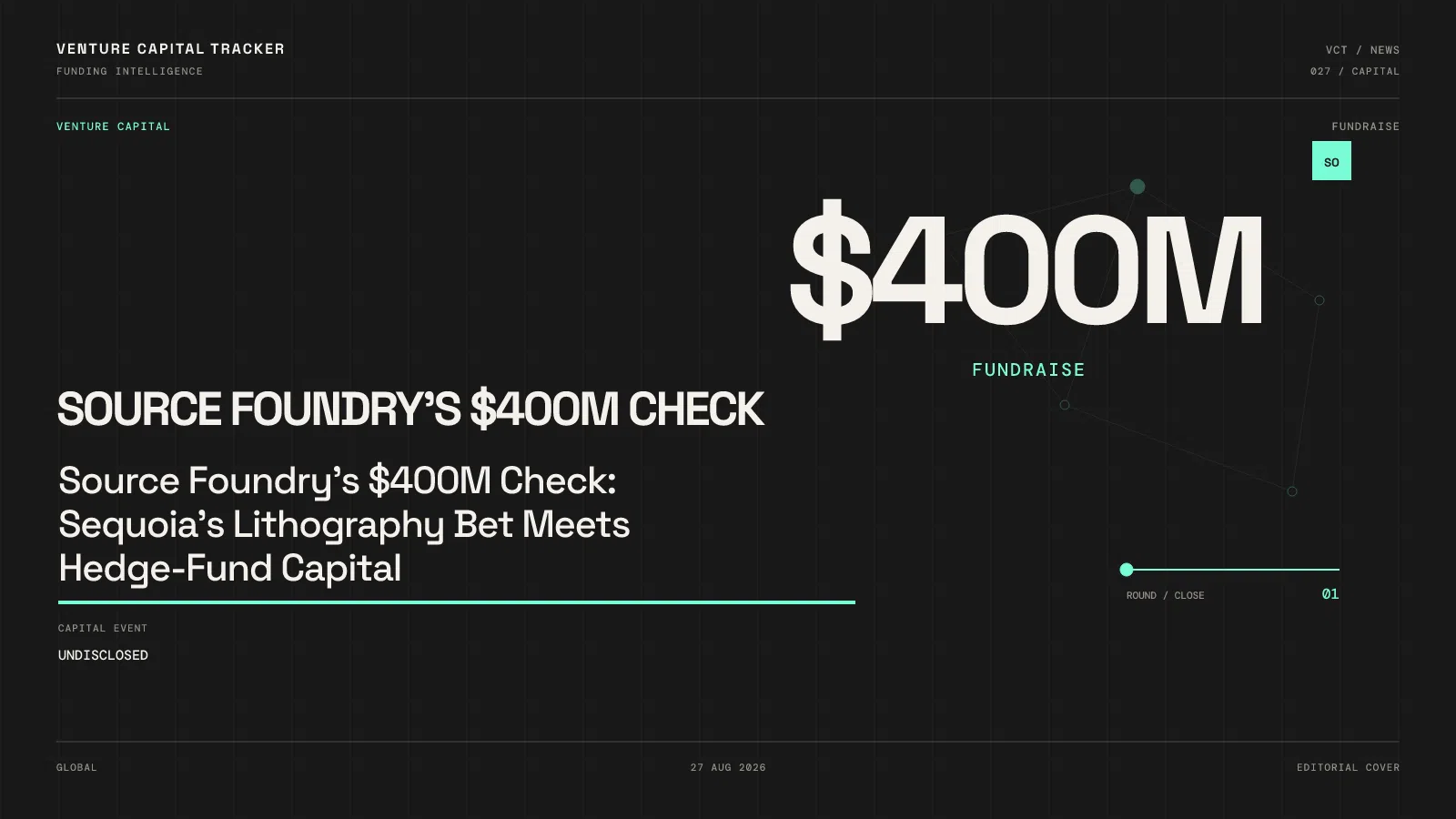
Source Foundry took a reported ~$400 million infusion from Leopold Aschenbrenner’s hedge fund Situational Awareness in early August 2026 — taking that fund’s stake to about $500 million — at a press-sourced valuation near $5 billion. The California stealth startup is already backed by Sequoia Capital. The product thesis is not “another AI chip”: it is lithography and fab tooling that could loosen ASML’s grip on the AI silicon chokepoint.
Deal details & investors
Funding event
Source Foundry
Led by Situational Awareness
Reported valuation ~$5B
Key facts
- Company
- Source Foundry (California; incorporated ~Jul 2025)
- Fresh capital
- ~$400M from Situational Awareness (week of Aug 7–9, 2026)
- Cumulative from SA
- ~$500M (prior ~$100M + new)
- Valuation (press)
- ~$5B
- Venture backer
- Sequoia Capital (Stephanie Zhan commentary)
- Founders
- Abdulmalik Obaid, Joe Burg (Stanford researchers)
- Category
- Semiconductor manufacturing equipment / lithography
Who uses the product — and for what job
Users (target): advanced logic foundries, IDMs, and eventually AI accelerator makers who need more wafers at leading nodes without waiting years for the next EUV tool queue.
Job: shrink the time, cost, and complexity of patterning advanced chips so AI demand (exponential software curve) is not permanently capped by linear industrial-equipment capacity.
Sequoia’s Zhan framed it plainly: AI demand grows on a software curve; fab capacity grows on an industrial-equipment curve. Source Foundry’s stated vision is to start from different physics and build something dramatically simpler and faster to manufacture.
Why now
- AI accelerators turned lithography lead times and ASML dependency into a strategic shortage, not a niche fab ops problem.
- Capital has already flooded models and GPUs; the next scarce layer is machines that make the chips.
- ASML EUV tools can cost >$400M each, take long build/install cycles, and define the industry’s throughput ceiling.
- Aschenbrenner’s fund cut most of its public AI book in July 2026, then concentrated remaining firepower into private AI-infrastructure bets (Anthropic retained; Source Foundry scaled).
Why Sequoia — and why Situational Awareness
Sequoia fits the classic hard-tech underwrite: category-defining infrastructure with multi-decade outcomes (see also Etched on inference silicon and Valar Atomics on power). Lithography tooling is the upstream of that stack.
Likely founder rationale for the hedge-fund check: raise a single megacheck from a thesis-aligned AI capital pool without resetting the board for a slow multi-GP Series process — while Sequoia remains the venture partner of record for governance and narrative.
| Capital type | What it brings |
|---|---|
| Sequoia | Venture diligence, category signaling, long-horizon partnership |
| Situational Awareness | Size + urgency; AI-infrastructure conviction after public unwind |
| Combined risk | Stealth physics bet + concentrated LP/hedge-fund capital |
We do not list Situational Awareness as a /fund/ entity — it is a hedge fund, not a VCT directory firm.
Competitive map
| Player | Lane |
|---|---|
| ASML | Incumbent EUV / DUV lithography monopoly economics |
| Canon / Nikon | Historical lithography; not EUV leaders today |
| Other U.S. lithography startups | Same “break the bottleneck” thesis; different physics claims |
| Etched / custom AI ASICs | Downstream of fab capacity — need tools like these to scale |
Market signal
A year-old stealth company absorbing ~$500M from one hedge fund at a reported $5B mark says private markets will price fab tooling optionality like model labs — even when commercial shipment dates are opaque. That is the opportunity and the diligence trap.
When not to use this as a template
- Wrong if you model it like a SaaS ARR company — physics and tool qualification dominate.
- Wrong if “ASML challenger” in a press headline is treated as a shipped product roadmap.
- Wrong if Situational Awareness’s public-market losses are ignored when underwriting secondary liquidity or follow-on capacity.
Practical takeaway
- Founders (deep tech): Pair Sequoia-grade narrative with a named bottleneck (lithography), not a vague “AI hardware” pitch.
- Investors: Separate primary issuance vs secondary uncertainty — reporting does not always clarify which this $400M was.
- Operators / scouts: Watch for foundry design-ins and tool specs; until then, treat valuation as a thesis price, not a comps set.
Follow Venture Capital Tracker on Google
Add VCT as a preferred source to see more of our venture-capital reporting in Google Search.
Editorial note: AI tools assisted with research, structure, or drafting. Venture Capital Tracker retains human editorial responsibility for factual accuracy, relevance, and source quality before publication.