· Investment Strategies · 2 sources · Updated · Verified
Qupital’s $300M Package: Series C Equity Plus MUFG ABS for E-Commerce Finance
Hong Kong’s Qupital announced $300M in combined Series C and ABS commitments on September 13–14, 2026, led by M Capital with MUFG and Quester — after claiming $9.5B+ cumulative loans. Equity vs ABS split and valuation were not disclosed.

By Venture Capital Tracker Editorial
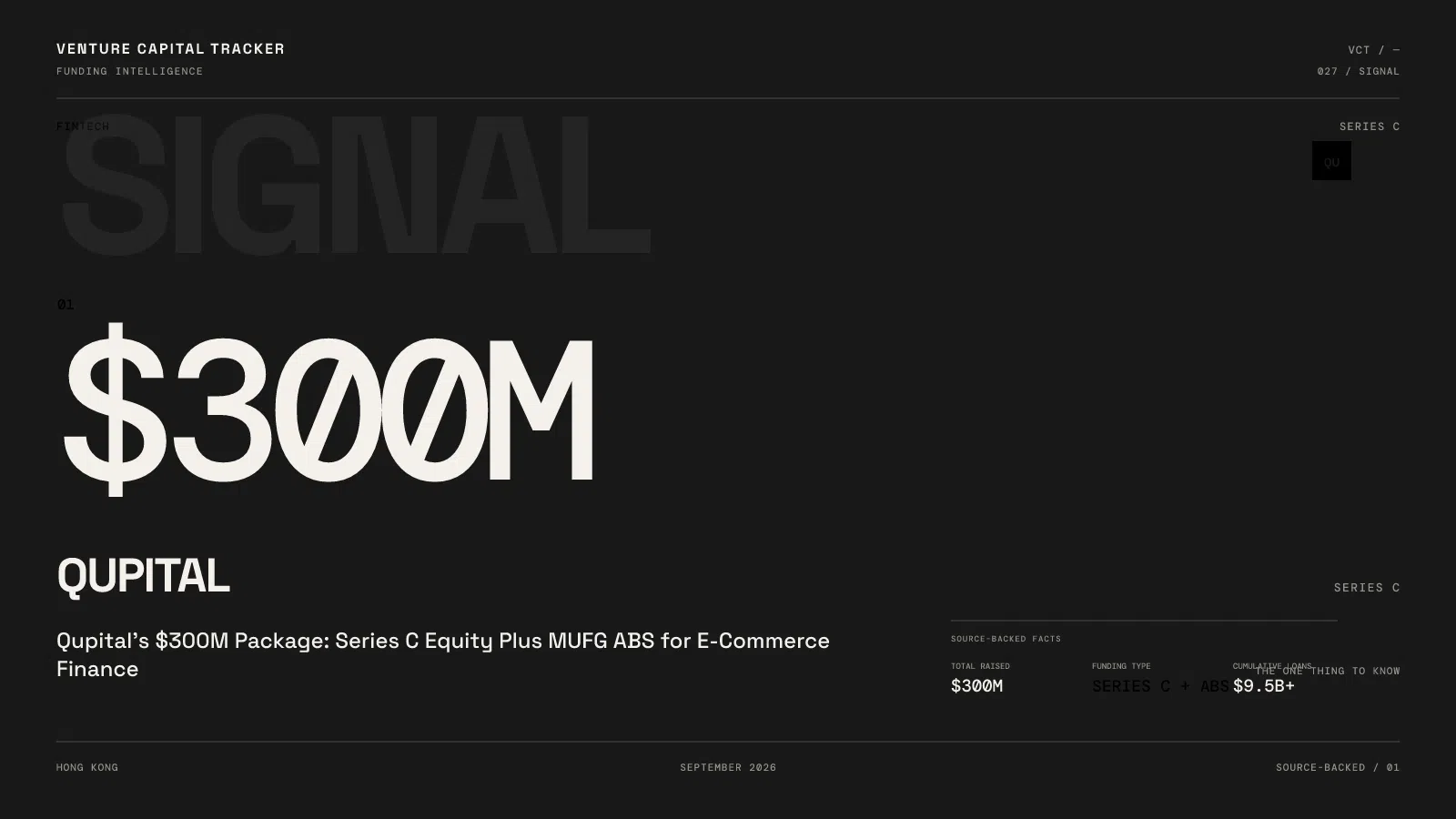
Qupital announced US$300 million in combined new capital commitments on September 13–14, 2026, anchored by a Series C led by Hong Kong asset manager M Capital, with ABS commitments from Mitsubishi UFJ Financial Group (MUFG) and Quester Capital. The company says cumulative loans processed have surpassed $9.5 billion. The equity vs ABS split and valuation were not disclosed (PR Newswire Asia).
This is a balance-sheet + securitization raise dressed as a Series C headline — the interesting number is whether marketplace-data underwriting can keep credit performance while the loan pool scales with bank ABS.
Key facts
- Company
- Qupital (qupital.com) — AI trade finance for cross-border e-commerce
- HQ
- Hong Kong
- Package
- $300M combined Series C + ABS commitments
- Equity lead
- M Capital
- ABS
- MUFG, Quester Capital
- Volume claim
- >$9.5B cumulative loans; tens of thousands of enterprises
- Platforms named
- Amazon, TikTok Shop, Tmall, JD.com, Pinduoduo
- Prior backers named
- Alibaba, MindWorks Capital, Greater Bay Area Homeland, HK ITVF
- Valuation / equity split
- Not disclosed
- Guidance
- Company expects profit margins >45% within 12 months
M Capital, MUFG, Quester, Alibaba, and MindWorks are not linked as /fund/ pages here.
Who uses the product — and for what job
Users: Cross-border e-commerce merchants and digital sellers who need working capital timed to marketplace settlement cycles — especially sellers whose cash is trapped in inventory and platform payout lags.
Job: Convert live sales / settlement data into underwriting so credit decisions move at marketplace speed. Qupital also markets itself to family offices and institutions as a path into e-commerce loan exposure via securitization.
Why merchants raise here: Traditional trade finance underwrites invoices and inventory slowly; marketplace-native lenders underwrite platform telemetry. That is the product wedge — and the risk surface if marketplace APIs or seller fraud patterns shift.
Why now
- Company narrative: double-digit growth in cross-border e-commerce leaves a “trillion-dollar liquidity gap” for SMEs (founder quote in the release — treat as thesis, not a measured TAM).
- AI automation is the underwriting thesis: founders argue agentic / social commerce compresses decision windows until human credit review cannot keep up.
- Capital-markets path: the release explicitly flags IPO, further fundraising, and M&A exploration — the $300M package is framed as runway into that chapter, not a terminal private mark.
Why M Capital + MUFG — portfolio fit
M Capital (Hong Kong alternative asset manager) leading the Series C is a regional growth-equity / credit-adjacent fit: the asset is a profitable (company-claimed) lending franchise that needs equity to expand markets (China, U.S., Japan, Southeast Asia named) while bank ABS multiplies loan capacity without putting the whole book on the startup’s equity balance sheet.
MUFG’s ABS commitment is the portfolio-fit tell. Banks buy structured exposure to performing SME / merchant cash flows when underwriting data is machine-auditable. If Qupital’s risk engine is real, MUFG is buying originator quality + data exhaust, not a splashy AI brand.
Do not treat “$300M Series C” as a priced equity round size until the company publishes the split. Label it Series C–anchored combined capital.
Competitive map
| Approach | Tradeoff |
|---|---|
| Marketplace lender programs (Amazon Lending, etc.) | Captive distribution; limited multi-platform sellers |
| Traditional trade finance / factoring | Proven credit boxes; slow for social commerce velocity |
| Pure BNPL / consumer credit | Different risk book; weak B2B inventory fit |
| Qupital multi-marketplace AI underwriting | Data breadth; must prove loss rates as ABS scales |
What is not proven
- Equity dollars vs ABS capacity inside the $300M.
- Valuation, ownership, and Series letter economics.
- Audited profitability, vintage loss curves, and the >45% margin guide.
- How much of the $9.5B cumulative volume is still outstanding vs repaid.
Practical takeaway
- Founders (fintech lending): Pair equity for geography with ABS for book size — and publish the split if you want Series C headlines to stick.
- Investors: Diligence loss rates and marketplace concentration before underwriting the AI story; MUFG’s presence is a credit diligence signal, not a valuation mark.
- Operators / merchants: Relevant if you sell across Amazon / TikTok Shop / Tmall-style platforms and need working capital that prices off live settlement data.
Follow Venture Capital Tracker on Google
Add VCT as a preferred source to see more of our venture-capital reporting in Google Search.
Last updated:
Editorial note: AI tools assisted with research, structure, or drafting. Venture Capital Tracker retains human editorial responsibility for factual accuracy, relevance, and source quality before publication.