· Investment Strategies · 6 sources
Pixxel’s $100M Series C: Temasek and Seraphim Bet on Indian Hyperspectral Infrastructure
Temasek and Seraphim co-led Pixxel’s $100M Series C — India’s largest single space-tech private round — taking total funding to $195M as Firefly, Honeybee, and Aurora scale after NASA and NRO contracts.

Editorial team
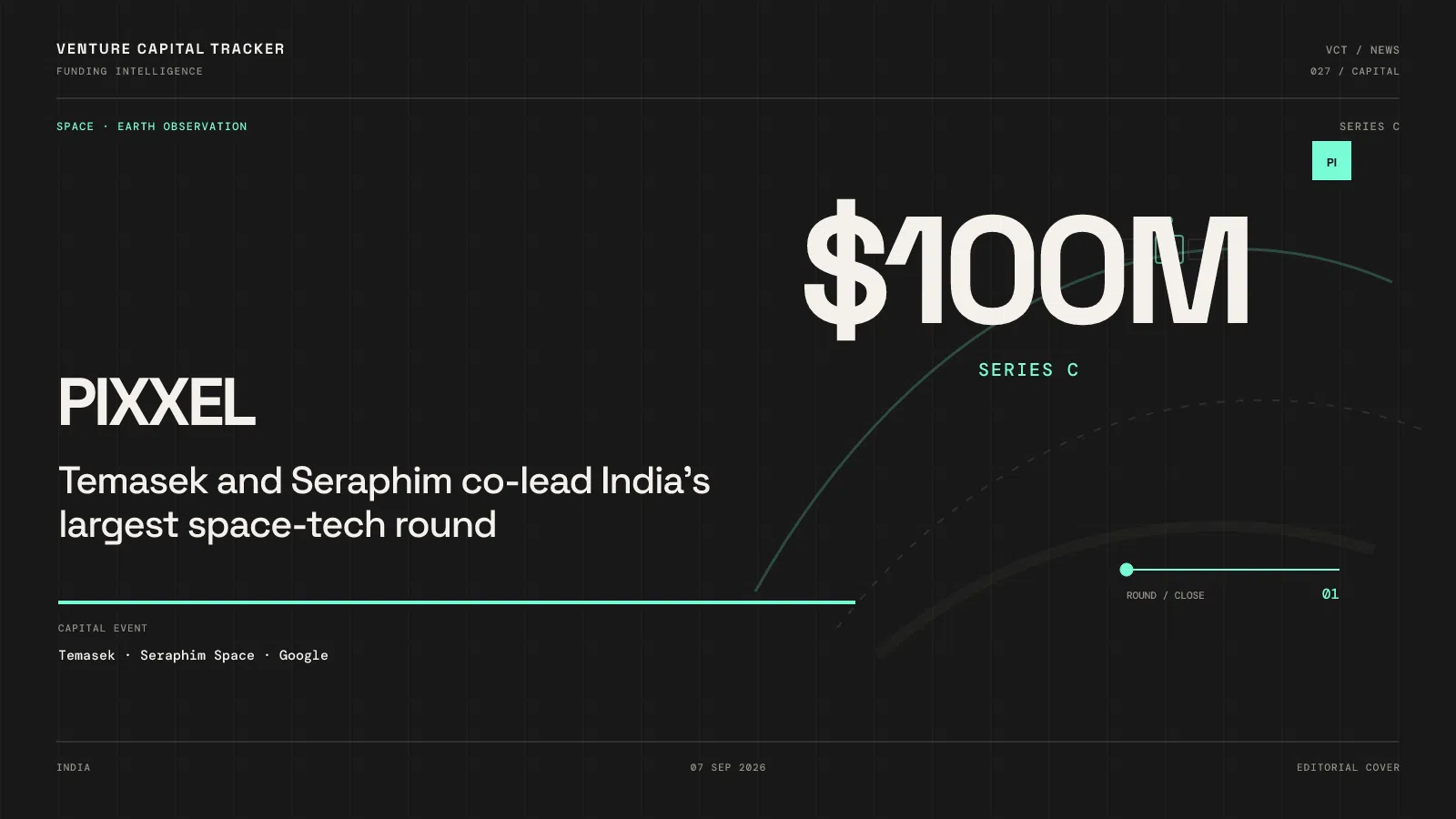
Temasek and Seraphim Space co-led Pixxel’s $100 million Series C, taking the Bengaluru hyperspectral company to $195 million in total funding — what the company calls the largest single private round for an Indian space-tech startup (Reuters / VCCircle, September 7, 2026). Existing backers Radical Ventures and growX Ventures returned; 360 ONE Asset and IMM Investment joined. Google remains an earlier Series B investor.
Spine: Pixxel is no longer only a constellation story — the cheque underwrites sensors + Aurora software + sovereign manufacturing after U.S. civil and intelligence contracts proved buyers will pay for spectral bands conventional imagery cannot see.
Key facts
- Company
- Pixxel (Bengaluru; U.S. presence)
- Founders
- Awais Ahmed, Kshitij Khandelwal (2019)
- Round
- $100M Series C → $195M cumulative
- Co-leads
- Temasek, Seraphim Space Investment Trust
- Prior path
- $25M Series A (2022, Radical); $36M Series B (2023, Google); $24M B extension (Dec 2024) → $60M Series B / $95M total pre-C
- On orbit
- Six Firefly hyperspectral satellites (company)
- Valuation
- Not company-disclosed; TOI/Entrackr sources ~$400–500M
- Use of proceeds
- Honeybee / SWIR + high-res optical; Aurora scale; sovereign spacecraft work; Gigapixxel manufacturing
Who uses the product — and for what job
Users: agriculture and environmental analysts, commercial Earth-observation buyers, and government missions that need material/condition signatures — not just prettier pictures.
Job: turn hundreds of narrow spectral bands into decision-ready layers (crop stress, minerals, gas/deforestation signals) via Firefly data and the Aurora platform.
Named proof points (dated):
- NASA Commercial SmallSat Data Acquisition On-Ramp contract (announced Sep 2024; performance through Nov 2028) for hyperspectral research datasets.
- NRO Strategic Commercial Enhancements award (May 2026) to evaluate/integrate commercial hyperspectral into multi-phenomenology architecture — alongside vendors such as ICEYE and EarthDaily in the same SCE tranche.
- Indian programs cited in company/press coverage: MoD iDEX challenges and IN-SPACe public-private EO constellation work.
Contract dollar values for NRO/NASA awards were not published in the materials reviewed — treat awards as capability proof, not disclosed ARR.
Why now
- India’s private space window (post-2020 reforms / IN-SPACe) is moving from demos to fleet + factory capital.
- U.S. civil/intel buyers are deliberately diversifying commercial phenomenology; hyperspectral is on that shopping list.
- Peer context: Skyroot’s unicorn mark raised the ceiling for Indian space valuations; Pixxel’s raise is the EO/sensing counterweight to launch narratives.
Why Temasek + Seraphim — portfolio fit
| Dimension | Fit |
|---|---|
| Temasek | Sovereign-scale capital comfortable with multi-year infra and Asia hard-tech; prior Indian space adjacency (e.g. Skyroot coverage elsewhere) |
| Seraphim | Specialist space VC / London-listed trust — follows constellation + ground-software theses across the stack |
| Founder rationale | Need patient balance-sheet for satellites and manufacturing, plus buyers who understand dual-use EO — not consumer SaaS pacing |
| Prior syndicate | Radical (Series A lead), Google (Series B), Lightspeed/Blume/Glade Brook cited historically — Series C adds SWF + space specialist density |
Temasek, Seraphim, Radical Ventures, growX, 360 ONE, and IMM are not in our /fund/ directory — editorial names only. Do not invent fund pages.
What remains undisclosed
- Exact post-money valuation (media band only)
- Revenue, backlog, or take-or-pay contract value
- Capex split between satellites vs Aurora vs Gigapixxel
- How much of “sovereign” demand is India vs export
Competitive map
Adjacent to Planet, Maxar/Vantor-class optical, ICEYE radar, and other hyperspectral entrants. Pixxel’s claim is spectral depth + Aurora workflow, not being the only EO vendor. Skyroot remains the better comparison for India capital formation, not product overlap.
Takeaway
$100M is manufacturing-and-sensing money after the hard part — getting U.S. agencies to put hyperspectral on a commercial evaluation path — already started. The open diligence question is whether Aurora and sovereign builds convert constellation cost into recurring software/data revenue before the next raise.
Follow Venture Capital Tracker on Google
Add VCT as a preferred source to see more of our venture-capital reporting in Google Search.
Editorial note: AI tools assisted with research, structure, or drafting. Venture Capital Tracker retains human editorial responsibility for factual accuracy, relevance, and source quality before publication.