· Venture Capital · 7 sources · Verified
Flapping Airplanes Raises $1B to Make AI More Efficient
Index and Lux co-led the AI lab's $1B Series A. Here is its chip-efficiency strategy, the reported $6B valuation and the commercial proof still needed.

By VCT Editorial
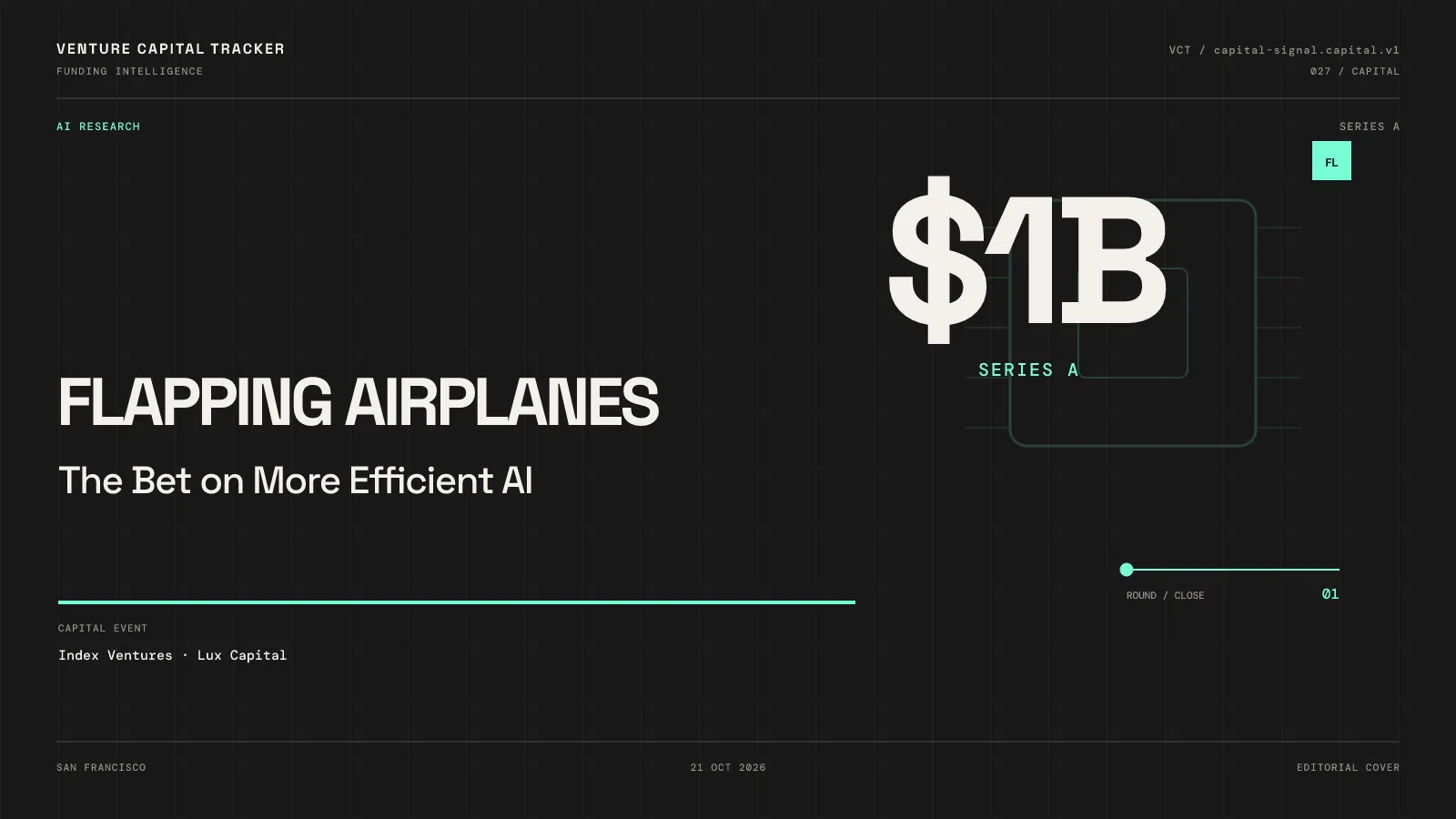
Flapping Airplanes announced a $1B Series A on October 21, 2026, co-led by Index Ventures and Lux Capital. The San Francisco AI lab is pursuing a costly question: can better software and learning methods get substantially more intelligence from existing chips and less training data?
The company's announcement confirms the round. Bloomberg reports a $6B valuation including the new money—a post-money valuation—with Sequoia, GV and Kleiner Perkins also participating. The financing backs research; it does not establish a profitable business or independently proven efficiency gains.
The company previously raised a $180M seed in January, according to TechCrunch.
What the lab is trying to change
Training teaches an AI model; inference is the work it does when answering a request. Both consume expensive computing resources. Flapping Airplanes wants to improve the software controlling those resources while researching models that learn from less data.
Its immediate technical focus is a megakernel: one GPU program combining work that would otherwise run in separate steps. The company says its framework can combine entire training runs, inference and even video games within a single kernel. It also claims it can overlap inference waiting for data with training doing calculations.
An illustrative example is a research team training tomorrow's model while serving today's users. If complementary workloads can share a chip effectively, some otherwise idle capacity could do useful work. That is the proposed mechanism, not a published customer saving. Whether it helps depends on the workload and on keeping response times predictable.
This systems work and the lab's broader learning research address different problems. Using a GPU more efficiently does not, by itself, prove a model can learn from fewer examples.
Why Index invested again
In its October 21 investment memo, Index partners Mark Xu and Shardul Shah describe a team working across chip-level software, model training and deployment. Xu is joining the board.
Their argument is that compute and data constraints create room for a company that improves several layers together. They identify robotics, trading and life sciences as potential markets where costs or scarce data limit adoption. Those are the investor's target opportunities, not a disclosed customer list.
The approach extends the rationale Sequoia's David Cahn set out in January: fund fundamental research with enough independence and time to test unconventional ideas. Founders Ben and Asher Spector and Aidan Smith are being backed for a research direction, rather than an established sales engine.
The commercial question is still open
The company announcement and investor memo do not disclose paying customers, revenue, pricing or a commercial launch timetable. There is therefore no supported basis for describing Flapping Airplanes as an API subscription business, a software licensor or a GPU cloud provider.
Potential buyers would have to see an advantage over their existing training and inference software. Switching means more than showing a fast demonstration: teams need compatibility with their models, reliable operations and an improvement large enough to justify integration work.
That makes the next evidence especially important. A reproducible comparison should hold model quality and hardware constant, report the full cost of useful work, and include response-time requirements. Faster execution that sacrifices answer quality or creates unpredictable delays may not improve the customer's economics.
Other investors are funding the same cost problem
Two verified financings show different routes through AI infrastructure:
- Inferact raised $150M in January 2026, co-led by Andreessen Horowitz and Lightspeed, according to its legal adviser Cooley. The vLLM founders' company concentrates on inference software, rather than Flapping Airplanes' broader learning research. VCT's Inferact explainer covers that distinction.
- Together AI announced a $305M Series B in February 2025, led by General Catalyst and co-led by Prosperity7. Its company-issued release described a cloud platform spanning training, fine-tuning and inference. That historical round is an adjacent business comparison, not a new October financing.
VCT's assessment is that the investment opportunity spans both making existing models cheaper to run and changing how models learn. Flapping Airplanes is attempting both. Its $1B gives the lab room to pursue that ambition; the decisive test will be whether a reproducible technical advantage becomes something customers can use and will pay for.
Follow Venture Capital Tracker in Google
Add VCT as a preferred source to make our venture-capital coverage easier to find in Google Search.
Editorial note: AI tools assisted with research, structure, or drafting. Venture Capital Tracker retains human editorial responsibility for factual accuracy, relevance, and source quality before publication.