OpenAI's $122B Round Pushes U.S. VC to an All-Time Record in Q1 2026
OpenAI's massive private round cemented the Bay Area as the global AI capital hub, accounting for an outsize share of Q1 2026's record venture totals.
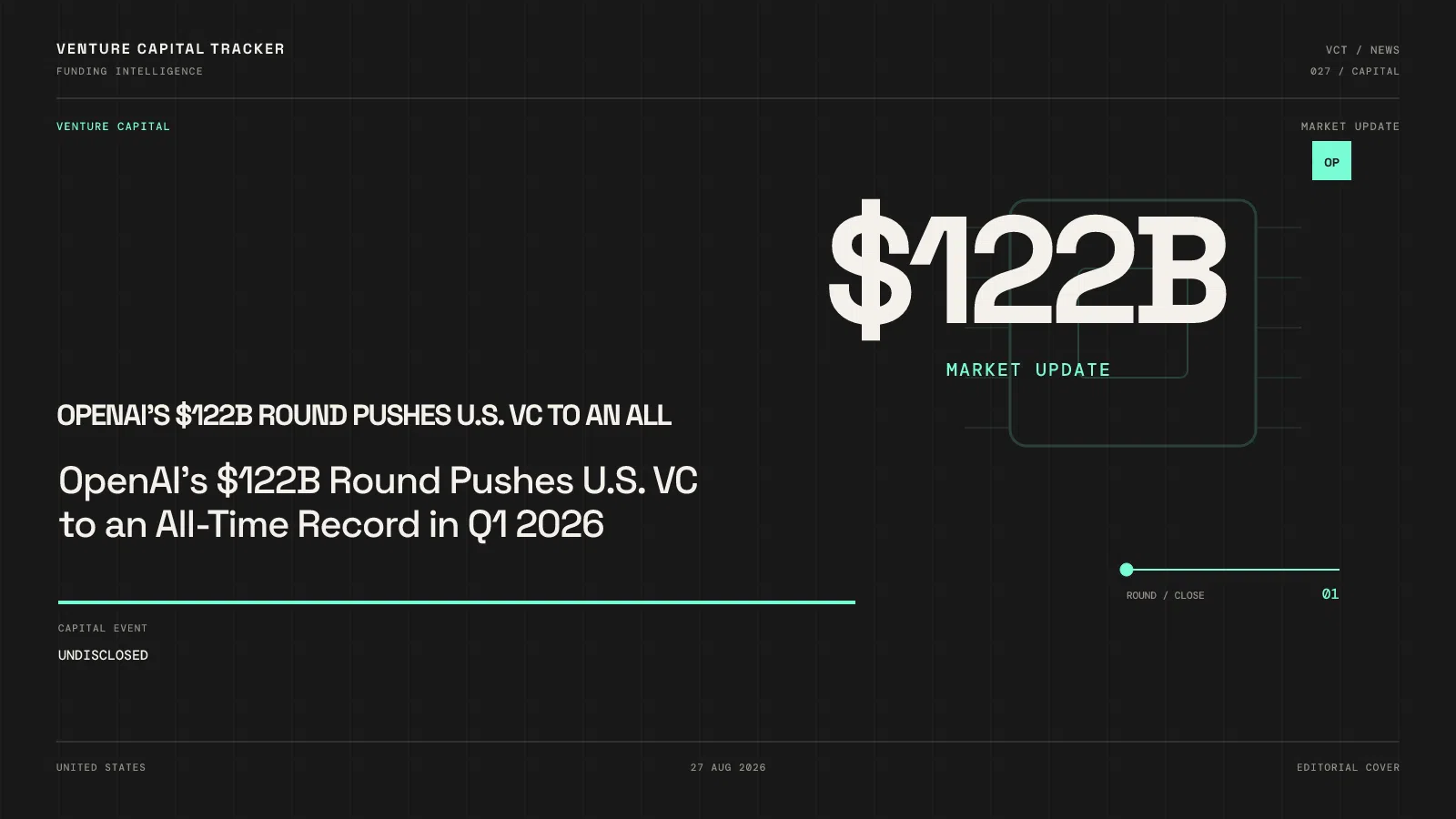
OpenAI's $122 billion private round, announced in Q1 2026, helped push U.S. venture funding to an all-time quarterly record. Crunchbase and San Francisco Business Times coverage reported roughly $250B raised by U.S.-based startups in Q1 2026 — about 83% of the global total — with AI companies taking the lion's share.
The story behind the number
OpenAI's raise is not a typical equity round so much as a capital-stack reconfiguration to fund the compute, datacenter, and chip commitments that frontier models now require. Reported spending plans include hundreds of billions of dollars in multi-year infrastructure obligations.
Why Q1 2026 was structurally unusual
- Single-company concentration: A handful of AI companies (OpenAI, xAI, Anthropic) absorbed most of the quarter's dollars.
- Corporate investors: Microsoft, Nvidia, Amazon, Google, and Oracle now act as capital, compute supplier, and distribution partner simultaneously.
- Infrastructure tilt: Inference, chip design, and datacenter dollars grew faster than model-layer spend in percentage terms.
Competitive map
- Anthropic ($30B Series G at $380B).
- xAI ($20B Series E in January 2026).
- Mistral ($1.7B Series C; $830M debt for a Paris datacenter).
- Databricks (~$4B+ Series L; $134B valuation, late 2025).
Market signal (the number to remember)
- ~$250B in U.S. Q1 2026 funding, with AI north of 70% of dollars deployed.
Practical takeaway (operator + investor)
- Founders outside AI foundation models: Do not benchmark your round against OpenAI. Size checks against your own sector and capital efficiency.
- Investors: The "mega round" era compresses fund math. Most LP-facing returns in 2026 will be earned in Series A and B checks into applied AI, not in late-stage foundation model rounds.
- Operators: Expect pricing pressure on compute to ease only when more chip and datacenter capacity comes online — plan 2026/2027 cost curves accordingly.
Sources
- San Francisco Business Times: https://www.bizjournals.com/sanfrancisco/news/2026/04/03/venture-capital-us-q1-startups-record.html
- Crunchbase News (Q1 2026 global data): https://news.crunchbase.com/venture/record-breaking-funding-ai-global-q1-2026/
- Bay Area concentration analysis: https://theaieconomy.substack.com/p/ai-vc-2025-bay-area-concentration
Editorial note: AI tools assisted with research, structure, or drafting. Venture Capital Tracker retains human editorial responsibility for factual accuracy, relevance, and source quality before publication.