· Investment Strategies · 1 source
Lyte’s $165M Series C at $1.6B: Custom Silicon for Robot Perception
Maverick Silicon led Lyte’s $165M Series C at a $1.6B post-money valuation — former Apple/PrimeSense engineers shipping synchronized vision silicon for physical AI, with Fidelity returning from the Series B.

Editorial team
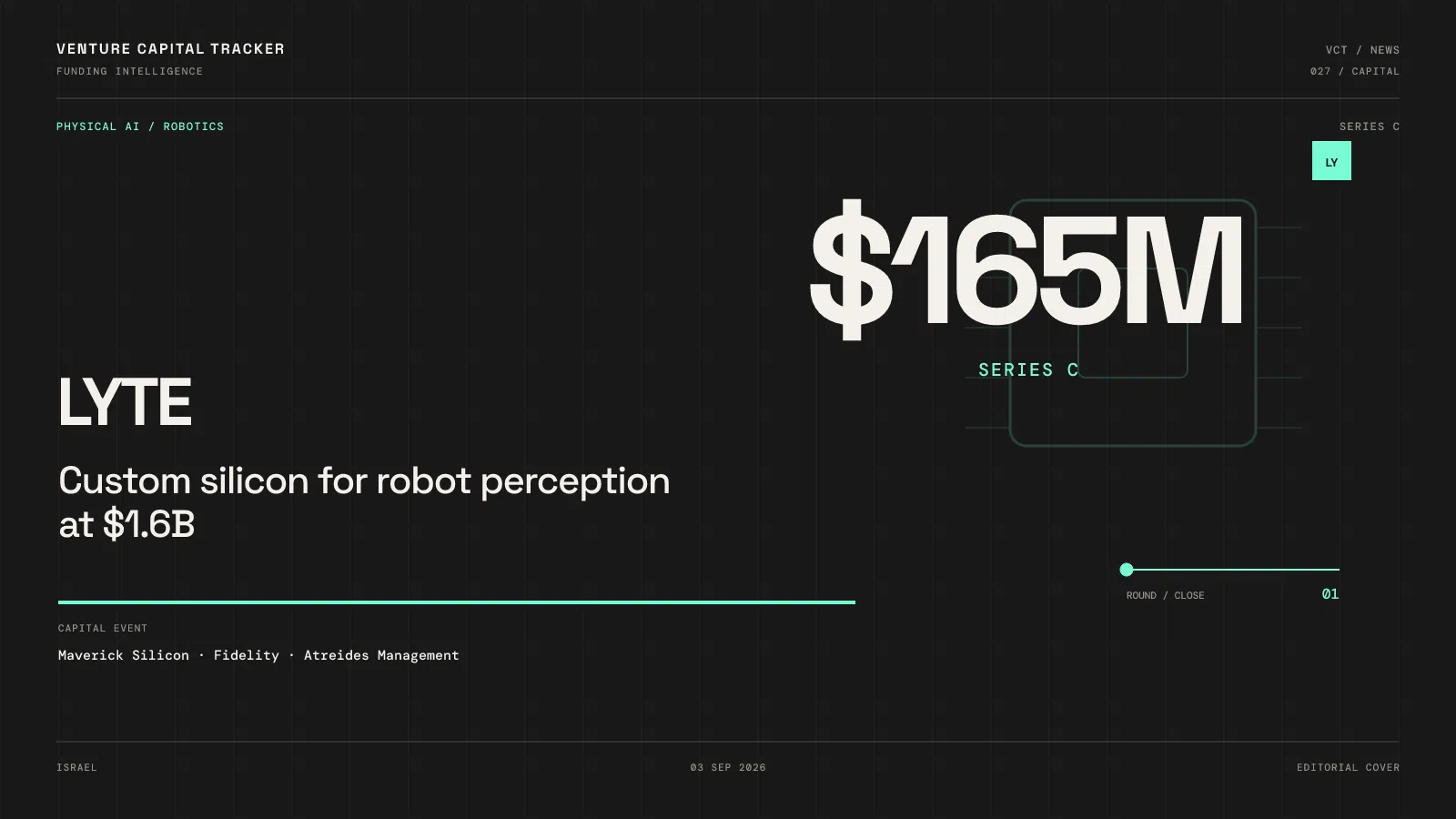
Maverick Silicon led Lyte’s $165 million Series C on September 2, 2026, at a $1.6 billion post-money valuation (SiliconANGLE). Fidelity — which led the Series B — returned; Atreides Management, Key1 Capital, and Ora Global joined.
Spine: physical AI is drowning in foundation-model capital while robots still run on commodity cameras that were never designed as a synchronized system. Lyte’s bet is category ownership via custom sensing silicon.
Key facts
- Company
- Lyte (Lyte AI Inc.)
- Round
- $165M Series C
- Valuation
- $1.6B post-money
- Lead
- Maverick Silicon
- Returning
- Fidelity Management & Research (Series B lead)
- Product
- LyteVision — silicon + multimodal sensors + spatial software
- Origin
- Stealth launch January 2026; founders from Apple / PrimeSense (Face ID / Kinect lineage)
Who uses the product — and for what job
Users: robotics platform companies and industrial operators embedding perception stacks into autonomous machines.
Job: give robots source-faithful spatial data — vision, imaging, and inertial signals orchestrated in silicon — so models act on measurements rather than noisy, drift-prone reconstructions from random off-the-shelf parts.
CEO Alexander Shpunt’s line in SiliconANGLE: “Physical AI has a sensing problem before it has a model problem.”
Why now
- Model training budgets exploded; deployed robots still fail on calibration drift, latency, and mismatched sensors.
- Stealth-to-$1.6B inside calendar 2026 is the anomaly — investors are pricing a hardware category bet, not another perception SaaS.
- Use of proceeds: scale silicon/sensor production, advance perception AI, expand deployments (company via SiliconANGLE).
Why Maverick Silicon — portfolio fit
Maverick Silicon is a semiconductor / deep-tech lead, not a classic SaaS growth fund. That matches Lyte’s claim that “owning the silicon separates companies that define a category from those that participate in one” (Chairman Avigdor Willenz).
Likely founder rationale: raise from investors who underwrite fabs, BOM, and production risk, with Fidelity providing public-market-adjacent scale capital for the Series C.
Maverick Silicon, Fidelity, Atreides, Key1, and Ora Global are covered without inventing /fund/ pages — none currently sit in our directory.
Competitive map
| Approach | Tradeoff |
|---|---|
| Off-the-shelf cameras + IR/LiDAR glued in software | Fast to prototype; noisy, drift-prone at scale |
| LyteVision integrated silicon stack | Higher control / cost; category-definition bet |
| Pure software perception startups | Compete on models; depend on whoever ships sensors |
Adjacent VCT reads: defense robotics (Aitan) needs orchestration; Lyte is the sensing substrate layer.
What is not proven
- Named commercial robot OEMs and unit volumes are not disclosed.
- Revenue / gross margin on silicon not disclosed.
- Prior round size and exact Series B valuation not in the SiliconANGLE piece.
Practical takeaway
- Founders (physical AI): If your demo depends on USB cameras, you are fundraising into Lyte’s critique — show sensor fidelity, not only model demos.
- Investors: Diligence production readiness and customer design-wins; a $1.6B stamp does not equal shipped BOM.
- Operators: Relevant if you are an OEM stuck debugging perception noise that models cannot fix.
Sources
Follow Venture Capital Tracker in Google
Add VCT as a preferred source to make our venture-capital coverage easier to find in Google Search.
Editorial note: AI tools assisted with research, structure, or drafting. Venture Capital Tracker retains human editorial responsibility for factual accuracy, relevance, and source quality before publication.