· Investment Strategies · 2 sources · Updated
Lumilens’ $700M Series C at $5.51B: AI’s Bottleneck Moved from GPUs to Wiring
BCV, Spark, and peers co-led Lumilens’ $700M+ Series C as the San Jose optical interconnect startup ships into a hyperscaler under a multi-billion customer agreement.

Editorial team
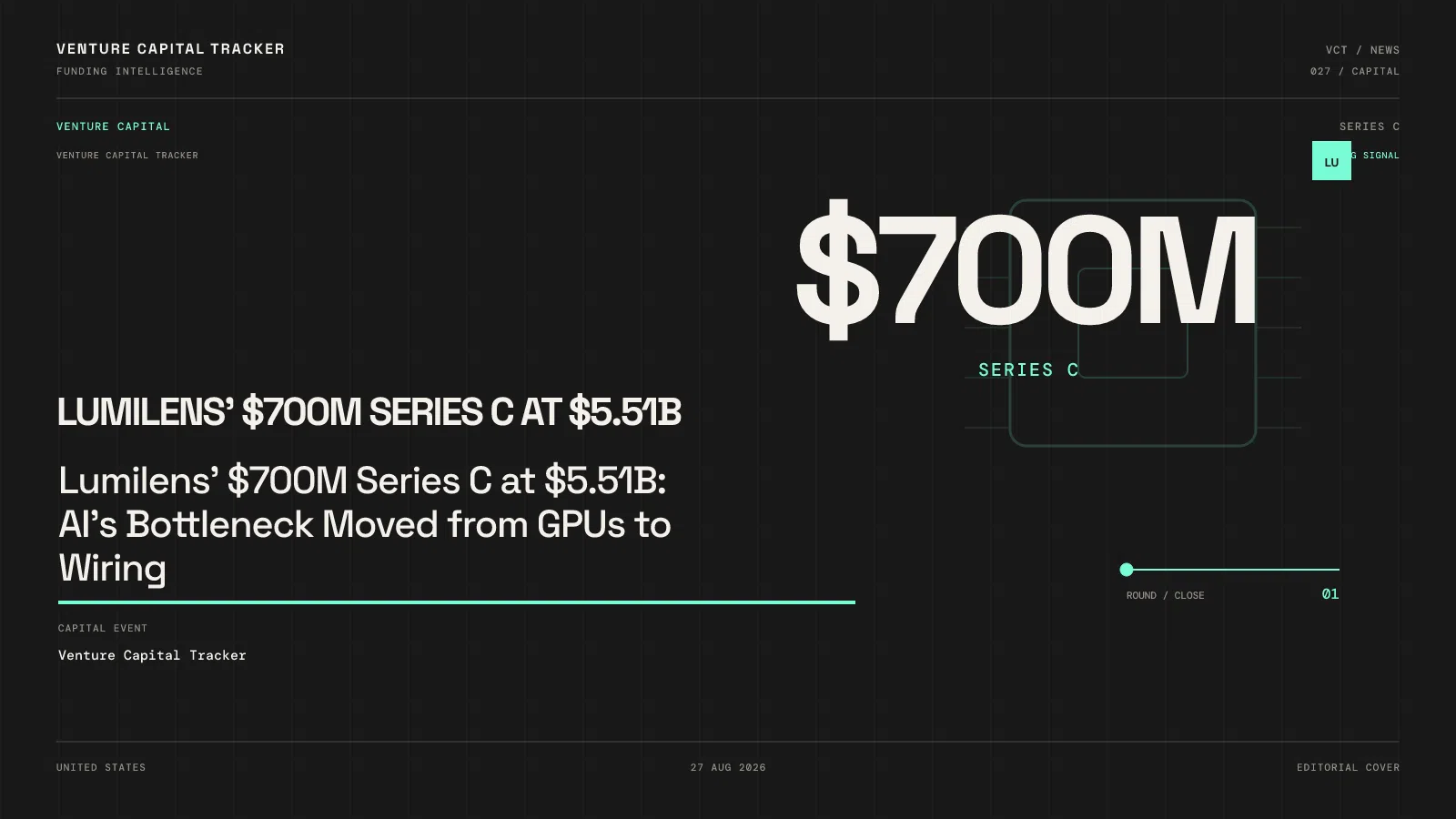
Lumilens came out of stealth on August 6, 2026 with more than $700 million in Series C capital at a $5.51 billion valuation — $900M+ cumulative. Co-leads include Bain Capital Ventures, Spark Capital, Atreides, Meritech, and Seligman, with Addition and Redpoint Ventures among participants. The pitch in one line: you can buy GPUs faster than you can wire them.
For comparable companies and investment activity, see VCT's 2026 AI infrastructure funding and market map.
Key facts
- Company
- Lumilens (San Jose)
- Round
- >$700M Series C · $5.51B valuation
- Date
- Announced August 6, 2026
- Co-leads
- Atreides, Bain Capital Ventures, Meritech, Seligman, Spark Capital
- Notable participants
- Addition, Redpoint, Qualcomm Ventures, Peak XV, Mayfield, JP Morgan Private Capital
- Cumulative
- >$900M
- Product
- LumiCore: NPO/CPO scale-up optics + 800G/1.6T+ scale-out pluggables
- Traction
- Shipping into hyperscaler production; multi-billion customer agreement (company)
- Founder
- Ankur Singla (CEO); team from Cisco, Juniper, Meta, Marvell, Lumentum, Coherent
Who uses the product — and for what job
Users: hyperscaler infrastructure teams building frontier training and serving clusters — the buyers who already know copper and transceiver supply are the constraint.
Job (two fabrics):
- Scale-out — more 800G/1.6T optical capacity between racks/rows as GPU counts explode.
- Scale-up — replace copper’s ~1.5 meter electrical reach so thousands of GPUs can act as one tightly coupled computer via near-package / co-packaged optics.
Company math worth remembering: a 400,000-GPU site needs >2.4 million transceivers. McKinsey shortfall estimates cited by Lumilens put 800G supply 40–60% short through 2027.
Why now
- Capex moved from “can we get H100s?” to “can the fabric keep up?”
- Citigroup’s $2.8T by 2029 AI hardware spend framing made connectivity a first-class infrastructure bet.
- Nvidia and the broader market already signaled photonics is strategic; startups that ship + manufacture beat slideware.
- Two-year path from founding (2024) to hyperscaler production is the surprise investors are paying for.
Why these investors — portfolio fit
| Firm | Fit |
|---|---|
| Spark Capital | Led Series B (early 2025); Series C is a conviction double-down on manufacturing + systems |
| Bain Capital Ventures | Infra/enterprise muscle for a company that must sell into hyperscaler qualification gauntlets |
| Addition / Redpoint | Multi-stage AI infra participation without needing to invent a new thesis |
Likely founder rationale: raise a manufacturing war chest from investors who already know Ankur’s prior companies (Mayfield’s Navin Chaddha notes a third partnership) and will fund fabs/partners/test automation, not just another networking software layer.
Competitive map
| Player | Lane |
|---|---|
| Incumbent optics (Coherent, Lumentum, etc.) | Volume pluggables; less full-stack NPO/CPO + manufacturing story |
| Nvidia / in-house photonics | Strategic competitor-partner dynamic for scale-up |
| Other CPO/NPO startups | Crowded interconnect category — execution and hyperscaler design-wins decide |
| Copper DAC/AEC vendors | Still win short reaches; physics caps AI scale-up domains |
When not to underwrite this like SaaS
- Wrong if you invent an ARR multiple — the story is qualified shipments + capacity.
- Wrong if “multi-billion agreement” is treated as recognized revenue.
- Wrong if you ignore supply-chain concentration risk in optics manufacturing.
Practical takeaway
- Founders (AI infra hardware): Pair physics claims with a named production path and a manufacturing product plan — Lumilens’ interposer/robotics story is half the memo.
- Investors: Diligence customer concentration (one hyperscaler?) and yield curves as hard as TAM slides.
- Operators: Ask which fabric ships first (scale-out pluggables vs CPO/NPO) and what still depends on copper inside the rack.
Last updated:
Editorial note: AI tools assisted with research, structure, or drafting. Venture Capital Tracker retains human editorial responsibility for factual accuracy, relevance, and source quality before publication.