Simple Energy Raises ₹1,750 Crore Series C to Scale Electric Scooters
Simple Energy closed a ₹1,750 crore ($180M) all-equity Series C led by Arokiaswamy Velumani’s family office to expand production, factories and service.
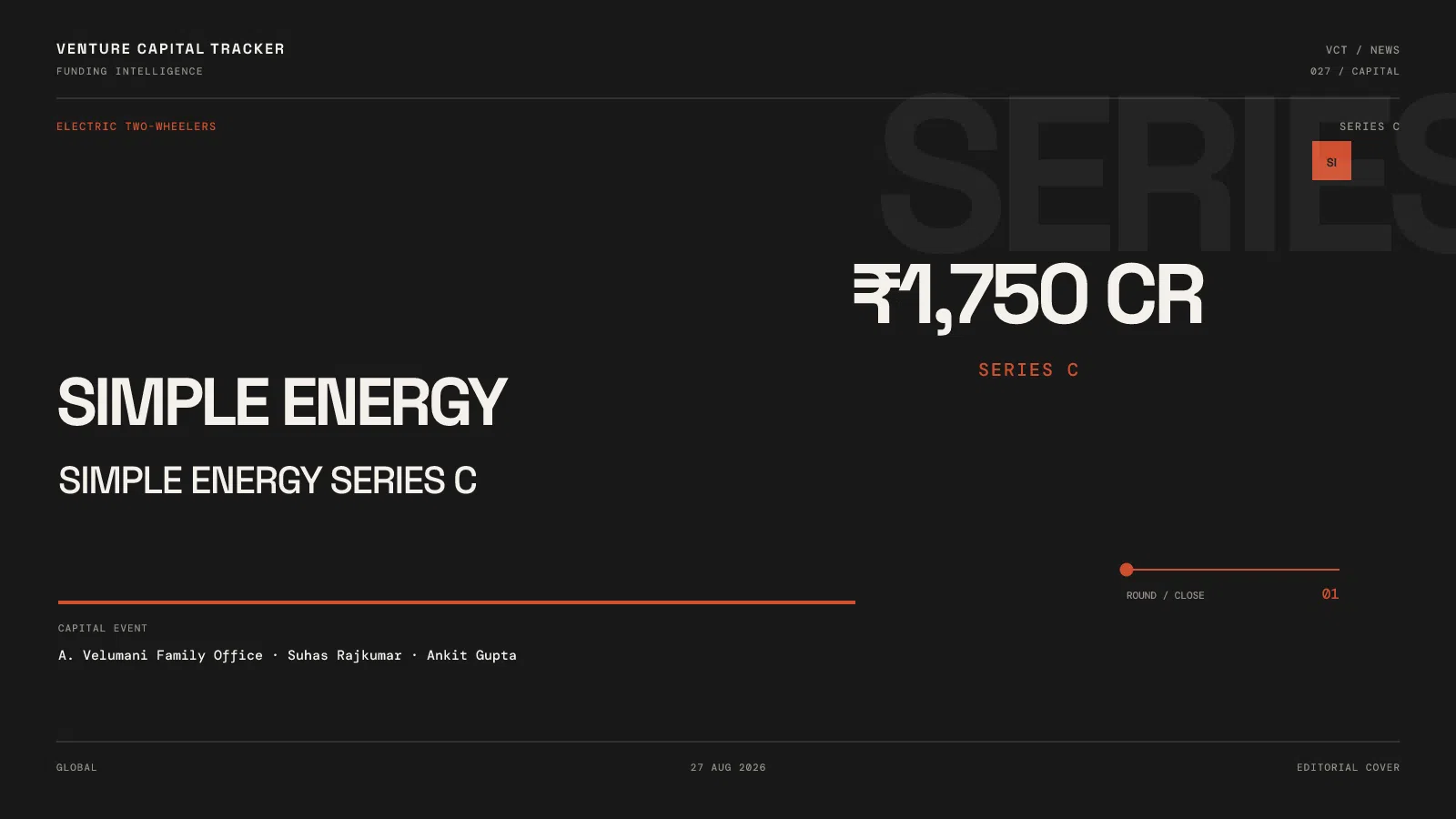
Simple Energy has closed a ₹1,750 crore Series C—about $180 million—entirely in equity, giving the Indian electric-scooter maker fresh capital for a second factory, higher production and a larger sales-and-service network.
The round was led by the family office of Thyrocare founder Dr. Arokiaswamy Velumani. Founder and CEO Suhas Rajkumar, co-founder and CFO Ankit Gupta, Bengaluru investor Amit Mishra and Haran Family Office also participated. The company did not disclose its valuation or the ownership issued.
Simple Energy Series C at a glance
| Item | Detail |
|---|---|
| Amount | ₹1,750 crore, approximately $180 million |
| Instrument | Equity |
| Stage | Series C |
| Lead | Arokiaswamy Velumani Family Office |
| Other participants | Suhas Rajkumar, Ankit Gupta, Amit Mishra, Haran Family Office |
| Announced | September 30, 2026 |
| Valuation | Not disclosed |
What the new capital is meant to change
Simple Energy says it will use the Series C for a new manufacturing facility, additional production, hiring, research and development, and expansion of its retail and service footprint. Those are linked problems. Increasing factory output without parts availability, service coverage and enough stores can turn capacity into working-capital pressure rather than growth.
The company currently reports more than 80 outlets across roughly 60 Indian cities. Its Hosur operation can produce about 10,000 vehicles a month, while reporting cited by Moneycontrol says current output is closer to 3,000. That utilization gap makes the financing less about proving Simple Energy can design a scooter and more about building a repeatable manufacturing-and-distribution system.
Simple Energy’s range now includes the Simple One, OneS, Wave and Ultra. The company develops major systems—including its chassis, battery, motor and software—in-house. Vertical integration can improve product control and gross margin, but it also means more capital is tied up in engineering, tooling, components, warranties and after-sales support.
Why the capital structure matters
The new Series C is all equity. That distinguishes it from Simple Energy’s June financing of ₹250 crore, which combined roughly ₹127 crore of equity with ₹123 crore of debt. Calling the two packages equivalent would overstate comparable venture capital.
Public reporting places total capital raised at approximately ₹2,530 crore after the Series C. The company says it does not expect another private round before a targeted fiscal-2028 IPO. That target is a management plan, not a completed filing or guaranteed timetable.
The competitive test
Simple Energy competes with startup manufacturers such as Ola Electric and Ather Energy and with scaled incumbents including TVS Motor and Bajaj Auto. Product specifications alone are unlikely to decide the market. The investment case now rests on four operating metrics:
- monthly production and factory utilization;
- store and service-center productivity;
- warranty and battery-replacement costs; and
- cash required for inventory and network expansion.
The company says monthly sales have increased more than fourfold over the past year. That figure should be treated as company-reported until supported by audited financial or registration data. The round gives Simple Energy the balance-sheet capacity to grow, but it also raises the execution bar: ₹1,750 crore is large enough that investors will expect measurable progress in deliveries, service coverage and manufacturing efficiency.
Bottom line
Simple Energy’s ₹1,750 crore Series C is one of the largest private financings in India’s electric two-wheeler sector. It is a confirmed all-equity close, not a mixed facility. The strongest analytical angle is whether a vertically integrated challenger can turn capital into dependable production and nationwide service before the planned IPO window.
_Funding figures and operating claims are presented for research and educational purposes and are not investment advice._
Follow Venture Capital Tracker in Google
Add VCT as a preferred source to make our venture-capital coverage easier to find in Google Search.
Editorial note: AI tools assisted with research, structure, or drafting. Venture Capital Tracker retains human editorial responsibility for factual accuracy, relevance, and source quality before publication.