· Investment Strategies · 4 sources
Jet Zero’s ~$21.6M Series C: Qantas, Airbus, and POSCO Finance Australian SAF Buildout
Jet Zero Australia closed A$30M (~$21.6M) Series C with Qantas and Airbus returning and POSCO International joining — total >A$80M as Project Ulysses clears Queensland approval ahead of FID.

Editorial team
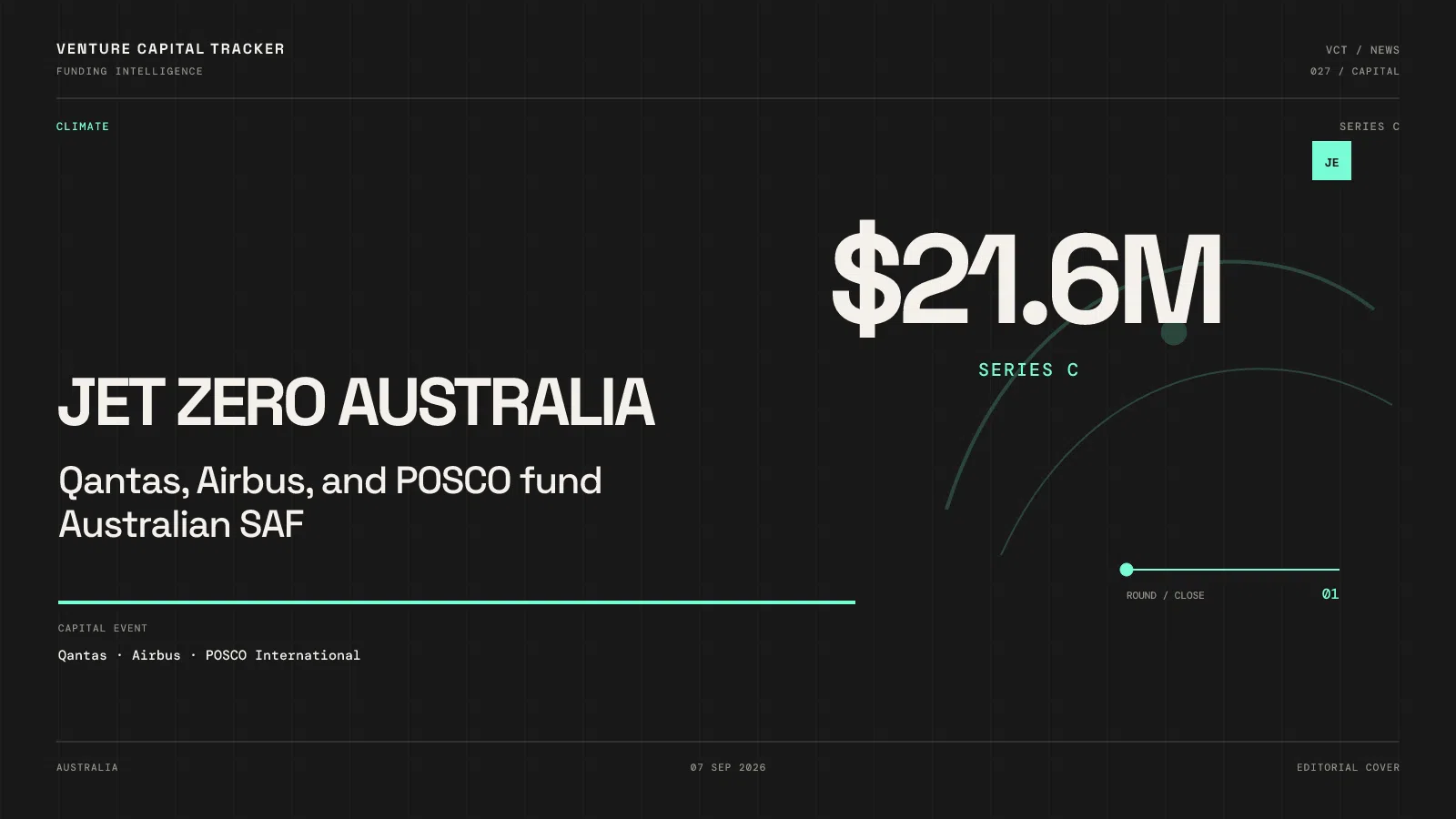
Jet Zero Australia closed an A$30 million (~US$21.6 million) Series C on September 7, 2026, with Qantas and Airbus returning and POSCO International joining — taking disclosed capital above A$80 million (~US$57.6 million) as Project Ulysses cleared Queensland final development approval (Aviacionline / company).
Spine: this is not a software growth print — it is buyer-side and industrial capital financing the gap between FEED and FID on a domestic Alcohol-to-Jet plant.
Key facts
- Company
- Jet Zero Australia (jetzero.com.au)
- Round
- A$30M (~$21.6M) Series C → >A$80M cumulative
- Investors
- Qantas, Airbus, POSCO International (new); prior strategic Idemitsu
- Advisor
- Barrenjoey
- Project
- Ulysses — Cleveland Bay Industrial Park, Townsville
- Capacity plan
- Up to ~113M liters/year SAF + renewable diesel (~90% SAF); ~183M L/year ethanol feedstock via LanzaJet AtJ
- Public support cited
- ARENA A$9M, Queensland A$5M for FEED
- Valuation
- Not company-disclosed; Aviacionline/AFR cite media band ~A$500M (~$360M)
- Status
- FEED done; FID and construction still open; production estimate 2028–2029
Who uses the product — and for what job
Users: airlines under SAF mandate pressure, aircraft OEMs under Scope 3 pressure, and industrial partners that can offtake fuel or secure feedstock.
Job: produce domestic low-carbon liquid fuels from agricultural bioethanol so Australian aviation is less dependent on imported HEFA/SAF and volatile oil markets.
Named demand signal: Qantas has publicly targeted SAF as 10% of jet fuel by 2030 (~600 million liters) — one plant of Ulysses’ planned size is a meaningful but incomplete piece of that math.
Why now
- Oil-price volatility and Middle East supply risk raised the political value of sovereign fuel (AFR framing around the raise).
- Australia is consulting demand-incentive frameworks that could de-risk offtake economics.
- Global SAF remains short; HEFA feedstock competition is intense — Alcohol-to-Jet from local ag by-products is a different supply path.
Why these investors — portfolio / strategic fit
| Investor | Likely reason |
|---|---|
| Qantas | Future offtaker; needs domestic liters against a 2030 SAF target |
| Airbus | OEM customer pressure + regional industrial policy alignment |
| POSCO International | Energy/industrial scale; exploring fuel and feedstock offtake (company) |
| Idemitsu (prior) | Asian refining/energy adjacency from earlier round |
Strategics here behave like ecosystem LPs: they can buy the output, supply inputs, or both — more useful than a logo for a hard-asset project.
What is not proven
- FID is not taken; construction capital will dwarf this Series C.
- Valuation ~A$500M is media-reported, not a company figure.
- Production start 2028–2029 is a plan, not a contracted delivery date.
- Public FEED grants do not equal plant financing.
Implication
The cheque that matters next is the one that closes FID — likely project finance plus offtake, not another A$30M equity print. Until then, Jet Zero is a policy + strategic-capital story: buyers and industrials writing equity to keep a Townsville AtJ option alive.
Follow Venture Capital Tracker on Google
Add VCT as a preferred source to see more of our venture-capital reporting in Google Search.
Editorial note: AI tools assisted with research, structure, or drafting. Venture Capital Tracker retains human editorial responsibility for factual accuracy, relevance, and source quality before publication.