· Investment Strategies · 3 sources
Forus’s $150M Series C at $3B: Bain Leads the AI Layer Between Rx and First Dose
Bain Capital Ventures led Forus’s $150M Series C at $3B — tripling a ~$1B May mark — as the former Tandem builds AI agents that move specialty prescriptions through insurance, assistance, and pharmacy.

Editorial team
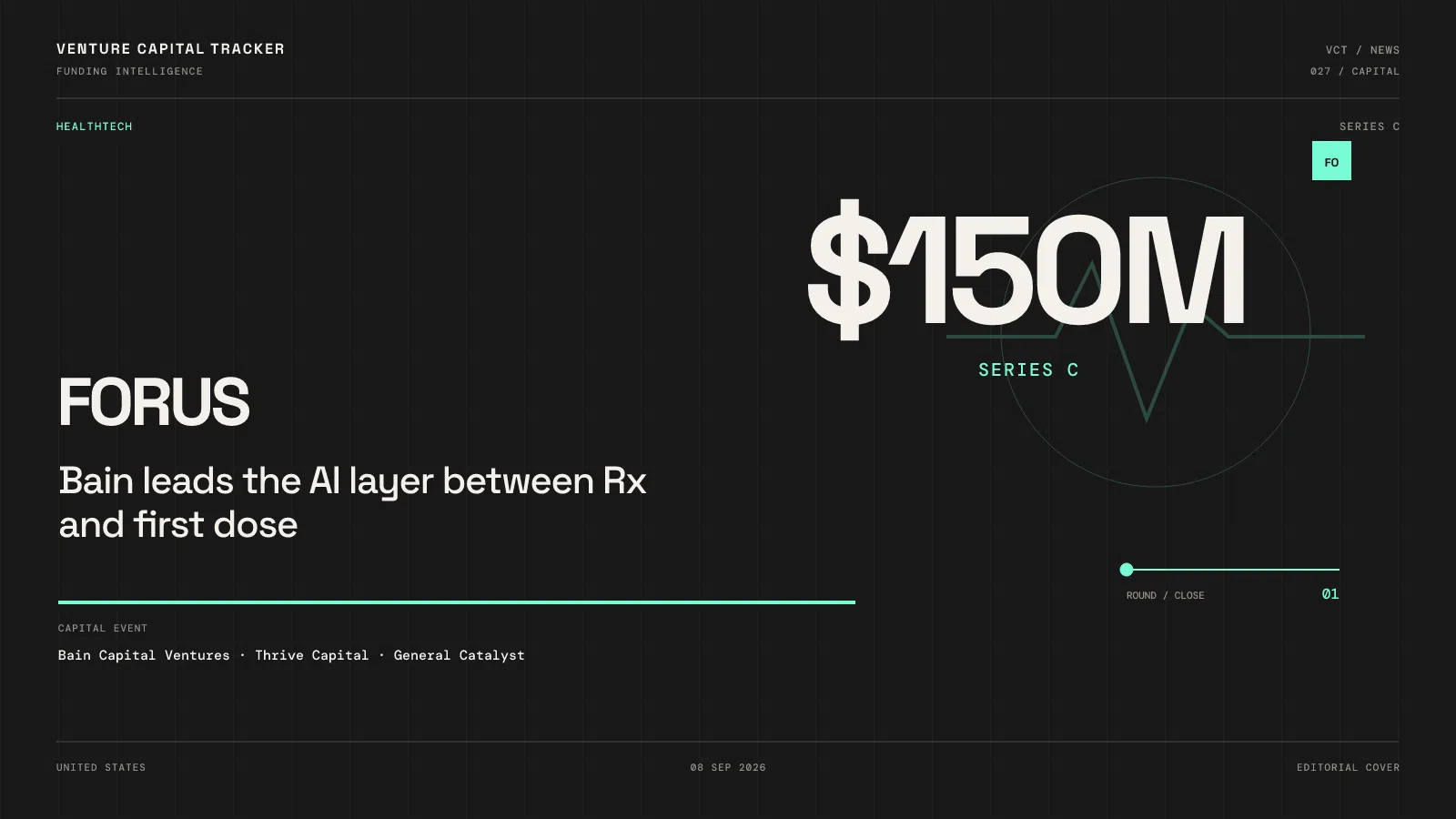
Bain Capital Ventures led Forus’s $150 million Series C at a $3 billion valuation on September 8, 2026, with every named existing institutional investor returning — including Thrive Capital, General Catalyst, Accel, Redpoint, BoxGroup, Pear VC, Neo, and others. Total disclosed funding now exceeds $300 million (company post; Reuters).
Spine: The raise is not “AI diagnoses disease” capital — it is capital for the ugly middle of U.S. specialty medicine, where more than a third of patients prescribed high-cost drugs never get a first dose (company claim).
Key facts
- Company
- Forus (New York; formerly Tandem)
- Founder / CEO
- Sahir Jaggi (company / GC interview coverage)
- Round
- $150M Series C at $3B
- Lead
- Bain Capital Ventures (seed through Series C)
- Cumulative
- >$300M disclosed; May 2026 said >$160M cumulative at ~$1B
- Coverage claim
- Millions of people; 85% of U.S. residential ZIP codes; all 50 states
- Biopharma
- 9 of top 15 global biopharma companies (company)
Accel, Pear, Avra, Human Capital, Vast, SV Angel are not in our /fund/ directory.
Who uses the product — and why
Primary users: physicians and patients stuck in prior auth, benefits investigation, copay assistance, and specialty pharmacy queues. Forus says the product is free for doctors and patients.
Secondary users: biopharma commercial and medical teams that need faster trial recruitment, launch coverage, and visibility into where access breaks. That is the monetization path that makes “free for the clinic” coherent.
Job: attach an AI agent to each prescription that reasons across portals, documents, calls, and faxes — case-manager work, not chatbot Q&A. Company-cited physician example: Virginia Rheumatology Clinic reports approvals in under two days and therapy start in one to two weeks versus months of stall.
Why now
- Specialty and gene therapies are multiplying while the access stack still runs on fax and portal roulette.
- May’s rebrand + ~$1B mark was a platform statement; four months later, a 3× valuation asks whether network density (ZIP coverage + biopharma logos) is compounding.
- Investors are buying workflow ownership of the Rx-to-fulfillment path, not another clinical LLM demo.
Why Bain — and why the whole syndicate returned
| Dimension | Fit |
|---|---|
| Bain Capital Ventures | Seed-to-C continuity; health/enterprise ops pattern matches multi-sided access networks |
| Thrive / GC / Accel / Redpoint | Consumer-scale and enterprise AI funds underwriting a two-sided (clinic + biopharma) wedge |
| Founder rationale | Need capital to put Forus in every U.S. doctor’s office before a single payer or pharmacy chain owns the same agent layer |
| Portfolio logic | Same check-writers who funded earlier rounds are recycling conviction rather than introducing a cold late lead |
What remains undisclosed
- Revenue, take rate on biopharma contracts, or gross margin
- How “free for doctors/patients” is subsidized unit-economically
- Exact May round structure (>$160M was cumulative, not a clean $160M Series B)
- Retention / dose-start conversion vs control
Takeaway
$3B for an access network only works if Forus becomes default infrastructure between specialty Rx and first dose. The open question is whether biopharma willingness to pay scales with ZIP-code coverage — or whether PBMs and payers build or buy the same agent layer first.
Day index: September 8–9 investment news.
Follow Venture Capital Tracker on Google
Add VCT as a preferred source to see more of our venture-capital reporting in Google Search.
Editorial note: AI tools assisted with research, structure, or drafting. Venture Capital Tracker retains human editorial responsibility for factual accuracy, relevance, and source quality before publication.