· Venture Capital Tracker Editorial · investment-strategies
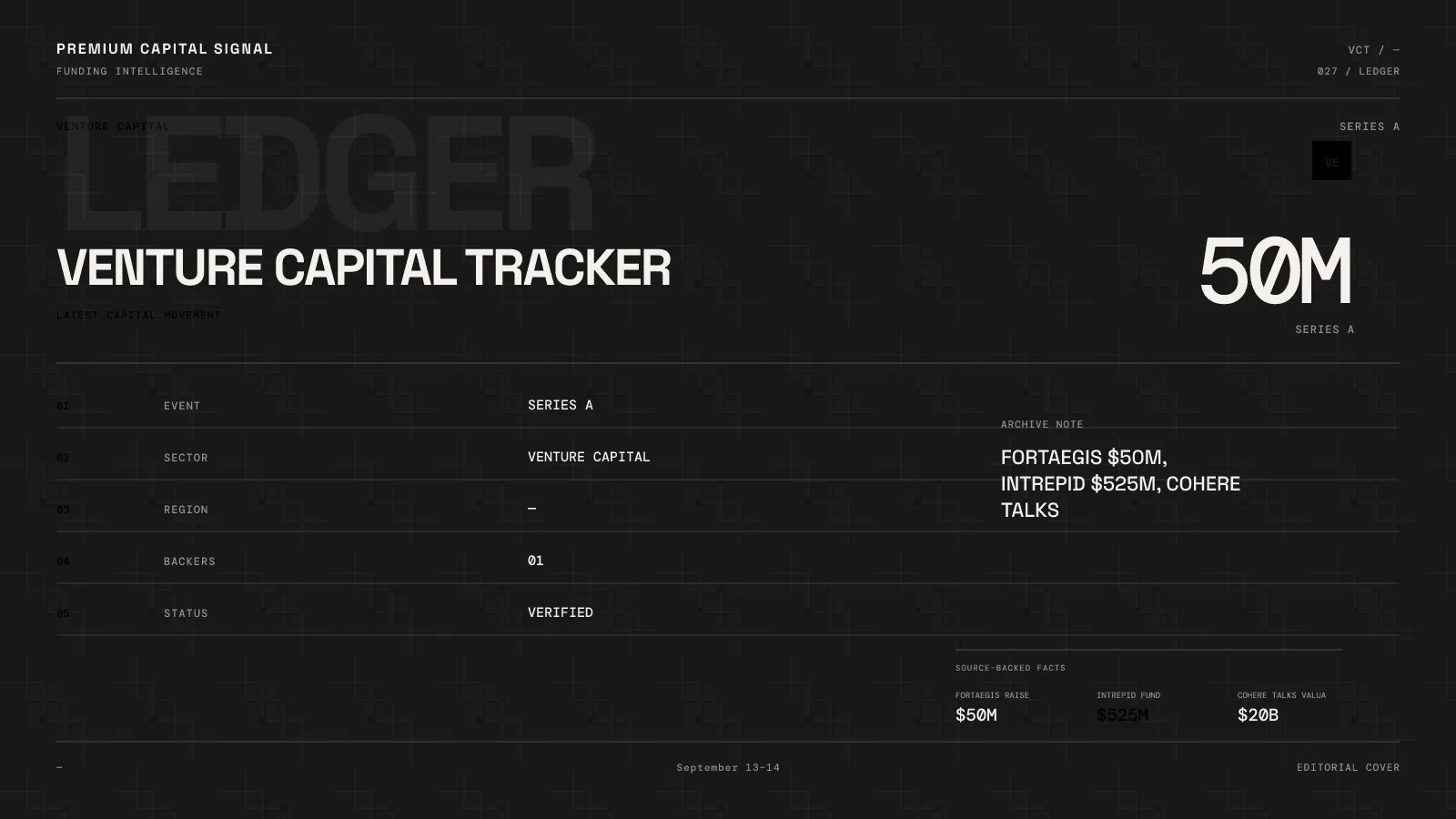
Fortaegis $50M Series A: Secure Silicon, 2027 Manufacturing
Amsterdam’s Fortaegis raised a $50 million Series A led by Serendipity Capital, with Tokyo Electron’s venture arm in. Valuation was not disclosed. Commercial manufacturing is aimed at 2027. Quantum-safe and 200× speed claims are company/FT-attributed, not independent benchmarks.
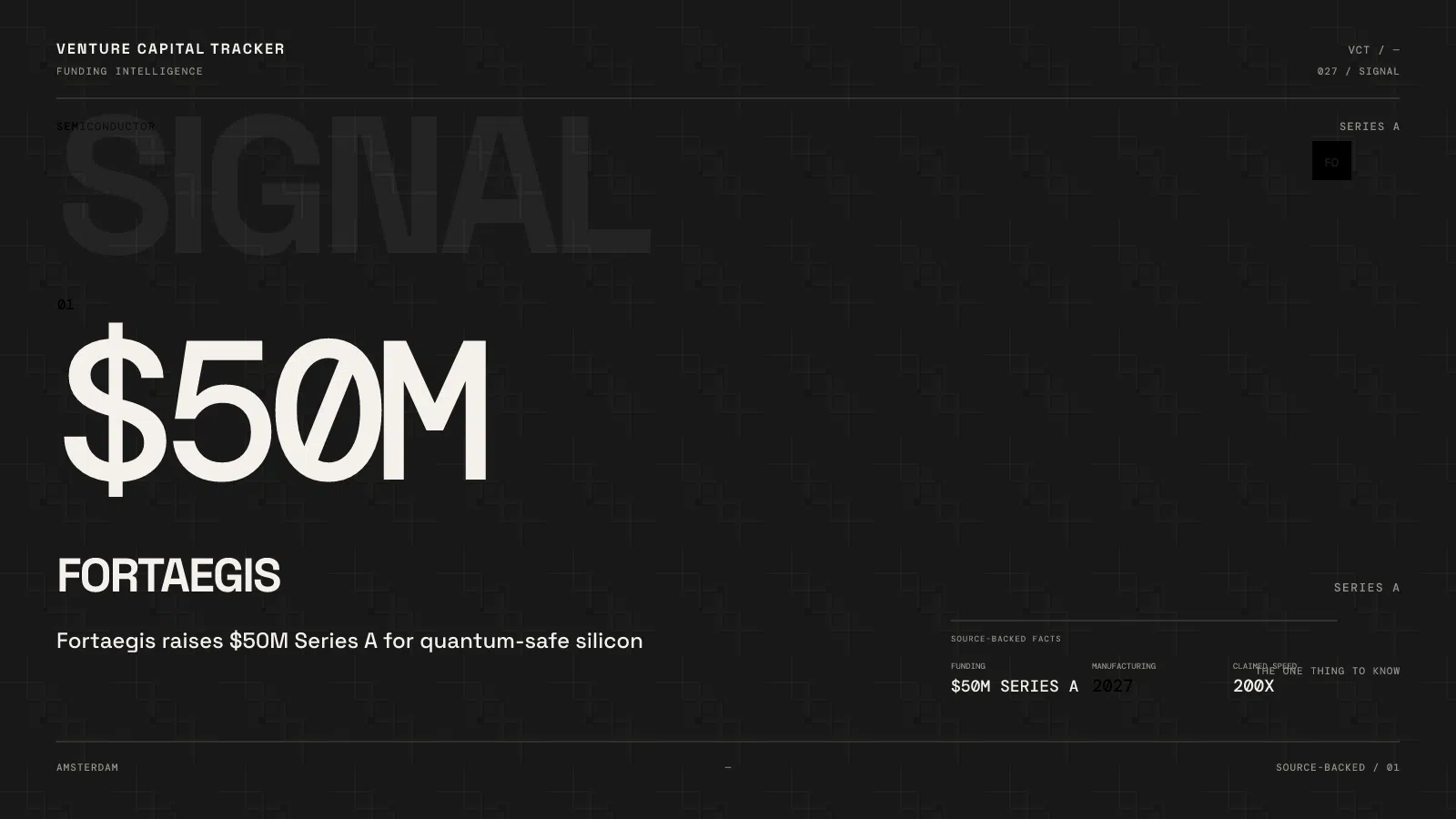
Fortaegis raised $50 million Series A on September 14, 2026, led by Singapore’s Serendipity Capital, with TEL Venture Capital (Tokyo Electron) in. Valuation was not disclosed. The Amsterdam company, founded October 2023 by Boudewijn Wijnands, wants commercial manufacturing in 2027. Sources: The Quantum Insider (company announcement + FT), FT.
A hardware-rooted identity company is raising production capital two years before the manufacturing date it printed — so the diligence job is independent evaluation and foundry economics, not the “quantum-safe” label.
Key facts
| Field | Detail |
|---|---|
| Company | Fortaegis (fortaegis.com) — secure-compute silicon |
| Round | $50M Series A · Sep 14, 2026 · oversubscribed (company) |
| Lead | Serendipity Capital. ** |
| Also in | TEL VC, TNO, NP-Hard, NovaCapital, Access Ventures, Coalition Capital, Prodrive |
| Valuation / ARR | Not disclosed |
| Manufacturing | 2027 (FT via Quantum Insider) |
| Named people | Chair Ilyas Khan (Quantinuum); U.S. board Chris Miller (_Chip War_) |
Who uses it — and for what job
Users: governments and operators of AI clusters, defense networks, satellites, telecom, and autonomous machines. Wijnands told the FT the company is working with governments in the U.S., U.K., Japan, Singapore, Germany, France, and the Netherlands. Company: more than 25 companies and governments.
Job: derive changing encryption keys from physical variation in silicon so identity sits in the chip rather than in stored secrets. FPGA products first; ASICs later (company).
Treat “25+ counterparties” as a pipeline claim, not a named-logo customer list. Treat 17 patents filed / 14 in preparation as a company count.
Why now
- AI agents and drone swarms create machine-to-machine trust problems that stored-key PKI handles poorly at latency.
- NIST is pushing PQC migration on a 2035 clock. Fortaegis is selling a proprietary silicon layer, not ML-KEM.
- TNO says it tested the architecture with aggressive hacking and could not penetrate the integrated system (FT via Quantum Insider) — that is one lab, not a public certification.
What is not proven
- Valuation, ownership, and lifetime capital (Serendipity seeded October 2023; TEL VC invested 2025 — this page does not add those into a $50M total).
- 200× faster than current internet crypto protocols — company/FT-attributed test claim. Protocol, message size, and baseline were not published here.
- ASML: a Dutch research project with TU/e (€1.07 million, July 2026–January 2030) is validation, not a TwinScan product win.
- TSMC foundry + Prodrive assembly (earlier reporting via Tower Post) — not in the September 14 company quotes we retrieved.
Practical takeaway
- Founders (deep-tech hardware): A $50M Series A that still points two years out is a manufacturing round. Print the foundry plan.
- Investors: Diligence TNO’s unpublished methods and whether “quantum-safe” survives a standards review.
- Operators: Relevant if you already run classified or OT networks and need hardware identity — not if you need a NIST PQC drop-in.
Sources
Follow Venture Capital Tracker in Google
Add VCT as a preferred source to make our venture-capital coverage easier to find in Google Search.
Last updated:
Editorial note: AI tools assisted with research, structure, or drafting. Venture Capital Tracker retains human editorial responsibility for factual accuracy, relevance, and source quality before publication.