· Investment Strategies · 3 sources · Updated · Verified
Form Energy Raises $750M Series G — Sequoia & Coatue Back Multi-Day Grid Batteries
T. Rowe Price led Form Energy’s $750M Series G (> $2B total equity). Sequoia joined; Coatue and Energy Impact Partners returned — who buys 100-hour iron-air storage and why this capital fits.

By Venture Capital Tracker Editorial
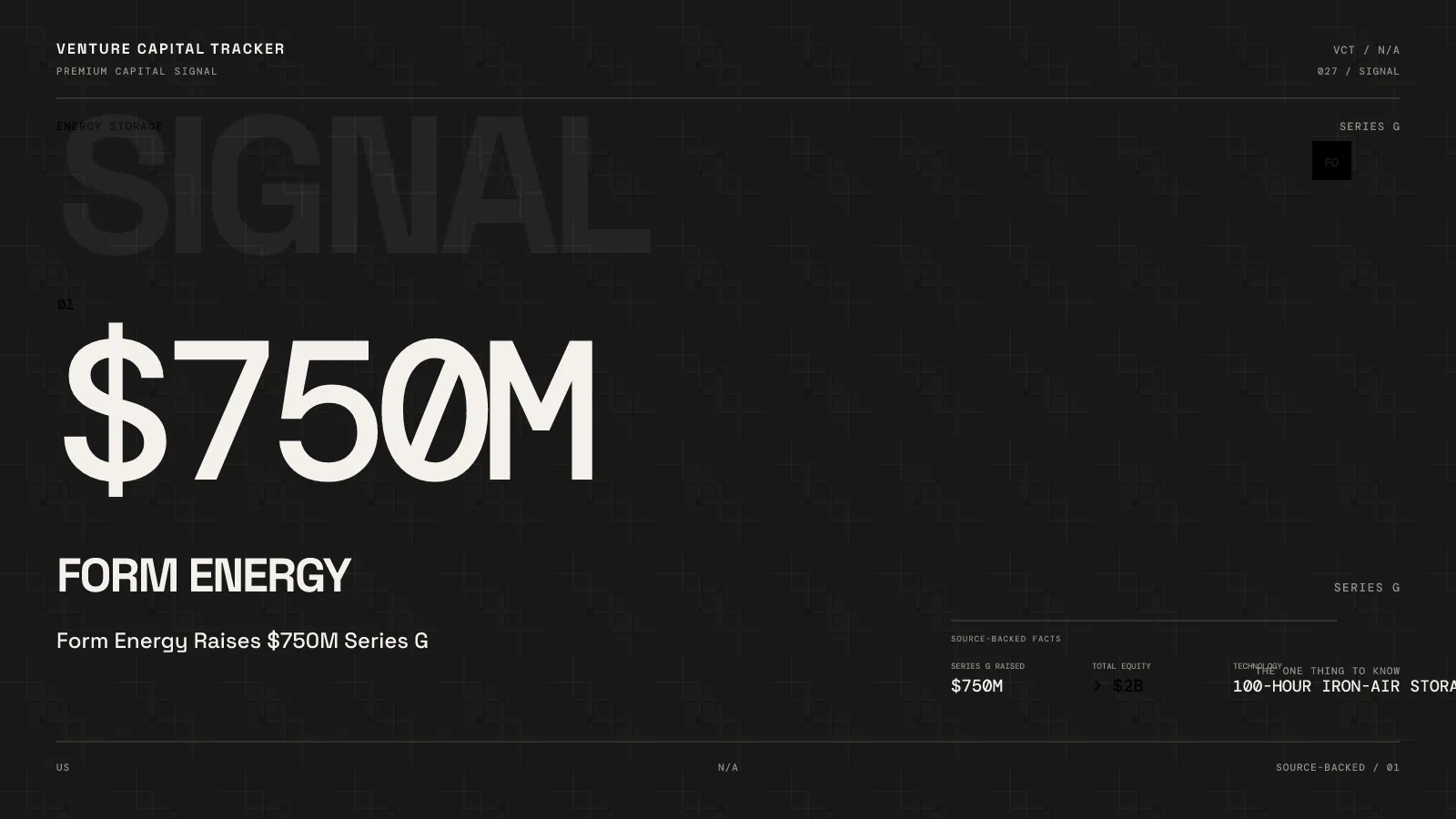
Form Energy raised a $750 million Series G announced August 12, 2026, led again by T. Rowe Price. Total equity is now over $2 billion. New money includes Sequoia Capital; returning names include Coatue and Energy Impact Partners.
Deal details & investors
Funding event
Form Energy
Led by T. Rowe Price
Key facts
- Company
- Form Energy — iron-air multi-day storage (Weirton, WV / Somerville roots)
- Round
- $750M Series G · >$2B total equity
- Date
- August 12, 2026
- Lead
- T. Rowe Price (also led Series F)
- New
- Sequoia, Janus Henderson, Franklin Templeton, PEAK6
- Returning (selected)
- Coatue, EIP, Breakthrough Energy Ventures, TPG Rise Climate, Prelude, Engine, Gigascale, NGP, GE Vernova, Capricorn, Blindspot, M&G Catalyst
- Placement
- Morgan Stanley (sole exclusive agent)
- Use of proceeds
- Weirton manufacturing scale + commercial deployments
- Traction claim
- Backlog ~20 → ~80 GWh in 2026; projects with Xcel, Google, Crusoe, FuturEnergy Ireland (company)
Who uses the product — and for what job
Users: grid operators, utilities, and hyperscale / industrial power buyers who need days of storage, not four-hour lithium packs.
Job: keep renewables and AI-era load reliable when the sun/wind are down for a long stretch — without building a new gas plant for every lull.
Iron-air trades power density for cheap energy capacity over ~100 hours. Buyers care about $/kWh for multi-day firming; peaking and frequency response stay lithium’s lane.
Why now
- AI data centers and industrial electrification are stressing firm power, not just nameplate renewables.
- Form’s backlog tripled (company) — capital is funding factory + deployments, not another science experiment.
- Leadership adds ops depth (Panasonic Energy alum as COO; SoftBank Vision Funds finance veteran as CFO) as the company leaves pilot mode.
- Sequoia’s David Cahn has publicly framed hard problems as the next venture rotation after software got cheap to build — Form is that thesis in steel and electrolyte.
Why Sequoia / Coatue — portfolio fit
Sequoia joining at Series G is a manufacturing + contracted demand bet, not a seed chemistry story. The firm already sits on other physical/infra outcomes; Form gives exposure to multi-day storage as a grid product with named offtake.
Coatue and EIP returning signal crossover and climate specialists still underwriting the category after prior rounds. T. Rowe leading again is the late-stage public-markets bridge.
Strategic rationale: keep climate specialists who already diligence’d the tech, add a brand-name venture franchise (Sequoia) for narrative and network, and keep a public-equity lead (T. Rowe) that can size a $750M check.
| Investor type | What they bring |
|---|---|
| T. Rowe Price | Late-stage size + prior Series F continuity |
| Sequoia | Hard-tech franchise signal; growth diligence |
| Coatue / EIP | Infra/climate pattern recognition + follow-on capital |
| Strategics (GE Vernova) | Grid OEM adjacency |
Competitive map
| Player | Lane |
|---|---|
| Lithium-ion BESS (Fluence, Tesla Megapack, etc.) | 2–8 hour duration; different cost curve |
| Base Power | Residential VPP; hours, not multi-day utility iron-air |
| Ore Energy | Earlier iron-air / long-duration peer (different stage) |
| Gas peakers | Incumbent firming; carbon + fuel price risk |
Market signal
$750M with no disclosed valuation and a backlog jump to ~80 GWh says investors will fund plants and projects when offtake is real — even when the product is priced in energy-hours buyers still learn to buy.
When not to use this as a template
- Wrong if the company still needs a science breakthrough to ship the first commercial unit.
- Wrong if backlog is LOIs without interconnection or offtake path.
- Wrong if you treat multi-day storage as a drop-in Megapack replacement (different procurement and valuation units).
Practical takeaway
- Founders (climate hardware): Sell duration + offtake before you sell chemistry poetry; factories need named GWh.
- Investors: Underwrite interconnection, $/kWh vs buyer budget, and manufacturing yield — not just cycle life slides.
- Operators / utilities: Ask whether you are buying power or energy — Form’s edge is the latter.
Sources
- Form Energy (Aug 12, 2026): formenergy.com
- TechCrunch: techcrunch.com
- Related: Sequoia · Coatue · Energy Impact Partners · 2026 August 12 13 Investment News Energy Codegen Enterprise
Form Energy investment: what $750M buys, and what it does not prove
The August 12, 2026 $750 million Series G was announced directly by Form Energy. Its official financing release identifies T. Rowe Price as lead and says total equity raised passed $2 billion. New investors included Sequoia, Janus Henderson, Franklin Templeton and PEAK6; Coatue and Energy Impact Partners were returning backers. Those investor roles are source-backed, unlike an inference based on a company logo list.
| Question | Evidence-led answer |
|---|---|
| What technology? | Iron-air battery storage designed for approximately 100 hours, rather than short-response lithium-ion applications |
| What is being financed? | Factory scale-up and commercial delivery of multi-day systems |
| What was the company valued at? | No valuation announced in the company's August release; do not invent one from funding amount |
| What customer signal is useful? | Named utility and industrial projects, delivery and backlog milestones; verify whether statements describe signed contracts or pipeline |
| Does a utility deployment prove scale? | No. Watch qualified capacity, production yield, contracted delivery, grid connection and lifecycle cost |
How to evaluate the moat: compare delivered cost per usable megawatt-hour of sustained energy, round-trip efficiency, life and maintenance, manufacturing reliability, and project schedules. Form's proposition is multi-day energy capacity, not a universal substitute for every grid battery. A utility buying four-hour peak shifting may have a very different technology choice.
Form Energy's funding announcement provides the primary chronology. See Form Energy company profile, Sequoia Capital and startup directory. Reviewed October 25, 2026.
Follow Venture Capital Tracker on Google
Add VCT as a preferred source to see more of our venture-capital reporting in Google Search.
Last updated:
Editorial note: AI tools assisted with research, structure, or drafting. Venture Capital Tracker retains human editorial responsibility for factual accuracy, relevance, and source quality before publication.