Base Power's Second $1B Round: Home Batteries as Grid Infrastructure at $13B
Ribbit, Addition, Valor Equity, and JPMorgan's Strategic Investment Group led Base Power's $1B Series D at $13B post-money — funding U.S.-made Base Core batteries and a virtual power plant at residential scale.
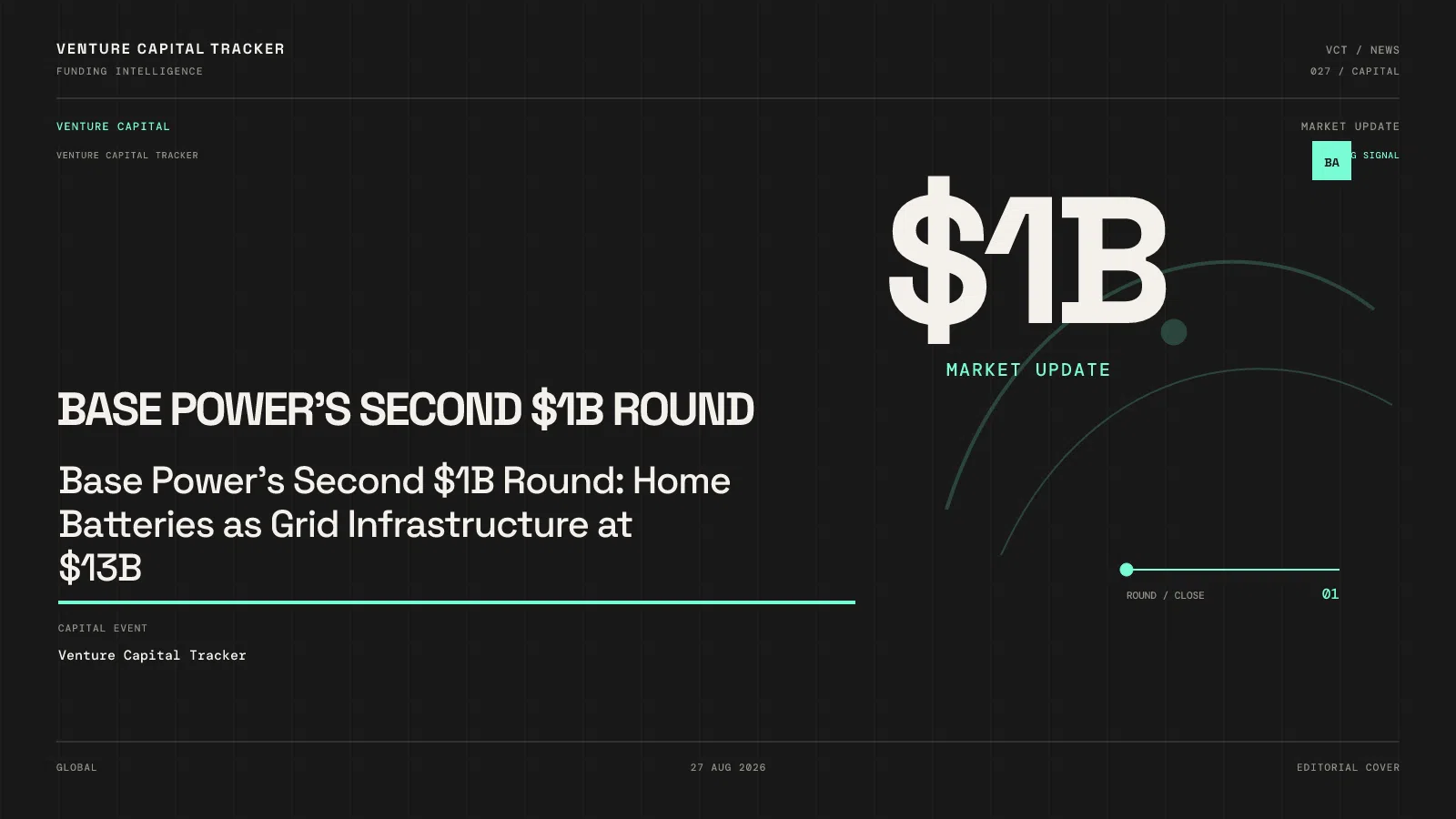
Base Power closed another $1 billion round — Series D at $13 billion post-money — on August 3, 2026, less than a year after a $1B Series C. Total capital raised sits above $2.5B. The company is betting that backyard batteries are grid infrastructure, not solar accessories.
Deal snapshot
- $1B Series D @ $13B post-money
- Leads: Ribbit Capital, Addition, Valor Equity Partners, JPMorganChase Strategic Investment Group
- Directory participants: Altimeter, D1 Capital, Coatue, Energy Impact Partners, Thrive Capital, a16z, Lightspeed
- HQ / mfg: Austin, Texas (Base Factory 1)
- Profile: Base Power
Who uses the product — and why
Homeowners buy large residential batteries (Base Core in the ~39–40 kWh class per press) for outage backup and, where Base sells retail power, a simpler energy bill. Utilities (Austin Energy, El Paso Electric and peers cited in prior coverage) can tap the fleet as distributed flexibility.
Press reports 500+ MWh installed and on the order of ~100 installs/day, with ambitions to double by year-end. Two go-to-market modes appear: sell kWh in retail-choice markets; sell battery control / capacity to utilities in regulated markets.
Job for the household: keep the lights on and lock in economics. Job for the grid: get fast-deployed storage without waiting for a single 200 MW substation project.
Why this is a live problem now
- Extreme weather + AI data-center load stress distribution grids.
- Lithium home storage works for hours; Base’s thesis is fleet scale + software + vertical install as a VPP.
- U.S. manufacturing and Security & Resiliency capital (JPMorgan SIG) match a policy-friendly narrative.
- Second $1B round in ~10 months signals growth investors treating this like a category-defining infra company, not a regional solar dealer.
Why these funds fit
| Investor | Fit |
|---|---|
| Ribbit | Consumer + financial rails thinking applied to energy-as-a-service. |
| Addition | Already led/anchored prior mega-round; compounding ownership in a breakout climate infra story. |
| a16z / Thrive / Lightspeed | Existing syndicate doubling down on American industrial + climate scale. |
| Altimeter / Coatue / D1 | Crossover/growth capital for a pre-IPO trajectory company. |
| JPMorgan SIG | Balance-sheet + resiliency mandate — unusual and telling for a “startup” battery maker. |
Competitive map
- Tesla Powerwall / Sunrun / Generac — residential storage and backup incumbents.
- Utility-owned storage and stand-alone BESS developers — different form factor, same grid job.
- Pure software VPPs without owned hardware — lighter capital, less install control.
Practical takeaways
- Founders: Vertical integration (factory + crews + retail license) is the moat story — and the burn story. Model both.
- Investors: Compare $/MWh deployed and attach rates, not only valuation vs Tesla Energy narratives.
- Operators / utilities: Ask who controls dispatch and how residential churn affects capacity commitments.
When not to
- Do not treat $13B as a public-market comps shortcut — still private, manufacturing and geographic expansion risk ahead.
- California and other large markets may not be online yet; Texas/Illinois density is not national coverage.
- Michael Dell did not participate per TechCrunch — ignore that rumor in diligence notes.
Sources
- TechCrunch (Aug 3, 2026): https://techcrunch.com/2026/08/03/base-power-raises-another-1b-to-save-the-grid-using-backyard-batteries/
- Business Wire / Yahoo Finance reprint: https://finance.yahoo.com/energy/articles/power-announces-1b-series-d-120000504.html
- /startup/base-power · /fund/ribbit-capital · /fund/addition
Editorial note: AI tools assisted with research, structure, or drafting. Venture Capital Tracker retains human editorial responsibility for factual accuracy, relevance, and source quality before publication.