· Investment Strategies · 3 sources · Updated · Verified
Exein’s $270M at $1.7B: Physical AI Needs Kernel-Level Guards
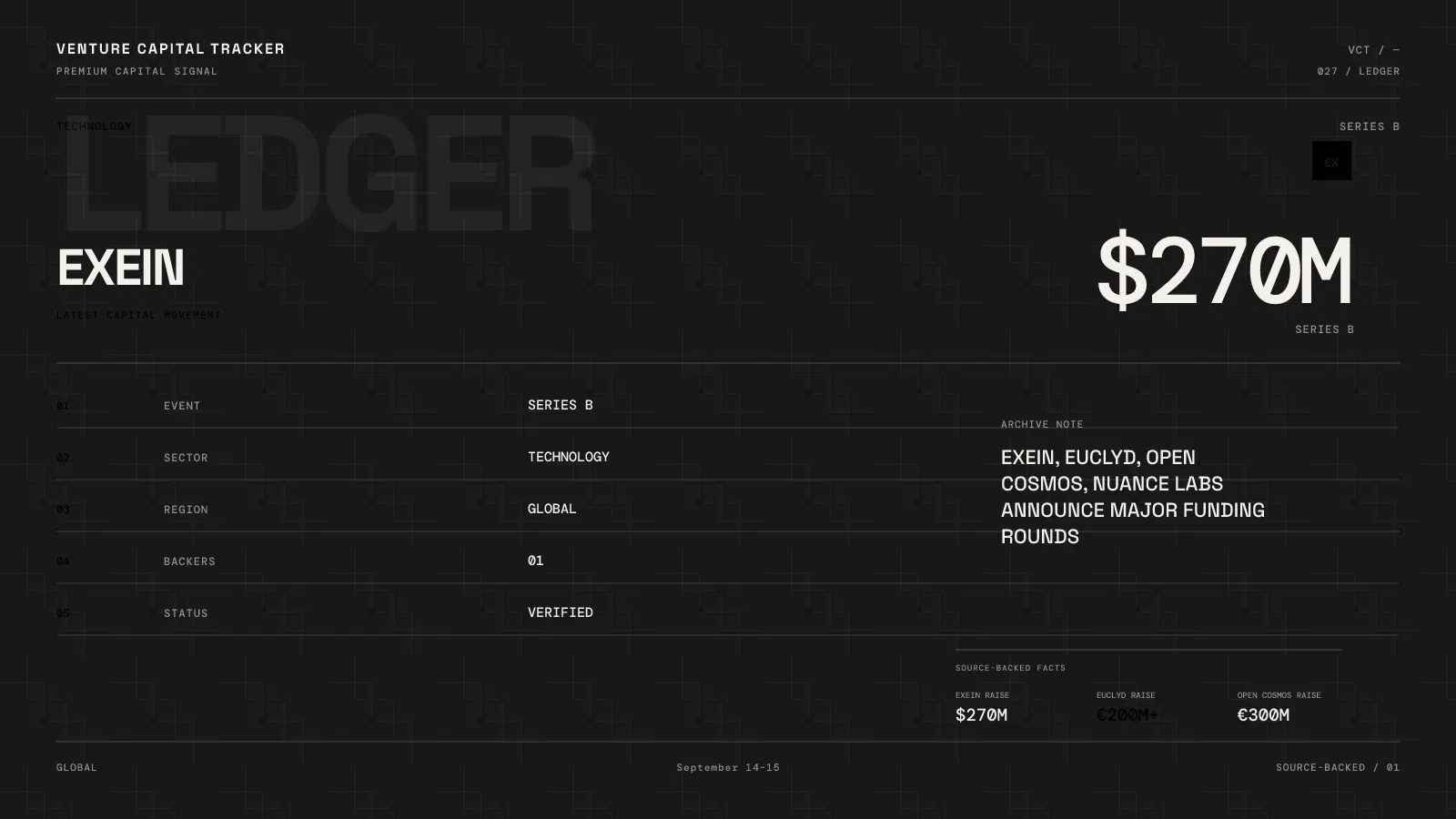
Rome’s Exein raised $270M led by Headline at a $1.7B valuation on September 15, 2026 — after ~$170M in 2025 — to secure robots, vehicles, and other physical AI below the agent layer. Balderton and European public-market capital returned.

By Venture Capital Tracker Editorial
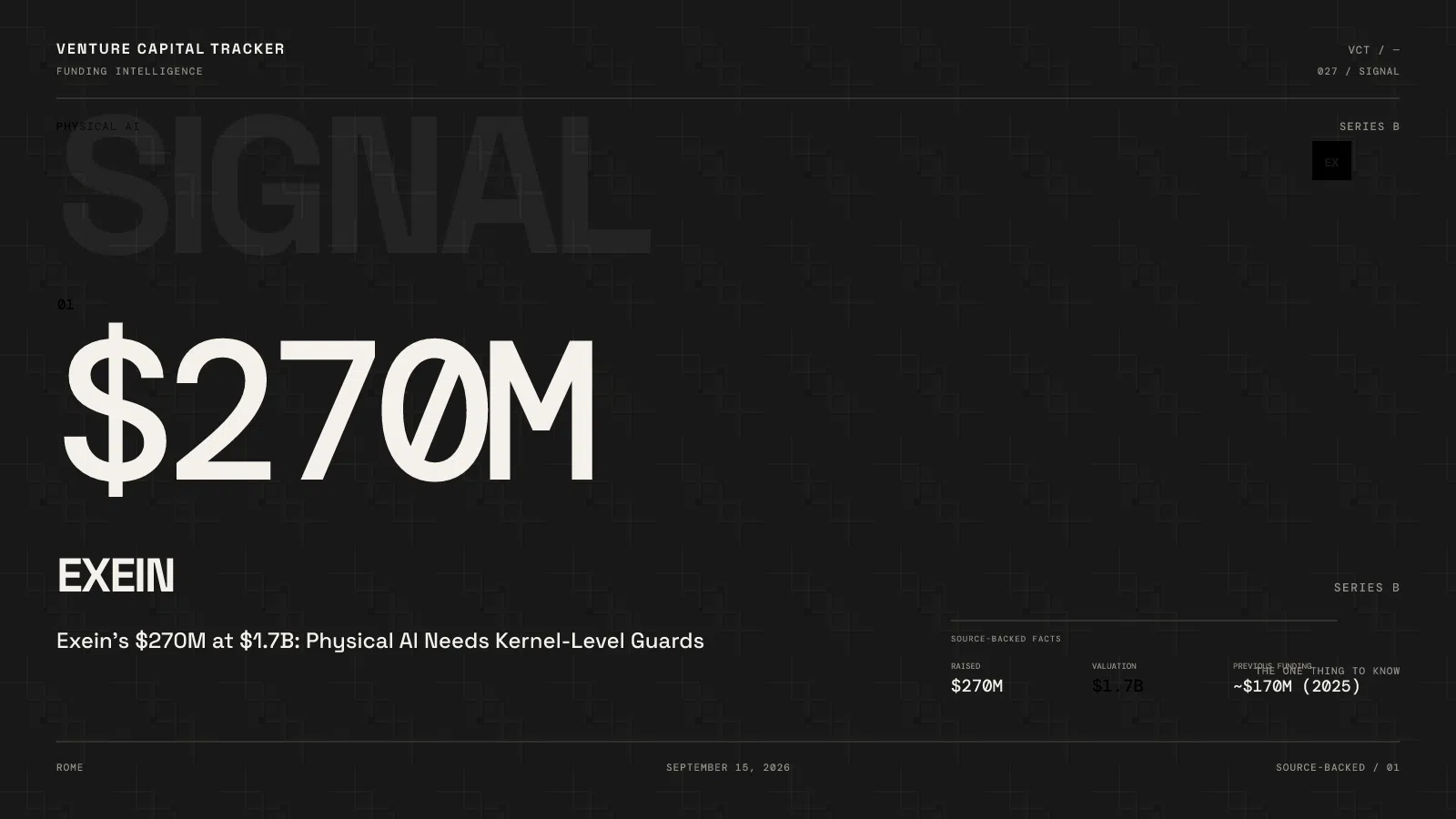
Exein raised $270 million on September 15, 2026, led by Headline at a $1.7 billion valuation — after roughly $170 million raised in 2025 — to harden security for Physical AI: robots, drones, vehicles, and other machines where a compromised agent has kinetic consequences (Il Sole 24 Ore, FT via Techmeme).
Europe’s most valuable cybersecurity startup story this week is not another cloud SIEM — it is kernel-level control under the agent, priced at unicorn scale with U.S. growth capital in the lead.
For context on embedded and physical-device security within the wider venture market, compare this financing with other rounds in VCT’s 2026 cybersecurity funding overview.
Key facts
- Round
- $270M growth equity (series letter not consistently disclosed); $1.7B valuation
- Lead
- Headline
- Notable participants
- Sofina, Goldman Sachs, EIB ETCI, KfW Capital, T.Capital; existing Balderton, HV, Intrepid, 33N, Lakestar, Supernova, Blue Cloud, Geodesic
- Prior capital
- ~$170M in 2025 (company / prior Exein releases)
- Product claims
- Photon kernel defense; foundation model on telemetry from 2B+ devices (company via press)
- Debt
- J.P. Morgan RCF extended; KfW joins as lender
- Revenue / ARR
- Not disclosed in Sep 15 coverage reviewed
Sofina, Goldman Sachs, EIB/ETCI, KfW, T.Capital, HV, Intrepid, 33N, Lakestar, Supernova, Blue Cloud, and Geodesic are not all linked in our /fund/ directory — editorial names except Headline and Balderton.
Who uses the product — and for what job
Users: Device OEMs, automotive and industrial operators, chipset partners, and increasingly builders of Physical AI systems that cannot treat agent guardrails as the only control plane.
Job today: Runtime / embedded security that stays on the device under resource constraints — historically sold into connected infrastructure and manufacturing footprints that Exein previously framed as billions of protected endpoints (company claims; treat as marketing scale, not audited ARR).
Job next: Autonomous security agents that detect and counter threats at machine speed, with architecture launch targeted for late 2026 and foundation models in Q1 2027 (Il Sole citing company plans). CEO Gianni Cuozzo’s cited framing: in Physical AI, control must sit below the agent, in the OS — because agents can circumvent their own guardrails.
Why now
- Physical AI funding and deployment (robots, AV stacks, industrial agents) are outrunning device-level security narratives that still look like IT SOC tooling.
- High-profile model-ecosystem incidents (Exein’s press cites Hugging Face-style agent-control failures) make “the agent watching itself” a weak story for buyers who own factories and fleets.
- Exein already raised hard in 2025 (€70M Series C plus a later ~€100M package per company blog) — this print is a scale and geography step (U.S. + APAC), not a seed-to-A jump.
Why Headline — and why Balderton stays
Headline (global growth, formerly e.ventures) gets a European cybersecurity company with a disclosed unicorn mark, oversubscription language, and a thesis adjacent to industrial/physical platforms rather than pure consumer SaaS. Leading at $1.7B puts Headline on the cap table as Physical AI security consolidates.
Balderton Capital is the classic European conviction follow: London firm, Europe-only mandate, prior Exein exposure. Returning capital into a Headline-led unicorn print keeps Balderton on a category leader without needing to re-win the lead.
Strategic / public capital (Sofina, Goldman, EIB ETCI, KfW, T.Capital) signals the deal was sold as critical-infrastructure security, not a pure software multiple story.
Competitive map
| Approach | Tradeoff |
|---|---|
| IT / cloud XDR & IoT visibility (Armis-class, etc.) | Strong discovery; weaker on-device kernel enforcement |
| Automotive / OT niche security vendors | Deep vertical fit; slower AI-agent narrative |
| Agent-layer guardrails alone | Fast to demo; fail when the agent is the attacker surface |
| Exein embedded + Physical AI roadmap | Device-native control; must prove agents + U.S./APAC GTM |
What is not proven
- Exact series letter, ownership %, and board seats for the $270M print.
- Current ARR, growth rate, and customer concentration (2025 “5× revenue” claims were company-side).
- Independent audit of 2B+ devices and foundation-model timeline.
- Ignore aggregator pieces that still name older leads (e.g. 360 Capital) for this round — primary coverage converges on Headline.
Practical takeaway
- Founders (embedded / Physical AI security): Lead with below-the-agent architecture and named industrial/chipset distribution — growth firms will underwrite unicorns if the physical-harm story is concrete.
- Investors: Diligence device economics vs logo count; separate equity from the extended RCF; confirm series nomenclature in the definitive docs.
- Operators / OEMs: Relevant if you ship connected machines that will run autonomous software and need OS-level kill switches, not just prompt filters.
Follow Venture Capital Tracker on Google
Add VCT as a preferred source to see more of our venture-capital reporting in Google Search.
Last updated:
Editorial note: AI tools assisted with research, structure, or drafting. Venture Capital Tracker retains human editorial responsibility for factual accuracy, relevance, and source quality before publication.